KOTRA targets $35 billion in exports to Japan by 2030, expands Korea-Japan supply chain cooperation
- Input
- 2026-10-15 15:38:23
- Updated
- 2026-10-15 15:38:23
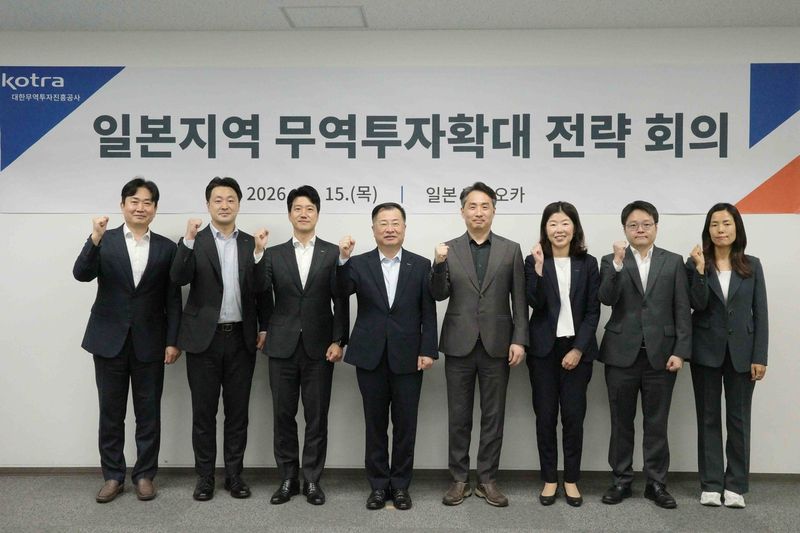
[Financial News] KOTRA is broadening the range of products it targets for the Japanese market, from consumer goods to shipbuilding equipment and energy, as it seeks to achieve $35 billion in exports to Japan by 2030. Its plan is to turn Korea-Japan economic cooperation into tangible export and investment results by increasing Korean companies' participation in Japanese firms' supply chains and supporting joint expansion into third-country markets.
KOTRA said on the 15th that it was holding the '2026 Japan Regional Trade and Investment Expansion Strategy Meeting' in Fukuoka, Japan, for three days starting on the 14th, chaired by President Kang Kyung-sung. The heads of four local trade offices in Tokyo, Osaka, Nagoya and Fukuoka attended and discussed ways to boost exports in response to changes in Japan's industrial and trade environment.
Exports to Japan, which totaled $28.3 billion last year, reached $21.4 billion in January-August this year, up 14.2% from the same period a year earlier. Building on this recovery, KOTRA plans to diversify its export products and approaches to market entry.
KOTRA will extend the success of K-beauty, which has ranked first in Japan's imported cosmetics market for four consecutive years, to food, household goods, fashion and pharmaceuticals. It will launch a 'Mega Export Project' providing year-round support, from securing a place in distribution networks to establishing a foothold in stores and generating repeat purchases.
For pharmaceuticals, KOTRA is targeting Japan's demand to diversify its supply chains. With Japan's self-sufficiency rate for active pharmaceutical ingredients standing at just 32%, the strategy is to enter the market first with products that are easier to obtain regulatory approval for, then build on that entry through supply chain participation and technical cooperation. KOTRA plans to increase pharmaceutical exports to Japan from $740 million last year to at least $1 billion in 2028.
Industrial cooperation will expand beyond semiconductors to shipbuilding, machinery and robotics. Forty Korean companies will take part in the Korea-Japan Shipbuilding Equipment Technology Exchange, to be held in Osaka on the 27th and 28th, to discuss cooperation with major Japanese shipyards in eco-friendly engines and smart ships. In the green transition market, KOTRA will pursue joint market-entry models centered on energy storage systems (ESS) and other areas, involving Korean large and small-to-medium-sized companies and Japanese general trading companies and power generators.
KOTRA will also step up efforts to develop regional markets in Japan. It will connect some 170 exchanges between Korean and Japanese sister and friendship cities with promotional events and export consultation meetings, while expanding cooperation with regional distribution networks. For Japanese local governments seeking to address labor shortages, KOTRA will bring in artificial intelligence (AI) technologies from Korean startups and provide support from on-site demonstrations through follow-up contracts.
KOTRA will also step up projects to enter third-country markets alongside Japanese companies. Thirty Korean companies in software-defined vehicles (SDVs), batteries and thermal management will participate in '2026 Inside Honda,' being held that day at Honda's R&D Center in Tochigi Prefecture. KOTRA plans to help them join the procurement networks of Japanese headquarters and expand deliveries to overseas production bases in India, ASEAN and elsewhere.
President Kang said, "Japan is on the front line of economic security and supply chain restructuring, as well as a key market where K-consumer goods have become part of everyday life on the strength of the Korean Wave. We will diversify the products, participants and approaches beyond semiconductors and make the next 'new 60 years' of Korea-Japan economic and industrial cooperation a period of tangible results."
[email protected] Kim Hak-jae Reporter