“If I’d known this would happen, I’d have put my money in a deposit earning even 3% interest a year” Retail investors lament amid repeated crashes
- Input
- 2026-10-15 15:36:22
- Updated
- 2026-10-15 15:36:22
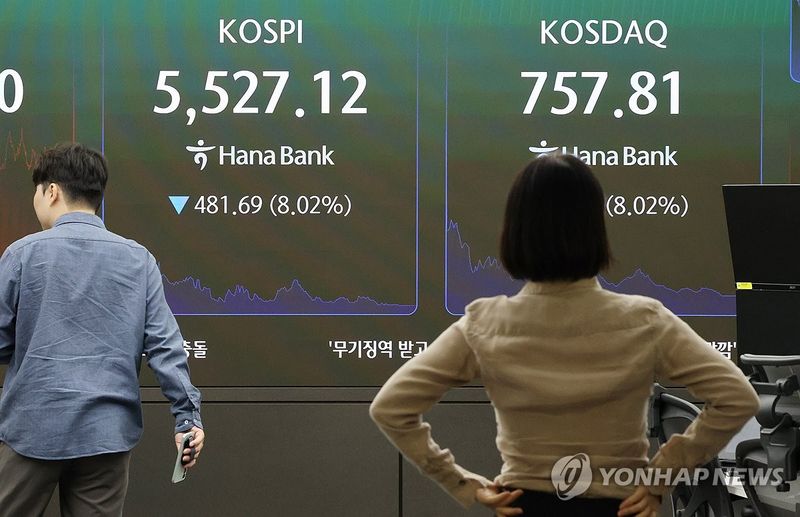
[Financial News] KOSPI and KOSDAQ both plunged by around 8%, triggering circuit breakers in both markets, as South Korea’s stock market suffered another steep decline. Rather than hoping for a rebound, more individual investors are voicing concerns about a prolonged slump.
According to the Korea Exchange, a Level 1 circuit breaker was triggered in the KOSDAQ market at around 12:23 p.m. on the 15th. At the time, the KOSDAQ index stood at 757.88, down 8.01% from the previous trading day, and a circuit breaker was then triggered in the KOSPI market at around 12:38 p.m.
The last time circuit breakers were triggered in both markets on the same day was about two and a half months ago, on July 29. Earlier in the session, sell-sidecars were also triggered one after another in the KOSPI and KOSDAQ markets.
Intraday, the KOSPI fell below even the 5,593 level, its closing-price low during July’s market crash, further dampening investor sentiment. Foreign selling continued, and major semiconductor stocks such as Samsung Electronics and SK hynix plunged, deepening the losses.
High U.S. inflation and concerns over AI investment returns... Investors lament, “Are semiconductors finished?”
The sharp market decline can be attributed to inflationary pressure in the United States and weakness in technology stocks. The U.S. Consumer Price Index (CPI) for September, released overnight, came in above market expectations, reigniting inflation concerns. The prospect of the Federal Reserve System (Fed) delaying rate cuts came into focus, sharply weakening investor sentiment.
Those concerns were compounded by worries about the financial health of artificial intelligence (AI) companies and the returns on their investments. U.S. technology and semiconductor stocks fell together, with AI cloud company CoreWeave plunging and major semiconductor companies such as Micron Technology weakening.
The shock from the New York stock market also translated into selling pressure in South Korea’s market. Major domestic semiconductor stocks, including Samsung Electronics and SK hynix, plunged and led the decline in the indices. Analysts say losses grew further as U.S.-originated bad news added to already-weakened investor sentiment toward semiconductor stocks, amid recent concerns that Chinese memory makers are catching up technologically.
“Has the KOSPI bull market ended?” Retail investors continue to lament
With domestic and international headwinds piling up, online investment communities were flooded with laments from individual investors exhausted by repeated crashes. According to Newsis that day, one investor lamented, “I wonder if this is the worst-case scenario for the KOSPI that we had imagined.” Another said, “In my long experience, it seems the bull market is over. With investor sentiment completely shattered, I don’t know who will lift the index back up.”
Another investor said, “The domestic market only rises when the U.S. market rises, and falls sharply even when the U.S. market dips just a little,” then asked, “Is there any reason to invest in the domestic market under these circumstances?” One investor admitted regretting not choosing safer assets: “Time deposits and installment savings accounts were the right answer. At least they guarantee your principal, don’t they?”
Market analysts said the decline in South Korea’s stock market deepened as inflationary pressure in the United States and fears of reduced AI investment were compounded by deteriorating investor sentiment. Han Ji-young, a researcher at Kiwoom Securities, said, “Several factors are working together: heightened inflation concerns after the U.S. September CPI came in above market expectations, worries that AI companies will scale back investment, and cooling investor sentiment following seven consecutive trading days of steep declines.”
Han added, “The market is extremely oversold, and seven consecutive trading days of steep declines have virtually eliminated the overhang from share prices themselves. This is a point at which a technical rebound, driven by a relief bounce and bargain hunting, could certainly occur.” Han said, “At this point, holding on is the practical alternative.”
[email protected] Kim Hee-seon Reporter