Usage in the “0% range,” burden at “100%” ... Criteria needed for 3G shutdown [In the AI era, telecom policy 2.0 must be formulated (Part 2)]
- Input
- 2026-10-18 15:35:56
- Updated
- 2026-10-18 15:35:56

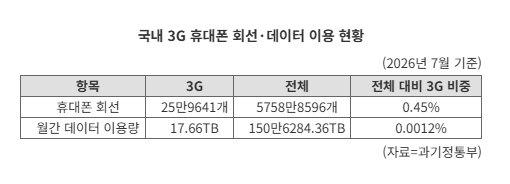
[Financial News] Domestic 3G data usage has fallen to less than 1% of total mobile traffic, but the burden of maintaining the network continues. Calls are growing for the government to set out specific criteria for shutting down 3G so that it can transition away from aging networks while ensuring the safety of users and facilities.■ Government approval required to shut down 3G ... “No specific conditions in place”According to the Ministry of Science and ICT on the 18th, as of the end of July this year, South Korea had 259,641 3G mobile phone lines, accounting for 0.45% of all mobile phone lines. That was a 62.5% decrease from 692,802 in January 2024. In the same month, 3G data usage totaled about 17.7 TB (terabytes), just 0.0012% of the 1,506,284 TB of total wireless data traffic.
Government approval is required to shut down 3G services. Under the Telecommunications Business Act, a facilities-based telecommunications operator of a certain scale or larger must obtain approval from the minister of science and ICT before discontinuing all or part of its business. Applicants must submit the reasons for discontinuation, confirmation that users have been notified, and plans to protect subscribers, among other information.
The key issue is that, beyond the approval application process, it is unclear what preparations must be completed before 3G can be shut down. The government says it will consider the matter on the condition that users are protected, but it has not set out the detailed requirements needed to decide on a shutdown, including the extent to which subscribers must migrate to LTE and 5G or the scope of support for handsets and service plans. Measures for users who cannot be reached and ways to ensure the safety of facility lines, such as emergency elevator phones, also remain to be worked out.
If the requirements for transitioning away from 3G are unclear, telecommunications operators will find it difficult to draw up plans for notifying subscribers and transitioning equipment. Clear standards are also essential so users can understand what support is available and facility managers can prepare to replace equipment.
Cho Dae-geun, an adjunct professor at Sogang University’s Graduate School of Public Policy, pointed out, “The law makes service discontinuation subject to government approval, but there is no checklist specifying what conditions must be met to obtain approval. Ultimately, these are matters that have to be decided at the government’s discretion on a case-by-case basis, which is why people say the standards are unclear.”
The government is taking a cautious stance. At a meeting with the three telecommunications companies last July, it received a proposal to develop a mid- to long-term policy for phasing out older mobile technologies and said it would consider the matter on the condition that users are protected. It said that usage conditions and protection measures must first be assessed, since 3G is used not only in mobile phones but also in elevators and other facilities.
Uncertainty over the transition schedule also prolongs the burden of maintaining aging equipment and operating multiple generations of networks at the same time. This is why there are calls for a plan that allows the power, spectrum and operational resources to be shifted to next-generation networks while allowing enough time for the preparations needed to protect users.
There are numerous examples overseas of resource consumption falling after legacy networks were shut down. Spain’s telecommunications group Telefónica said it completely shut down the 3G network of O2, which it operates in Germany, in 2021, reducing annual energy consumption by about 60 GWh (gigawatt-hours). Virgin Media O2 in the UK reported that in 2022, 3G networks carried less than 4% of all mobile data, yet operating the network accounted for 11% of the company’s total energy use. The company plans to phase out its 3G network, reduce energy consumption and use the spectrum freed up for 4G and 5G services.
The phaseout of legacy networks such as 2G and 3G is accelerating globally. According to the GSMA’s Spectrum Policy Trends 2025 report, 131 legacy networks worldwide are scheduled to be shut down by 2030, including 72 3G networks. The strategy is to retire networks with declining usage and aging equipment, increase the utilization of spectrum for mobile communications and boost investment in growth industries such as 6G and artificial intelligence (AI).
Professor Cho emphasized, “The government is asking operators to invest in building 5G SA and preparing for 6G. Since investment resources cannot grow without limit, it must clearly set out policy criteria for deciding whether to retire legacy equipment so that corporate and national investment resources can be focused on new growth industries such as 6G and AI.”
[email protected] Yoon Hong-jip Reporter