Ruling and opposition parties clash over refusal to re-nominate a Supreme Court nominee; legislation minister says it violates constitutional duty
- Input
- 2026-10-15 14:54:22
- Updated
- 2026-10-15 14:54:22
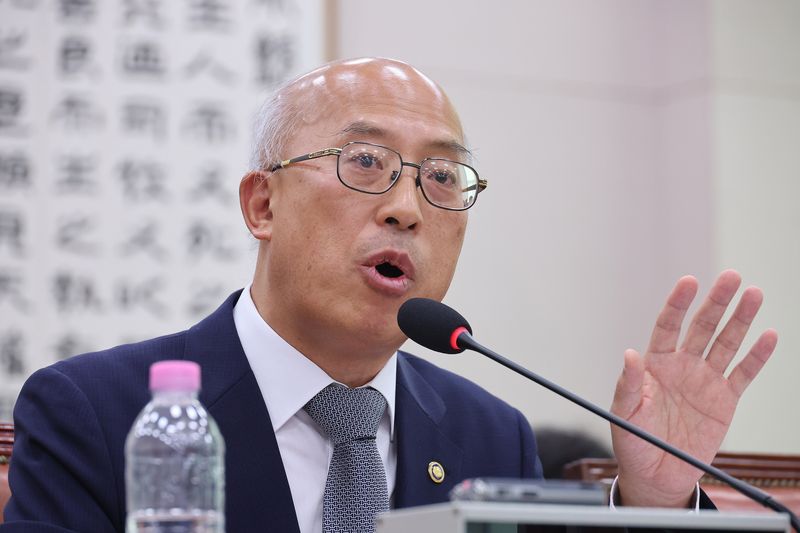
[Financial News] The ruling and opposition parties clashed on the 15th during the National Assembly Legislation and Judiciary Committee’s audit of the Ministry of Government Legislation over Chief Justice Cho Hee-dae’s refusal to re-nominate a candidate for Supreme Court justice. The Democratic Party of Korea criticized the refusal as dereliction of duty and a failure to uphold constitutional obligations, while the People Power Party countered that the president’s demand for a new nomination had no legal basis.
Democratic Party lawmaker Kim Dong-a argued, “If the president has requested a new nomination, a constitutional duty arises for the chief justice,” adding, “If he does not make a new nomination, that amounts to dereliction of duty.” Minister of Government Legislation Woncheol Cho also replied, “When the nomination power is not exercised, Supreme Court justices are not appointed and the Court’s operations are disrupted. That means the constitutional duty has not been fulfilled.” Democratic Party lawmaker Lee Seong-yoon took issue with the fact that no Supreme Court justice nomination had been made for 225 days.
The People Power Party questioned the president’s authority to demand a new nomination. When lawmaker Kim Tae-gyu asked for a basis in the Constitution or law, Minister Cho replied, “It is a conclusion that naturally follows from the interpretation.” Kim objected, calling it an “arbitrary interpretation.”
People Power Party lawmaker Yoon Sang-hyun criticized the demand for a new nomination, saying, “The president’s demand has blocked the National Assembly’s authority to consent to appointments.” Lawmaker Park Hyung-soo also pointed out, “If the president keeps rejecting the nomination until the chief justice nominates someone the president likes, the nomination power has no meaning.” By contrast, Democratic Party lawmaker Kim Eui-kyeom countered that if the president were required to accept the chief justice’s nomination, “the chief justice would effectively hold the power to appoint.”
The interpretation of Article 84 of the Constitution, cited as the basis for suspending President Lee Jae-myung’s trial proceedings, also became an issue. When lawmaker Kim Tae-gyu asked what basis there was for interpreting immunity from prosecution to include the suspension of trials, Minister Cho cited the principle of state prosecution under the Criminal Procedure Act, saying, “Prosecution under Article 84 of the Constitution includes not only indictment but also the maintenance of prosecution.” Democratic Party lawmaker Kim Han-kyu said, “It feels like continually shaking a sitting president is a refusal to accept the results of the presidential election.”
The so-called “DMZ Act,” which would have the South Korean government exercise authority over access to the Demilitarized Zone (DMZ) for peaceful use, also became controversial. Minister Cho said, “The original text of the Armistice Agreement permits peaceful use,” adding, “The area 2 km south of the Military Demarcation Line is subject to our sovereignty.”
Regarding consultations with the United Nations Command, Minister Cho said, “Positions within the government on the interpretation of the Armistice Agreement have been largely aligned, and the United Nations Command is also easing its position somewhat,” explaining that the sides had moved closer to agreement. However, the United Nations Command has raised concerns that the bill violates the Armistice Agreement.
[email protected] Kim Gyeong-min Reporter