South Korea’s Ginseng and Red Ginseng Exports Flash Warning Signs, Hobbled by Non-Tariff Barriers and Weak Price Competitiveness
- Input
- 2026-10-19 14:08:27
- Updated
- 2026-10-19 14:08:27
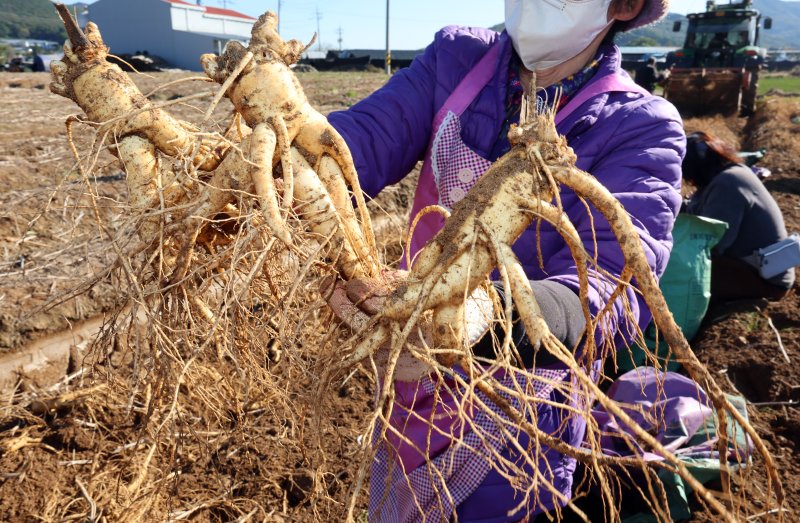
[Financial News] Exports of South Korean ginseng and red ginseng, once hailed as a major export driver for K-food, have declined for four consecutive years, putting the entire industry on high alert. A combination of factors, including weaker price competitiveness due to rising production costs and tighter non-tariff barriers in major export markets such as China, has significantly shaken the products’ position in the global market.
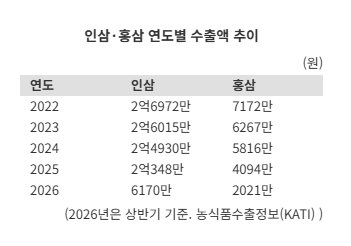
According to the Agricultural and Food Export Information service (KATI) and industry sources on the 19th, South Korea’s ginseng exports totaled $61.7 million through the first half of this year, a sharp 33.2% drop from the same period a year earlier. Red ginseng, which is processed from ginseng, brought in $20.21 million in exports during the period, down 4.2% year on year.
South Korean ginseng and red ginseng exports have been on a downward trajectory since peaking in 2022. Ginseng exports fell from $269.72 million in 2022 to $260.15 million in 2023 and $249.3 million in 2024. They dropped further to $203.48 million last year.
Red ginseng exports have also taken a substantial hit. After reaching $71.72 million in 2022, exports fell to $62.67 million in 2023, $58.16 million in 2024 and $40.94 million in 2025.
The four consecutive years of decline have heightened concern across South Korea’s ginseng farms and processing and export businesses.
A series of compounding setbacks is seen as the main reason for the poor performance of ginseng and red ginseng exports. A key factor is weaker price competitiveness as production costs rise. Sharp increases in labor, materials, farming and other overall production costs have driven up the prices of Korean ginseng and red ginseng products for shipment.
According to Ginsengtong, the Geumsan Ginseng Integrated Platform, the average wholesale price of raw ginseng at the Geumsan Wholesale Market on the 16th was 32,750 won per 750 grams (one chae), up 31% from the same period a year earlier.
This has put the products at a disadvantage in price competition with health foods from other countries and lower-priced alternatives in overseas markets. Inflation and weakening consumer demand in major export markets such as China, amid a prolonged global economic downturn, have also played a part. With prices high, local consumers have cut spending on expensive products regarded as relatively non-essential, including health functional foods, significantly reducing their purchasing power for Korean ginseng and red ginseng.
Instability in the domestic production base is another concern. Because ginseng takes a long time to grow, from planting and cultivation through to harvest, a decline in cultivated acreage and changes in output could affect supply conditions over the medium to long term. In 2024, South Korea produced 18,272 metric tons of ginseng, down 18.7% from the previous year.
Stricter non-tariff barriers (NTBs) in major export markets are further raising the hurdles for exports.
China, the largest market, is pursuing a “Revision of the Import Standards for Korean Red Ginseng as a Medicinal Material,” further tightening customs procedures and standards for ingredient testing. Vietnam, a key market in Southeast Asia, has also made labeling, safety verification and sanitary approval procedures for imported foods more stringent through a “Revision of the Food Safety Act,” increasing the export burden on South Korean companies.
Major exporters are scrambling to find ways out, including by diversifying exports.
An industry official said, “To expand red ginseng exports, we are broadening our local distribution networks and strengthening our products and marketing to suit consumer preferences in each country.” The official added, “In the Chinese and U.S. markets, we plan to stabilize our business by strengthening our premium heritage based on our brand portfolio while also exploring new regions and markets.”
[email protected] Kim Seo-yeon Reporter