“Effectiveness of security oversight under scrutiny” ... FSS audit on the 19th expected to see sharp criticism over hacking incidents
- Input
- 2026-10-15 15:06:40
- Updated
- 2026-10-15 15:06:40
According to the financial sector on the 15th, data breaches caused by hacking have recently occurred at nine financial firms, including commercial banks such as Shinhan Bank, KB Kookmin Bank, Hana Bank and BNK Busan Bank, as well as Yegaram Savings Bank, Welcome Savings Bank, Hyundai Capital, and the online investment-linked finance (P2P) firms PFCT and Mowooda. Last year saw major incidents, including a ransomware attack at SGI Seoul Guarantee Insurance, a data breach at Lotte Card affecting 2.97 million people, and the theft of 44.5 billion won from Upbit. In response, the FSS held inspection meetings several times and emphasized the need to strengthen security. Some have also criticized the financial authorities’ oversight system as “useless” in the face of AI-powered hacking attacks.
A financial industry source said, “The Financial Services Commission and the Ministry of Science and ICT have very different positions on hacking. The Ministry of Science and ICT, drawing on its technical understanding, asks what the government can do to help under the current circumstances, while the Financial Services Commission and the FSS only ask whether regulations and checklists have been properly followed.” The source added, “It’s true that attacks using AI were anticipated and warnings were issued, but isn’t it practically impossible for anyone to know exactly how a hack will be carried out?”
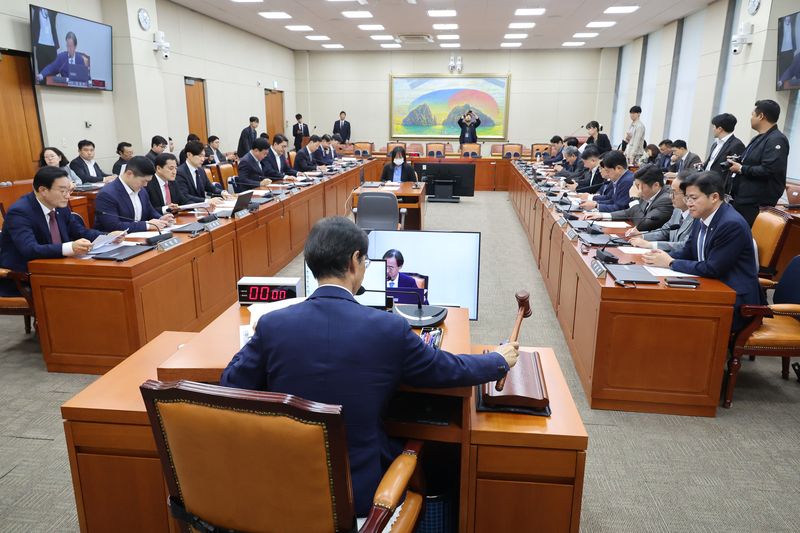
The National Policy Committee is expected to summon CEOs as witnesses and, rather than settle for simple technical explanations, ask about security investment across the board. The aim is to hold them accountable at the level of overall management and macrofinancial policy. Since bank chiefs, rather than working-level executives, will appear, questions are also expected to extend from security against cyberattacks to wider banking-sector issues, such as household loan quotas.
A ruling-party member of the National Policy Committee said, “Members of the National Assembly are probably the ones who hear the most complaints from people who couldn’t get loans because household lending was tightened. From the ruling party’s perspective, I’d rather not have questions about household loans, but now that the bank chiefs have been named as witnesses, the issue is bound to come up.”
Questions are expected about attacks that bypassed banks’ security systems, as well as banks’ reporting systems. The hearing is also expected to focus on blind spots in internal controls and executives’ responsibility for security-related investment, including a case in which a security failure in a loan-broker system led to the leakage of information belonging to around 25,000 customers. Regarding single-stock leveraged ETFs, concerns have been raised that products tied to individual stocks such as Samsung Electronics and SK hynix have increased stock-market volatility and magnified investor losses. As during the previous audit of the Financial Services Commission, the opposition plans to ask whether the FSS sufficiently assessed the market impact and risk factors before approving the products, and why it moved to improve the rules just one month after their launch.
Other key issues expected to be addressed at the audit include ETF upfront fee structures, banks’ business practices to expand non-interest income, and targeted restrictions on household lending. The progress of financial legislative initiatives, including plans to reform financial companies’ corporate governance and the Phase 2 virtual asset bill (General Act on Digital Assets), is also expected to become a point of debate.
[email protected] Park Mun-su Reporter