Seoul apartment move-in outlook turns sunny as capital region alone rebounds amid nationwide decline
- Input
- 2026-10-15 15:00:57
- Updated
- 2026-10-15 15:00:57
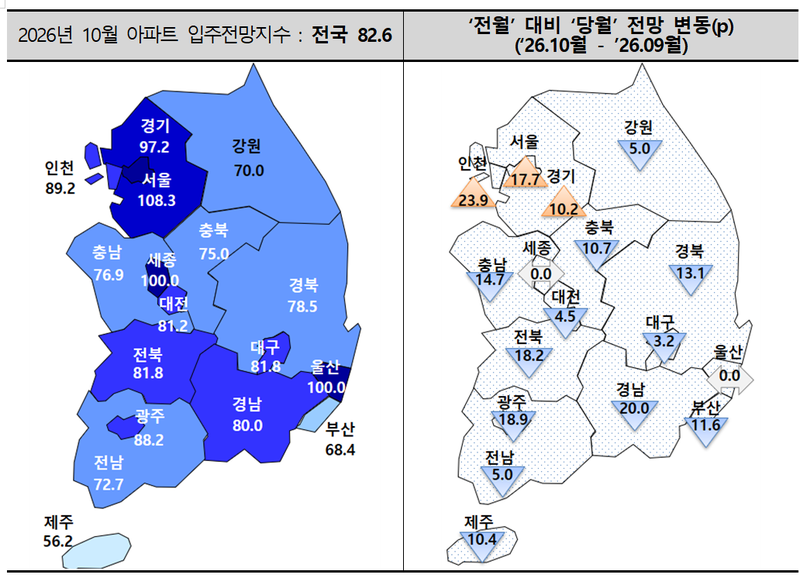
According to the Housing Industry Research Institute (Jusanyeon) on the 15th, the Seoul apartment move-in outlook index rose 17.7 points in October, from 90.6 the previous month to 108.3. Over the same period, the capital region index rose 17.2 points, from 81.0 to 98.2.
Gyeonggi rose 10.2 points, from 87.0 to 97.2, while Incheon jumped 23.9 points, from 65.3 to 89.2. The increase in Incheon was attributed to a base effect following the sharp 18.5-point drop the previous month.
The Housing Industry Research Institute cited the spread of rising prices to mid- and low-priced apartment complexes on the outskirts of Seoul and in southern Gyeonggi as a factor behind the index's rise, as Seoul apartment sale prices had climbed for 86 consecutive weeks through the fourth week of September. It also said that continued demand to switch to home purchases amid a shortage of jeonse listings had boosted expectations that move-in conditions for newly built apartments would improve.
Unlike the capital region, the nationwide move-in outlook index fell 5.0 points, from 87.6 in September to 82.6 in October. It continued its decline for a third consecutive month after posting 97.5 in July, and also fell below the recent one-year average of 85.3.
Actual move-in rates followed different trends in Seoul and Gyeonggi and Incheon. Seoul's apartment move-in rate rose 2.8 percentage points in September, to 84.8% from 82.0% the previous month. By contrast, the rate in the Incheon-Gyeonggi area fell 2.9 percentage points, from 80.2% to 77.3%.
The move-in rate for the capital region as a whole fell 1.0 percentage point, from 80.8% to 79.8%. In Seoul, rising home sale prices made conditions for selling existing homes relatively favorable, but across the capital region, difficulties securing loans to cover the final balance amid tighter lending restrictions were seen as having constrained move-ins.
The nationwide move-in rate rose 8.7 percentage points, from 59.5% in August to 68.2% in September. The most frequently cited reason for not moving in was failure to secure a loan for the final balance, at 37.0%, followed by delays in selling existing homes (31.5%), failure to secure tenants (14.8%), and delays in selling presale rights (5.6%).
The nationwide number of apartments scheduled for move-in in October is expected to be around 16,000 units, an increase of about 65% from the previous month. Of these, 7,924 units were in the capital region.
[email protected] Choi Ga-young Reporter