‘Salmon suffer from the heat, too’: KIOST detects ‘abnormalities’ in salmon amid high water temperatures
- Input
- 2026-10-15 14:12:13
- Updated
- 2026-10-15 14:12:13
The Korea Institute of Ocean Science and Technology (KIOST) said on the 15th that a research team led by Dr. Kang Hye-min recently confirmed impaired liver function and increased expression of heat-response genes in salmon exposed to high water temperatures.
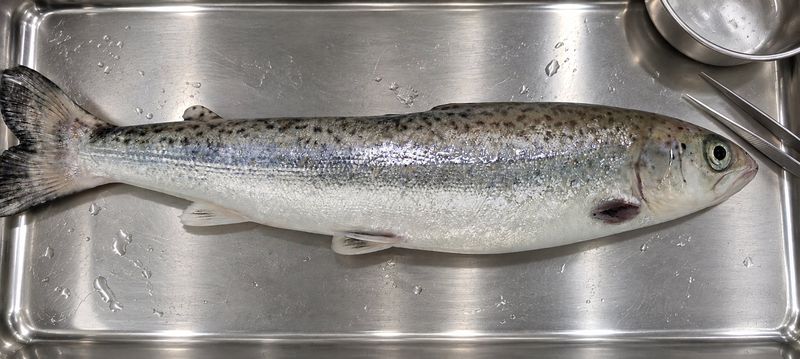
Salmon are a fish species that move between rivers and the sea, but most previous studies had focused on only one of these environments at a time. In this study, juvenile salmon were divided between freshwater and seawater and raised under the same conditions so their responses to high water temperatures could be compared.
The research team divided 192 Atlantic salmon at the smolt stage among four freshwater tanks and four seawater tanks, setting the water temperature in the tanks at 14°C, 18°C, 22°C and 26°C. Using 14°C—the temperature at which salmon grow well—as the benchmark, they raised the temperature in the other tanks by 1°C per hour to simulate a rapid rise. After the target temperatures were reached, they monitored the salmon for five days.
The results clearly showed that the salmon’s condition varied with water temperature. Only the salmon in the 14°C tanks gained weight, while no change in body weight was observed in tanks at 18°C or higher. At 26°C, some fish died in both the freshwater and seawater tanks. The research team concluded that the rapid rise in water temperature affected the growth and survival of juvenile salmon.
Blood tests also showed signs of impaired liver function. In salmon raised in freshwater at 26°C, levels of ALT, a marker of liver damage, rose sharply. By contrast, blood protein levels fell in both the freshwater and seawater tanks. The research team interpreted this as evidence that high water temperatures burden the liver and affect energy metabolism.
The genes that protect salmon’s bodies also became more active. Protein structures change when exposed to heat. In the 26°C tanks, expression of HSP90—a gene that produces heat shock proteins that repair altered proteins—rose sharply. Compared with 14°C, expression was about 16 times higher in freshwater and about 8.5 times higher in seawater.
Dr. Kang Hye-min said, “High water temperatures recur every summer, making water-temperature management at fish farms increasingly important.” She explained, “The three indicators identified in this study changed together as water temperatures rose in both freshwater and seawater. They could be used to monitor ‘high-temperature stress’ throughout salmon farming, from raising the fish in freshwater to transferring them to the sea.”
[email protected] Byeon Ok-hwan Reporter