Debt-Fueled Investing Slows, Household Loans Fall for First Time; COFIX Rises Again, Squeezing Mortgage Borrowers
- Input
- 2026-10-15 16:44:31
- Updated
- 2026-10-15 16:44:31
Household Loans Fall for First Time This Year
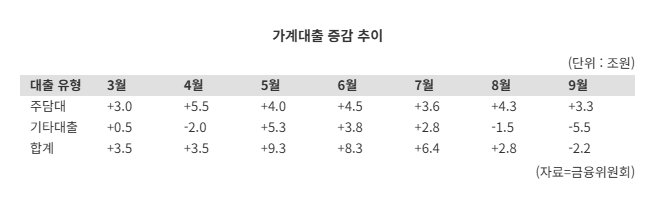
According to the Financial Services Commission on the 15th, household lending across the financial sector fell by 2.2 trillion won in September. This was the first net decline in household lending across the sector since December last year, when it fell by 1.2 trillion won. Monthly growth peaked at 9.3 trillion won in May, then slowed before turning negative in September.Other loans, including unsecured loans, drove the decline in household lending. Other loans fell by 5.5 trillion won, a much larger drop than the 1.5 trillion won decline in the previous month. A sharp increase in the decline in unsecured loans—from 400 billion won to 3 trillion won—was a major factor.
The stock market’s correction is seen as a key reason for the sharp decline in unsecured loans.
A bank official said, “With stock prices repeatedly plunging and rebounding, people who invested while shouldering interest costs appear to have become more cautious about borrowing more,” adding, “Demand for investments using unsecured loans will remain subdued for the time being.”
By sector, household lending by banks rose by 600 billion won, with growth slowing sharply from 3.5 trillion won the previous month. Household lending by nonbank financial institutions fell by 2.8 trillion won, a larger decline than the 700 billion won drop the previous month. The declines widened at mutual finance institutions, insurers and specialized credit finance companies, while savings banks shifted from a 300 billion won increase to a 400 billion won decline.
Shin Jin-chang, secretary-general of the Financial Services Commission, said, “The net decline in household lending in September was affected by seasonal factors, including a drop in housing transactions and move-in volumes, sales and write-offs of nonperforming loans at quarter-end, and holiday bonuses.” He added, “We recently raised the target for managing total household lending from an annual growth rate of 1.5% to around 3.0%, and are managing group loans separately from each financial company’s overall lending target.”
Rising Rates Increase Interest Burden
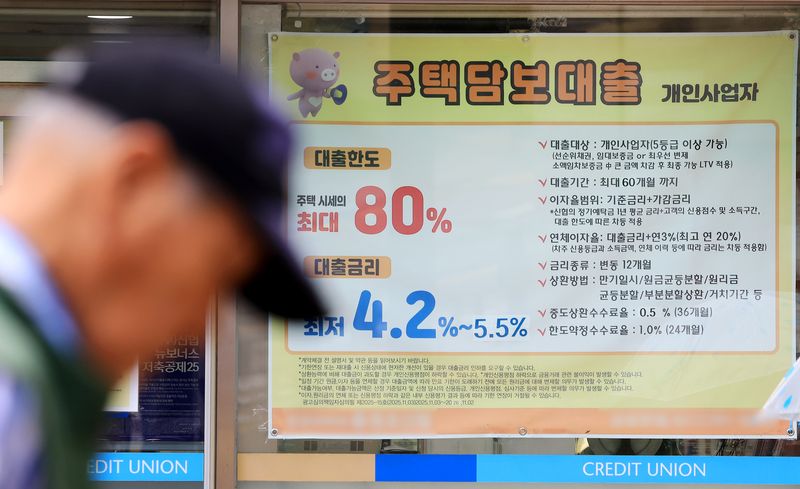
Even as overall household lending declined, mortgage loans increased by 3.3 trillion won last month. Growth was 1 trillion won lower than the previous month’s 4.3 trillion won, but the upward trend continued.The concern is that rising lending rates are adding to borrowers’ repayment burden.
According to the Korea Federation of Banks, the average annual rate on newly issued amortizing mortgages at the five major commercial banks—KB Kookmin, Shinhan, Hana, Woori and NH Nonghyup—was 4.94% in August, up 0.28 percentage points from 4.66% the previous month. This was the largest increase so far this year.
Moreover, COFIX (the Cost of Funds Index), which serves as a benchmark for variable-rate mortgage lending, has risen again, adding to upward pressure on interest rates.
COFIX based on new transactions in September, announced by the Korea Federation of Banks that day, stood at 3.43%, up 0.25 percentage points from the previous month and the highest level this year. After rising for four consecutive months from April through July, it was unchanged in August before rising again, reaching a level 0.54 percentage points above the 2.89% recorded at the end of last year. COFIX reflects banks’ funding costs; when it rises, variable-rate mortgage rates tied to it may also increase.
A financial-sector official said, “When market rates rise, banks’ funding costs increase, raising the interest burden on new borrowers as well.” The official added, “If existing variable-rate borrowers are charged higher rates when their loans are repriced, their repayment burden may grow, leaving them with less money for living expenses and consumption.”
[email protected] Ye Byeong-jeong, Park Mun-su Reporter