“Is 5,000 the floor in the market rout?” ... The market’s fate hinges on semiconductor stocks and foreign selling
- Input
- 2026-10-15 14:02:47
- Updated
- 2026-10-15 14:02:47
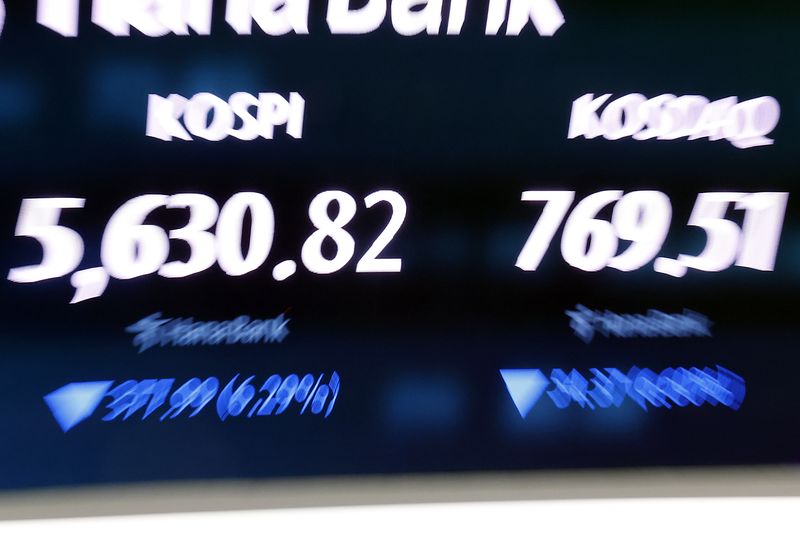
[Financial News] With the KOSPI rattled by domestic and external headwinds, Samsung Securities has identified the 5,000 level as a short-term support level.
Volatility in the domestic stock market has increased as U.S. inflationary pressure, credit risks among artificial intelligence (AI) companies and foreign investors’ selling have converged. But analysts say the 5,000 level could provide downside support if corporate earnings forecasts do not begin to deteriorate in earnest.
However, this does not mean that 5,000 is a guaranteed bottom. Samsung Securities said investors should focus on risk management rather than aggressively buying the dip until foreign selling abates and external uncertainty eases.■Markets rattled by U.S.-driven headwinds... a “triple whammy” of inflation, interest rates and AI credit riskAccording to an emergency market update report on stock strategy from Samsung Securities on the 15th, research analyst Joain cited U.S. inflation concerns, safe-haven sentiment, credit risks in the AI industry and a supply-demand gap in the domestic stock market as factors behind the recent market correction.
First, U.S. inflation data came in above market expectations, heightening concerns about monetary policy. The U.S. Consumer Price Index (CPI) rose 3.7% in September from a year earlier, exceeding the market forecast of 3.6%. Core CPI, which excludes food and energy, also rose 2.6%, above the forecast of 2.5%.
Concerns about high inflation translated into higher interest-rate costs. The report said the U.S. 10-year Treasury yield topped 5.3% immediately after the CPI release, then closed at 5.19% as bond buying came in. It said the high yields offered by U.S. Treasuries, a safe-haven asset, could weaken the relative investment appeal of emerging-market equities.
Credit risk in the AI industry has also emerged as a new variable. Yields on corporate bonds issued by U.S. AI cloud company CoreWeave climbed to more than 15%, and the credit default swap (CDS) market is pricing in a probability of default of at least 50% within the next five years, the report noted.
This is fueling doubts about the sustainability of AI infrastructure investment as a whole, beyond the funding challenges of individual companies. In a high-interest-rate environment, rising interest burdens and additional financing costs could also strain the flows of capital that have supported the expansion of AI investment.
U.S. stocks also fell overnight. The S&P 500 declined 1.11%, the Nasdaq fell 1.88%, and the Philadelphia Semiconductor Index (SOX) dropped 4.30%, extending its losing streak to six consecutive trading days.■No buyers to absorb foreign selling... semiconductor stocks weigh on the indexA shortage of buyers able to absorb foreign investors’ selling was cited as a concern in the domestic stock market.
Research analyst Joain said, “As foreign investors continue to sell Korean stocks, the supply-demand gap is widening, with the buying capacity of both institutional and retail investors also limited.” Foreign selling is particularly concentrated in large-cap semiconductor stocks such as Samsung Electronics and SK Hynix, adding to downward pressure on the index.
Even when foreign investors sell, the impact on the index can be reduced if enough buyers are waiting to absorb the shares. But with buying capacity limited, as it is now, the index could fall further when large-cap stocks come under selling pressure.
External factors adding to market anxiety also remain. If energy supply disruptions stemming from the Middle East persist and winter heating demand rises, concerns about energy supply and demand could worsen. The U.S. Federal Open Market Committee (FOMC) meeting in late October, earnings from big tech and semiconductor companies, and the U.S. midterm elections in early November were also cited as key factors that could determine the market’s direction.■KOSPI at 5,000: valuation is low, but earnings are keyValuation is why Samsung Securities is focused on the KOSPI’s 5,000 level. The firm forecast that 5,000 could act as a support level if downward revisions to corporate earnings do not gain momentum. At that level, the 12-month forward price-to-earnings ratio (PER) is 4.1 times and the price-to-book ratio (PBR) is 1.1 times—both lower than during the periods of heightened volatility at the end of March and the end of July this year that the report compared it with.
“Even if stock prices have fallen sharply and valuations have become low, the appeal of being undervalued could weaken if earnings forecasts are revised down,” Joain said. “Conversely, if earnings forecasts hold up, selling pressure could ease at the 5,000 level.”
Samsung Securities did not, however, conclude on this basis that now is the time to buy aggressively. It recommended avoiding aggressive increases in portfolio exposure and focusing on risk management until foreign selling abates and external uncertainty eases.
[email protected] Kang Jung-mo Reporter