Asian stocks plunge across the board...KOSPI down 7%, Nikkei nearly 5% lower
- Input
- 2026-10-15 13:42:19
- Updated
- 2026-10-15 13:42:19
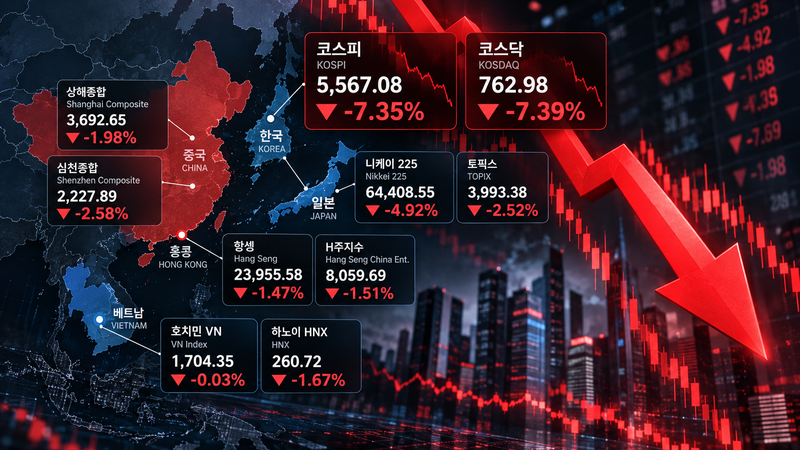
[Financial News] U.S. inflation came in above market expectations, sending major Asian stock markets sharply lower in tandem.
According to financial industry sources on the 15th, as of 1:32 p.m., the KOSPI stood at 5,567.08, down 7.35% from the previous trading day. The KOSDAQ also traded at 762.98, down 7.39%. Korean stocks posted particularly steep losses even among major Asian markets.
Japanese stocks also fell sharply. As of 1:16 p.m., the Nikkei 225 stood at 64,408.55, down 4.92% from the previous trading day. The TOPIX, another key Japanese index, also traded at 3,993.38, down 2.52%.
Greater China stock markets were also lower. As of 12:15 p.m., Hong Kong’s Hang Seng Index stood at 23,955.58, down 1.47% from the previous trading day. The Hang Seng China Enterprises Index also fell 1.51%. At 12:14 p.m., China’s Shanghai Composite Index was down 1.98% at 3,692.65. The Shenzhen Composite Index also fell 2.58% to 2,227.89.
Vietnamese stocks were also weaker. As of 11:16 a.m., Hanoi’s HNX Index stood at 260.72, down 1.67% from the previous trading day. At the same time, Ho Chi Minh City’s VN Index was down 0.03% at 1,704.35, a relatively modest decline.
Fears of monetary tightening in response to rising U.S. prices are cited as a factor behind the spreading sell-off across Asian markets. The U.S. Consumer Price Index (CPI) for September rose 3.7% from a year earlier, above the market forecast of 3.6%. The prospect of another rate hike by the U.S. Federal Reserve (Fed) has consequently come into focus, and investor sentiment appears to have weakened, particularly toward AI- and semiconductor-related stocks.
Meanwhile, U.S. stocks also fell across the board the previous day. The tech-heavy Nasdaq Composite declined 1.9%, while the S&P 500 also fell 1.1%. Selling pressure appears to be spreading across global technology stocks as inflationary pressures in the United States coincide with concerns over the profitability of AI investments.
[email protected] Im Sang-hyeok Reporter