Seoul Officetel Rents Jump 1.02%, but Yields Are Lowest Nationwide
- Input
- 2026-10-15 14:08:27
- Updated
- 2026-10-15 14:08:27
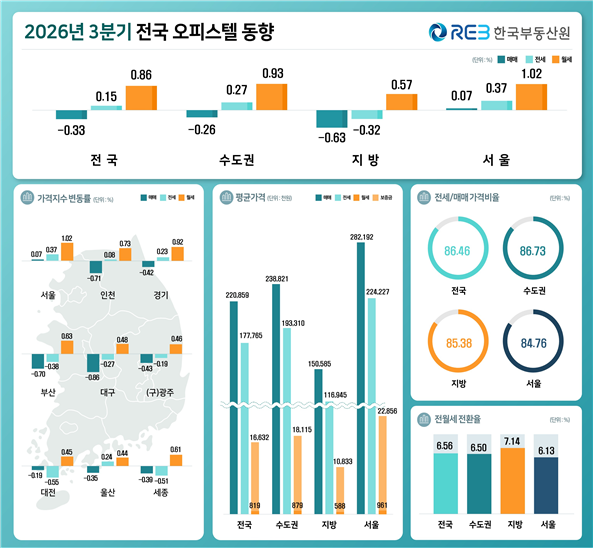
According to the “2026 Third-Quarter Officetel Price Trends Survey” released on the 15th by the Korea Real Estate Board, purchase prices for Seoul officetels rose 0.07% from the previous quarter. Over the same period, jeonse prices rose 0.37% and monthly rents increased 1.02%.
Purchase and jeonse prices continued to rise, but at a slower pace. The increase in purchase prices eased from 0.24% in the second quarter to 0.07% in the third, while the rise in jeonse prices narrowed from 0.40% to 0.37%. By contrast, the increase in monthly rents widened from 0.90% to 1.02%.
In Seoul’s purchase market, demand for officetels as an alternative to apartments continued, particularly for units near subway stations and in relatively new buildings. However, urgent-sale listings amid regulations on owners of multiple homes narrowed the price gains. By area, prices rose 0.31% in the central district, 0.17% in the southwest, 0.14% in the northeast and 0.05% in the southeast, while falling 0.47% in the northwest.
In the jeonse market, a shortage of apartment jeonse listings sustained demand for mid- and large-sized officetels. However, weaker demand for units away from subway stations and for smaller units limited the overall increase. Jeonse prices rose 0.70% in the central district, 0.42% in the northeast, and 0.39% each in the southwest and southeast. They fell 0.03% in the northwest.
Monthly rents rose notably amid a shortage of jeonse and monthly-rental listings, demand for homes close to workplaces, and demand for officetels as alternatives to apartments. The central district recorded the biggest increase, at 1.24%, followed by the northeast at 1.17%, the southeast at 1.11%, the northwest at 0.94% and the southwest at 0.88%.
Nationwide, officetel purchase prices fell 0.33%, while jeonse prices and monthly rents rose 0.15% and 0.86%, respectively. In the Seoul metropolitan area, purchase prices fell 0.26%, while jeonse prices and monthly rents rose 0.27% and 0.93%, respectively.
Purchase prices in Gyeonggi Province fell 0.42%, while jeonse prices rose 0.23% and monthly rents increased 0.92%. In Incheon, purchase prices fell 0.71%, while jeonse prices and monthly rents rose 0.08% and 0.73%, respectively.
Despite rising rents, Seoul officetels had the lowest yield among the regions surveyed. As of September, the yield in Seoul was 5.15%, below both the national average of 5.90% and the metropolitan-area average of 5.76%. The figures for Gyeonggi and Incheon were 6.08% and 6.58%, respectively. Yield is calculated by dividing annual rent by the purchase price minus the rental deposit.
Seoul’s jeonse-to-monthly-rent conversion rate was also below the national average, at 6.13% compared with 6.56%. The ratio of jeonse prices to purchase prices was 84.76% in Seoul, below the national average of 86.46%.
As of September, the average purchase price of a Seoul officetel was KRW 282,192,000, and the average jeonse price was KRW 224,227,000. The average rental deposit was KRW 22,856,000, and the average monthly rent was KRW 961,000.
[email protected] Choi Ga-young Reporter