Gwangju Special City Office of Education to Share Student-Led “2030 Classrooms”
- Input
- 2026-10-15 13:14:33
- Updated
- 2026-10-15 13:14:33
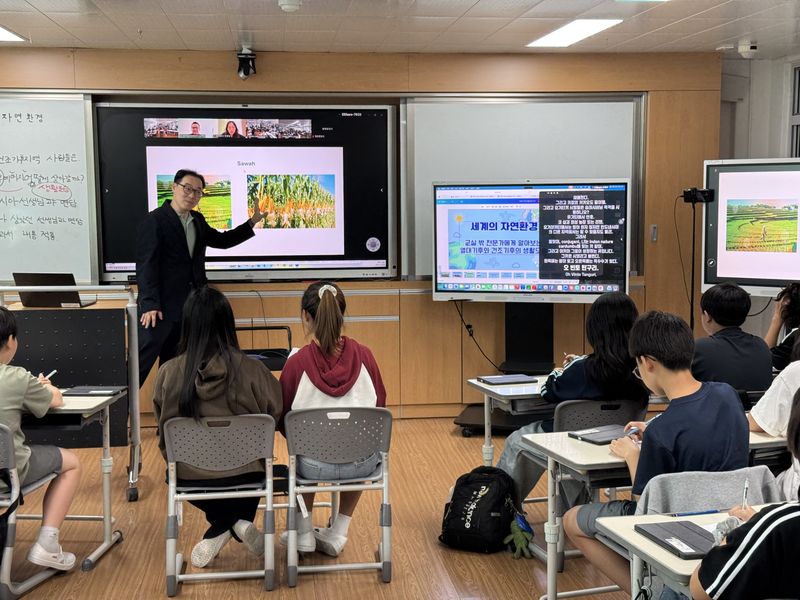
【Financial News, Jeonnam-Gwangju = Hwang Tae-jong, Reporter】The Jeonnam-Gwangju Integrated Special City Office of Education (Gwangju Special City Office of Education) is sharing its student-led “2030 Classrooms” and facilitating lesson sharing among teachers.
The aim is to share and spread changes in teaching that encourage students to ask questions and explore on their own, and to find solutions to problems through collaboration.
On the 15th, the Gwangju Special City Office of Education said that “2030 Classrooms” are intended to drive changes toward student-centered teaching, including lessons unconstrained by time and space, going beyond simply improving classroom environments. The program is seen as putting into practice lessons that make use of diverse digital tools, such as remote video-conferencing and real-time language translation systems, to foster students’ initiative and participation.
Park Cheol-wan, head of the Gwangju Special City Office of Education’s Talent Education Bureau, emphasized, “The purpose of ‘2030 Classrooms’ is not simply to equip them with new spaces and teaching equipment, but to change lessons so that students grow into the agents of their own learning.”
This lesson-sharing initiative will run through November 6, with 119 classrooms newly selected this year taking part from among the 252 “2030 Classrooms” currently operating in the former Jeonnam region.
In particular, the initiative is being organized in conjunction with the “1st K-Education Special City Lesson-Sharing Festival,” which will be held on November 28 at the Suncheon Bay Ecological Culture Education Center.
First, the “Early Childhood 2030 Classrooms” will showcase joint-curriculum lessons involving nearby small kindergartens. They will also present examples of early childhood- and play-centered lessons that expand learning as children communicate and collaborate with their peers, overcoming the spatial limitations between kindergartens.
The “Elementary 2030 Classrooms” will share glocal lessons that begin with local nature and explore climates and ways of life around the world. Using textbooks and artificial intelligence (AI) materials, students examine the characteristics of tropical and arid climates. They communicate with teachers in Indonesia, South Africa, Botswana and elsewhere, connected by video, using real-time interpretation and translation tools; they ask directly about local ways of life and independently explore the relationship between climate and lifestyle. They then turn what they have learned into environmental picture books and e-books to share with students at schools in other regions, and use a climate declaration to carry those lessons into practice in their daily lives.
In the “Secondary 2030 Classrooms,” students from three small schools connected online will take part in a project-based lesson in which they jointly set priorities for policies to support sustainable development in their region. Through the process of identifying problems, comparing and reviewing policies, setting priorities and reflecting, they will experience collaborative decision-making and have an opportunity to reflect on their role as citizens who contribute to regional development.
Park Cheol-wan, head of the Talent Education Bureau, said, “I hope this lesson-sharing initiative will extend across preschool, elementary and secondary education, and lead to the ‘K-Education Special City Lesson-Sharing Festival,’ creating an opportunity to find a shared direction for change in teaching and spread examples of effective practices.”
Meanwhile, the “K-Education Special City Lesson-Sharing Festival” will also unveil a “Lesson Hotspots Map,” compiled to let visitors see at a glance the distinctive lesson brands developed by schools and teachers.
[email protected] Hwang Tae-jong Reporter