Oh Se-hoon: “Restrictions on transferring reconstruction association membership should be lifted for three years”
- Input
- 2026-10-15 12:35:52
- Updated
- 2026-10-15 12:35:52
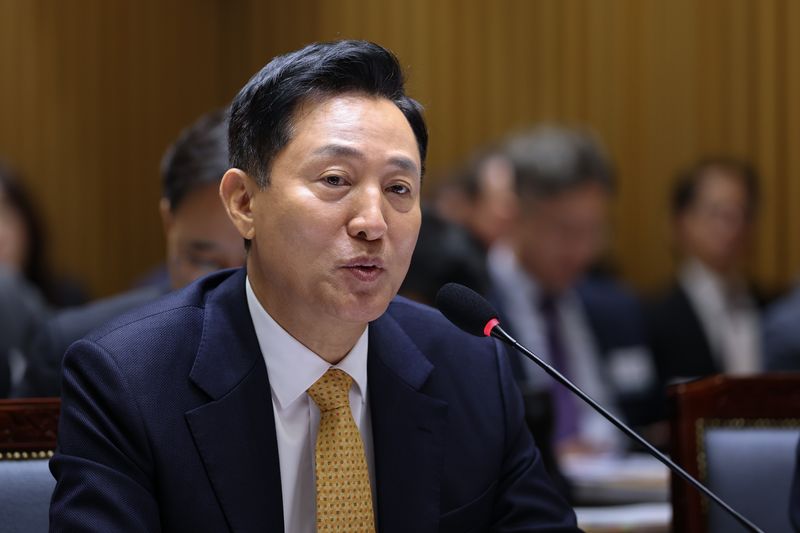
At a parliamentary audit of the Seoul Metropolitan Government by the National Assembly’s Public Administration and Security Committee, held at Seoul City Hall in Jung District, Seoul, on the 15th, Oh pointed to restrictions on transferring association membership as a major factor delaying urban renewal projects.
Responding to a question from People Power Party lawmaker Seo Myeong-ok about measures to stabilize the housing market, Oh said, “If restrictions on transferring association membership were lifted temporarily for just three years, sources of conflict within the associations would be significantly reduced,” adding, “That would allow projects to move faster.”
The Seoul Metropolitan Government is pursuing the revitalization of urban renewal projects through initiatives such as its Fast-Track Integrated Planning program, with the goal of starting construction on 310,000 housing units by 2031.
The government and the Seoul Metropolitan Government offered differing views on the recent rise in home prices in Seoul. People Power Party lawmaker Joo Ho-young noted that the government had cited a decline in housing permits and construction starts in Seoul since 2022 as a cause of rising prices, while the Democratic Party of Korea (DPK) had taken issue with the lifting of land transaction permit zones in the Gangnam area.
Oh explained, “The most important thing is whether Seoul residents can have predictability and confidence about housing supply. Because they lack confidence in supply, speculative demand emerges, with people thinking they need to buy before prices rise.”
He particularly highlighted the recent spread of rising home prices into Seoul’s outlying areas. Oh argued, “Rising apartment prices in Seoul’s outskirts are closely linked to increases in jeonse and monthly rents,” adding, “Because the current government’s policies emphasize owner-occupancy, rental prices have risen sharply and the supply of jeonse homes itself has become insufficient.”
As rental prices rise and listings become scarce, tenants are moving to buy homes, pushing up apartment prices even in outlying areas.
Oh said, “If jeonse and monthly rents rise sharply, tax and financial benefits for private rental housing operators should be increased dramatically,” adding, “We need to create a policy environment that enables them to actively participate in supplying rental housing, such as Youth Safe Housing.”
He reiterated his opposition to the government’s plan to develop some of Yongsan Park for housing. Oh said, “The government’s plan to develop part of Yongsan Park’s main site into apartments directly contravenes the Yongsan Park Special Act,” adding, “Amending the law would be necessary to repurpose even part of the main site for another use.” He also said that about two-thirds of respondents opposed the development in an emergency public opinion survey conducted by the Seoul Metropolitan Government.
As an alternative, he proposed supplying up to 13,000 housing units on the site of the Tancheon Water Reclamation Center. Oh explained, “Remediating soil contamination at Yongsan Park alone could take at least three to four years, and possibly six to seven years, so even by using the Tancheon site, we could supply apartments at nearly the same time.”
Meanwhile, the audit also saw a heated exchange over allegations of kickbacks involving the company that built the Han River Bus and allegations that the Seoul Metropolitan Government prepared and then discarded a request for an investigation. DPK lawmakers Kim Young-bae, Park Ju-min and Park Jeong-hyeon pressed the city on why it did not request an investigation despite being aware of the allegations.
Oh responded, “I received a report around September 2025 and ordered a thorough investigation, to the point of instructing officials to prepare a request for an investigation.” The Seoul Metropolitan Government said it first sought an audit by the Board of Audit and Inspection (BAI), and that the Audit Committee has since been investigating the matter.
Questions also continued about missing reinforcing bars at Samseong Station on the GTX-A line. When People Power Party lawmaker Jin Jong-oh asked about allegations that the Seoul Metropolitan Government had concealed or downplayed the issue, Oh said, “That is entirely untrue,” and explained that the city had reported the matter to the Korea Rail Network Authority six times and pursued reinforcement work based on expert advice.
[email protected] Lee Seol-young Reporter