Takaichi, in a hurry to advance tax-cut legislation, picks new agriculture, forestry and fisheries minister just a day later
- Input
- 2026-10-15 12:02:05
- Updated
- 2026-10-15 12:02:05
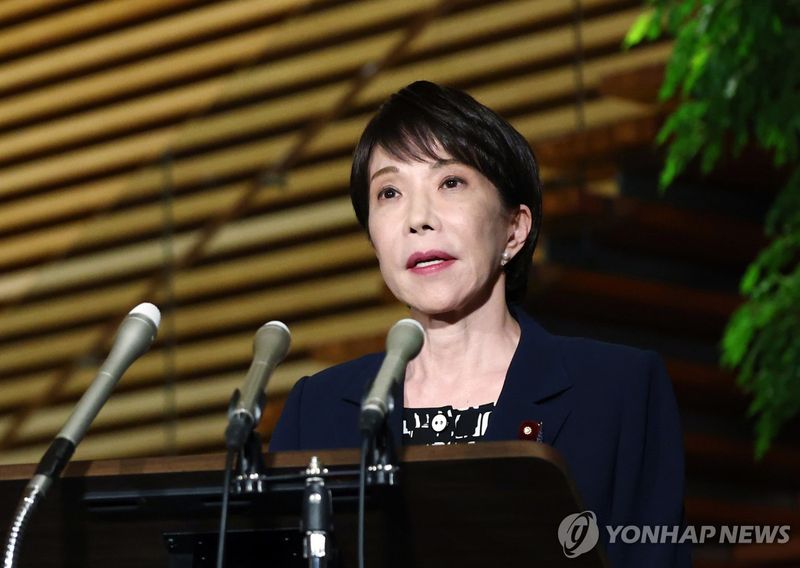
【Financial News, Tokyo—Correspondent Seo Hye-jin】On the 15th, Japanese Prime Minister Sanae Takaichi replaced a close ally in her Cabinet who had become embroiled in a “budget retaliation” remark and allegations of election law violations. She named a successor with extensive experience in agricultural policy. But criticism has also mounted over the prime minister’s personnel judgment and response, including her defense of the minister in the early stages of the controversy. Takaichi’s Cabinet, which lacks a majority in the House of Councillors, now faces added pressure in passing key legislation, including a consumption tax cut.
According to NHK and the Nihon Keizai Shimbun, Prime Minister Takaichi met LDP lawmaker Arata Takebe that day and asked Takebe to take on the post of minister of agriculture, forestry and fisheries. The request came just one day after she accepted the resignation of Agriculture, Forestry and Fisheries Minister Kazuo Yana. Takebe is expected to formally take office that evening after an attestation ceremony at the Imperial Palace.
Takebe, 56, is a six-term lawmaker representing Hokkaido’s 12th district. He has served as senior vice minister of agriculture, forestry and fisheries and as chair of the LDP’s Agriculture and Forestry Division, among other roles. He is the son of Tsutomu Takebe, who served as agriculture, forestry and fisheries minister and LDP secretary-general; this is his first Cabinet appointment. NHK said the appointment was “a move to limit the impact on parliamentary deliberations and government operations by bringing in someone well-versed in agricultural policy.”
■ From ‘budget retaliation’ remarks to election-law allegations
Yana was effectively forced out less than a month after entering the Cabinet for the first time in a reshuffle on the 17th of last month. Yana is the first Cabinet minister to leave over a controversy since the Takaichi administration took office in October last year.
The controversy began at a local LDP meeting last May. Yana said road budgets for this year in Nasu-Karasuyama City and Nakagawa Town, Tochigi Prefecture, had been “slashed drastically.” The heads of both municipalities had supported rival candidates in the February election to the House of Representatives of Japan. The remarks drew widespread criticism after being understood to mean that Yana had used the budget to penalize areas that had not supported him.
Yana withdrew the remark and apologized, while denying that he had ever actually called for budget cuts. Whether any cuts were retaliatory has not been confirmed. But it emerged that Yana had inquired with the Ministry of Land, Infrastructure, Transport and Tourism about road budgets for the areas, bringing into focus whether a politician had improperly intervened in budget allocations.
The election-law allegations became a decisive liability for Yana. In a previous election to the House of Representatives of Japan, Yana’s camp provided supporters with free shuttle-bus rides. The practice could run afoul of Japan’s Public Offices Election Act, which restricts providing benefits to voters.
Yana said he had checked with the election commission in advance, but the commission said it had no record of an inquiry. He later changed his account, saying he may have asked about how the costs should be accounted for rather than whether the arrangement was legal. An additional allegation emerged that campaign workers who urged people to vote by phone had been paid.
■ Prime minister’s defense of close ally … the burden extends beyond appointment responsibility to parliamentary business
The burden on Prime Minister Takaichi goes beyond losing one minister. She appointed a close ally who had been disciplined over political funding issues and then insisted the minister remain in office even after the controversy escalated.
Yana, a member of the former Abe faction, was disciplined by the party over omissions in a 2024 political funds income-and-expenditure report. Despite that record, the prime minister appointed Yana to the Cabinet and praised the minister on the campaign trail as “my storehouse of wisdom.” Takaichi also backed Yana early in the controversy, saying, “Work hard and repay us with results.”
The Nikkei cited the prime minister’s reluctance to reverse her own personnel decision as a reason for the delayed response. A close aide to the prime minister told the newspaper, “It was a mistake in the initial response. They tried to limit the damage but only made the wound deeper.” The Asahi Shimbun said “power has become concentrated in the prime minister’s hands, while internal checks have weakened.”
Criticism of the slow response also came from within the ruling camp. Masaji Matsuyama, chairman of the LDP’s House of Councillors caucus, told the Yomiuri Shimbun, “Yana should have apologized from the start. The response was wrong, and resignation was inevitable.” A senior official of the Japan Innovation Party, a coalition partner, also criticized the initial response, saying the administration still had work to do on crisis management.
After accepting the resignation, Prime Minister Takaichi said, “I take my responsibility for the appointment very seriously.” The opposition, however, says the matter cannot be resolved simply by replacing the minister.
The Constitutional Democratic Party of Japan decided to hold the prime minister to account for the appointment. Democratic Party for the People leader Yuichiro Tamaki also called for further deliberations, saying, “The suspicion that budget allocations may be changed arbitrarily through political intervention has not been dispelled.”
It has become harder for Takaichi’s Cabinet, which is pushing for a consumption tax cut, to secure the opposition’s cooperation. The Asahi Shimbun predicted that opposition parties galvanized by the episode would also become a factor in the passage of bills related to consumption tax cuts and reducing the number of seats in the House of Representatives of Japan.
[email protected] Seo Hye-jin Reporter