Deaths from storm and flood disasters this summer fell from 25 to 1; property damage also dropped 89%
- Input
- 2026-10-15 12:00:00
- Updated
- 2026-10-15 12:00:00
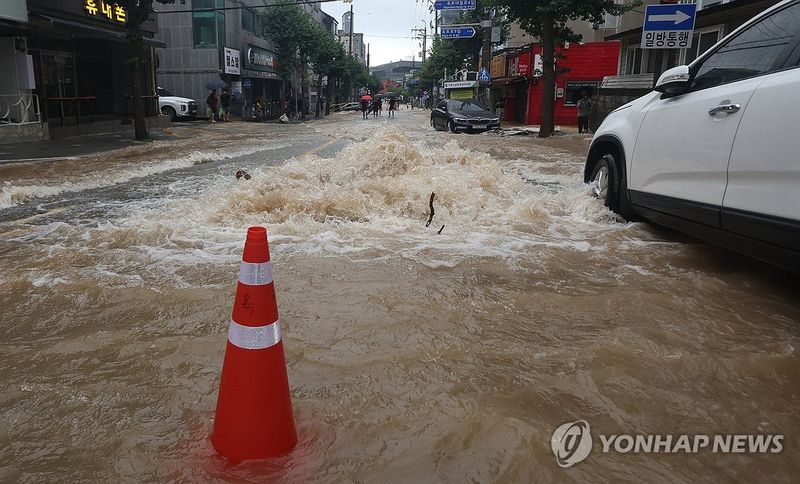
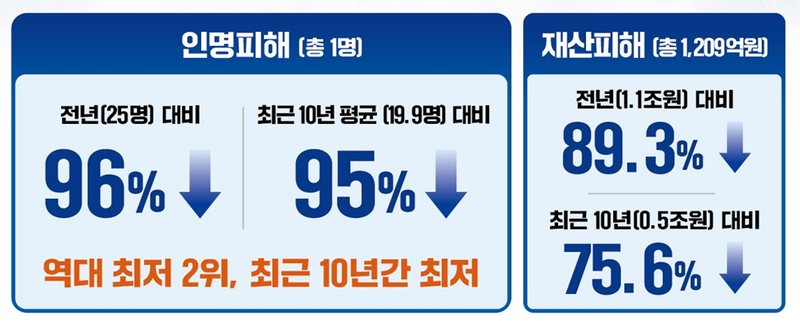
[Financial News] This summer, deaths from storm and flood disasters, including torrential rain, fell to one from 25 last year. This is the lowest toll since 2015, when there were no casualties. Property damage also fell 89.3%, from 1.1307 trillion won to 120.9 billion won. The government said the decline in damage was helped by stronger proactive measures, including establishing evacuation criteria for residents based on rainfall for the first time and granting town, township and neighborhood heads the authority to order evacuations.
The Ministry of the Interior and Safety said on the 15th that a preliminary tally of damage during the “2026 Summer Natural Disaster Response Period,” which ran from May 15 to October 15, showed that casualties had fallen 96% from the previous year. This year’s sole death was a person buried by a debris flow after a slope collapsed in Geoje, South Gyeongsang Province, on August 17.
Damage also fell significantly compared with the average over the past 10 years. The government’s tally showed that this year’s death toll was 95% below the 10-year average of 19.9, while property damage was down 75.6% from the 10-year average of about 500 billion won. This year’s property damage totaled 92.7 billion won at public facilities and 28.2 billion won at private facilities, down 255.4 billion won and 754.4 billion won, respectively, from last year.
However, rainfall nationwide this summer was below normal. From June to August, the country received 558.6 mm of rain, 23.2% less than the normal 727.3 mm, and had 31.2 rainy days, 7.3 fewer than the normal 38.5 days. Some areas, however, were hit by record downpours. On August 17, Geoje in South Gyeongsang Province received 654.3 mm of rain in a single day, the third-highest daily total on record. It was the highest ever for heavy rain, excluding typhoons. The 968.1 mm of rain that fell in Geoje from August 15 to 18 amounted to nearly half its annual rainfall.
This year, the government focused on evacuating residents first when signs of danger emerged. It replaced the on-the-ground judgment that had previously guided decisions at situation-assessment meetings and elsewhere with specific criteria based on objective figures such as rainfall. In the case of landslides, people were instructed to evacuate immediately when accumulated rainfall reached 300 mm or more and hourly rainfall reached 50 mm or more.
The authority to order resident evacuations was also expanded from city, county and district authorities to include heads of towns, townships and neighborhoods, allowing evacuation decisions to be made quickly. In Busan’s Seo District, for example, residents were evacuated in advance after cracks were found in a retaining wall below a multi-family home. The wall collapsed shortly afterward, but there were no casualties.
This year, the government introduced for the first time a “Disaster-Level Heavy Rain Emergency Alert,” which is automatically sent at the town, township and neighborhood level when rainfall reaching disaster levels is observed. An alert is sent when hourly rainfall is at least 85 mm and 15-minute rainfall is at least 25 mm, or when hourly rainfall is at least 100 mm. Since the first alert was sent in Suseong District, Daegu, on July 17, it has been sent 11 times in total. On August 17, a civil defense siren was also used for the first time in Ilun-myeon, Geoje, South Gyeongsang Province, to notify residents to evacuate.
The Ministry of the Interior and Safety plans to review shortcomings identified during this response period and strengthen the disaster response system, focusing on risk-area management and protecting vulnerable groups.
Minister of the Interior and Safety Yun Ho-jung said, “We will continue to carefully monitor places vulnerable to disasters first and do our utmost to become a government that protects people’s lives through prevention-focused disaster management that identifies risks early and responds to them.”
[email protected] Lee Bo-mi Reporter