“Korea-U.S. strategic investment: Now, implementation” “We keep our promises”: Political and business leaders of both countries speak with one voice on carrying out investments
- Input
- 2026-10-15 11:28:31
- Updated
- 2026-10-15 11:28:31
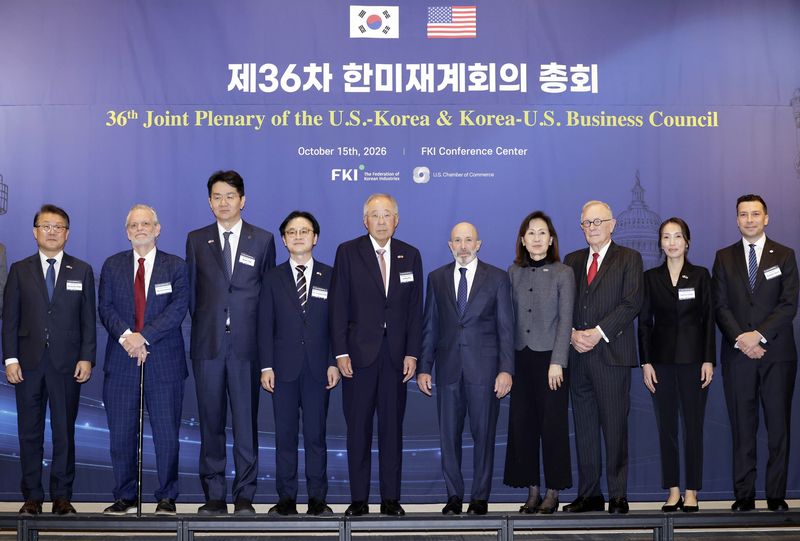
[Financial News] As Korea-U.S. strategic investment enters the full-scale implementation phase, political and business leaders from both countries reaffirmed their commitment to carrying out investments and expanding industrial cooperation. Companies said they would turn agreements between the governments into tangible business results, while calling for improved investment conditions, including faster permits and approvals and smoother exchanges of personnel.
About 60 political and business figures from both countries, including FKI Chairman Ryu Jin, U.S.-Korea Business Council Chairman Evan Greenberg, Minister of Trade, Industry and Energy Kim Jung-kwan, and U.S. Ambassador to South Korea Michelle Steel, attended the 36th Korea-U.S. Business Council plenary meeting, jointly hosted by the Federation of Korean Industries (FKI) and the U.S. Chamber of Commerce at FKI Tower in Yeouido, Seoul, on the 15th.
Held after the governments of South Korea and the United States announced strategic investment projects, including the construction of gas-fired power plants in Texas, the meeting focused on turning the framework for cooperation established by the governments into corporate investments and business ventures.
Chairman Ryu emphasized, “The strategic investments agreed upon by the governments of both countries have now entered the full-scale implementation phase,” adding, “From now on, it is the companies’ time. It is companies that will take the lead in turning the framework for cooperation established by the governments into tangible results.”
The investment record of Korean companies was also presented. According to the Export-Import Bank of Korea, South Korea’s direct investment in the United States totaled $206.3 billion from 2016 to 2025, averaging more than $20 billion a year. FKI’s own survey found that $22.3 billion in investment had been carried out over the past year. Chairman Ryu said, “We will fulfill our role as a trusted partner, building the industrial ecosystems of the future together with U.S. companies.”
Ambassador Steel underscored the importance of carrying out the agreements. She said, “A promise made in Korea-U.S. relations is always kept,” adding, “Now we expect to roll up our sleeves in earnest and move forward with putting this agreement into action.” Her remarks were seen as underscoring a commitment to turn the economic cooperation agreements between the two countries into tangible investments and business results.
She also discussed the business environment for U.S. companies in South Korea. Ambassador Steel emphasized her hope that progress would also be made on other issues covered by the agreement reached by the leaders of South Korea and the United States last November, stating, “This includes U.S. companies’ access to the Korean market and fair treatment in Korea.”
Minister Kim said industrial cooperation had become a key pillar supporting the alliance. “In the past, the Korea-U.S. alliance strengthened industrial cooperation between the two countries. Now, industrial cooperation is becoming a key driver that further strengthens the alliance,” he said, calling for expanded cooperation to stabilize supply chains, drive innovation in artificial intelligence (AI) and advanced technologies, and strengthen the competitiveness of advanced manufacturing.
Companies called for institutional support to carry out investments. In a joint declaration, the business communities of both countries urged their governments to create a predictable, pro-market business environment, expedite permits and approvals, and resolve visa issues to facilitate personnel exchanges.
By sector, participants discussed responding to rising electricity demand driven by the spread of AI and ways to implement the Korea-U.S. shipbuilding partnership under the theme “From Semiconductors to Shipbuilding.” In pharmaceuticals and biotechnology, they also explored ways to strengthen supply chains for essential medicines, pursue joint research and development, and expand clinical cooperation.
[email protected] Kim Hak-jae Reporter