Energy data for 7.3 million buildings nationwide, all in one place ... KICT builds 'DataNet'
- Input
- 2026-10-15 10:54:13
- Updated
- 2026-10-15 10:54:13
[Financial News] The Korea Institute of Civil Engineering and Building Technology (KICT) announced on the 15th that it had built DataNet, a national-scale data-linkage system that connects energy use data for 7.3 million buildings nationwide with building-related administrative data scattered across multiple agencies, linking them at the building level.
A research team at KICT’s Building Energy Research Division used the building register as its reference dataset to identify and classify 17 types of administrative data, including building energy use, weather, commercial districts and businesses, business permits, geospatial information, and information on apartment complexes, educational, medical, and cultural facilities. It completed the linkage of 13 types of data. The average matching rate across datasets was 94.8%, with high rates for medical institution information (98.4%) and commercial establishment information (96.7%), among others.
DataNet’s core function is to standardize address information managed differently by each agency so that data can be accurately linked at the building level. South Korea uses both lot-number and road-name addresses, and a single parcel often contains multiple buildings, making accurate data linkage difficult through simple address comparisons alone. To address this, the research team is carrying out the DataNet project with 16 institutions nationwide and around 130 researchers, integrating building-related data dispersed across agencies from April 2023 through this coming December. The team has improved the quality of energy data by applying a three-stage address-matching method during data linkage and integration, and by using techniques such as outlier tagging and “calendarization,” which redistributes billing periods into calendar-based months. Reported monthly energy use can also be separated into heating, cooling, and base use, making it possible to assess consumption performance for each building. The team developed form and shading indices that account for building shape and the shading effects of surrounding buildings, and analyzed the relationship between monthly energy use and outdoor temperatures to help identify each building’s heating and cooling sensitivity and operating characteristics.
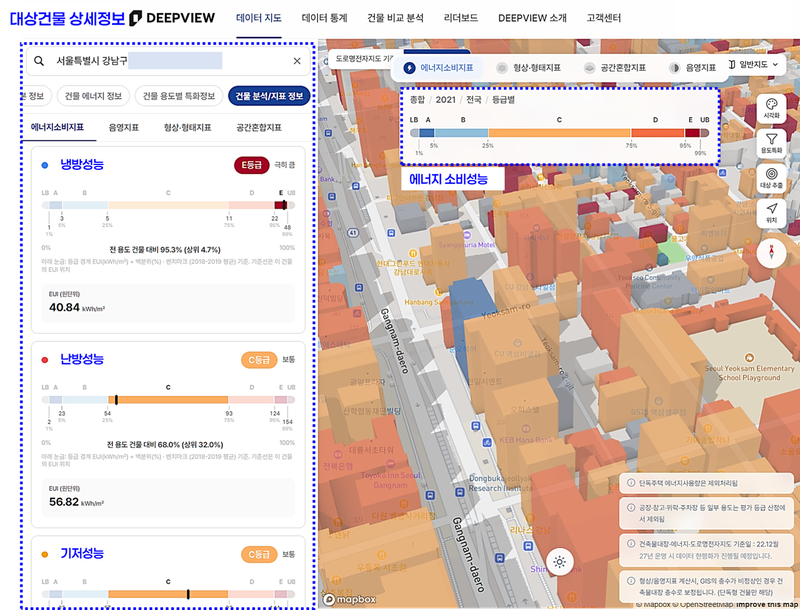
The research findings are currently being offered as a pilot service through DeepView, a web-based visualization system that lets users explore building energy information on a map, and are managed through data integration management infrastructure. DataNet covers building-level information, not personal information, and sensitive information, including that concerning key national facilities, was excluded at the source to account for both data use and security. The research team plans to continue integrating the remaining datasets, improving matching accuracy, and advancing energy performance assessment methods for different facility types through the end of 2026.
KICT President Park Seon-gyu said, “This research is significant because it has laid the foundation for analyzing the energy performance of buildings nationwide by connecting scattered building data,” adding, “Going forward, we will actively use these research findings to improve building energy efficiency based on data and support carbon-neutrality policies.”
The findings were published on the 15th in the international journal 'Energy & Buildings'.
[email protected] Yeon Ji-an Reporter