U.S. inflation alarm sounds twice...CPI followed by Beige Book signals price pressures
- Input
- 2026-10-15 10:37:51
- Updated
- 2026-10-15 10:37:51
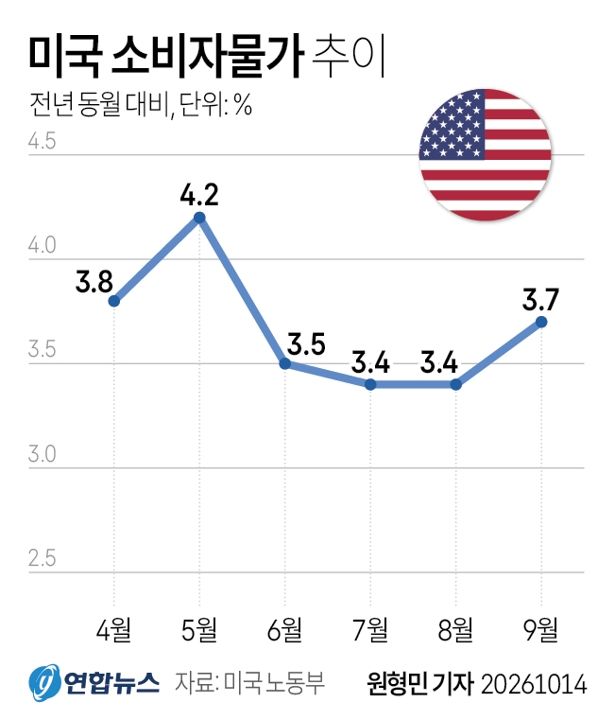
CPI rises 3.7%...Core inflation also increases
The United States Department of Labor (U.S. Department of Labor) said the September CPI rose 0.6% from the previous month and 3.7% from a year earlier. The increase was larger than in August, when inflation was 3.4%. The figure exceeded market expectations and remained far above the Fed's 2% inflation target, measured by the Personal Consumption Expenditures (PCE) price index.
Gasoline was the direct driver. Gasoline prices, which surged after the U.S.-Israeli war against Iran, rose 9.1% over September, accounting for more than half of the monthly increase.
The figure to watch is core CPI, which excludes energy and food. It rose 0.3% from the previous month and 2.6% from a year earlier, exceeding both forecasts of 0.2% and 2.5%. This raises concerns that energy costs could spread to the prices of other goods and services.
The October Beige Book, released the same day, suggested that inflationary pressures could persist. The report mentioned high diesel prices 21 times, more than ten times the two mentions in the previous report. A survey conducted just before the war against Iran began in late February had no such mentions.
Of the 12 Fed districts, three described inflation as strong, eight as moderate, and one as slight. Three of the eight districts reporting moderate inflation said price pressures were intensifying further.
The Federal Reserve Bank of Dallas said, “Rising diesel prices were the most frequently cited factor driving up business costs,” adding that they “are affecting freight transportation, agriculture and airfares, while squeezing profit margins across multiple industries.”
Gasoline and diesel affect prices through different channels. Gasoline prices directly raise the prices consumers feel at the pump. Diesel, by contrast, is used across industries, including in freight trucks and farm machinery. Higher diesel prices can be reflected in final consumer prices through increased transportation and production costs.
If September's CPI reflects inflation that has already materialized, October's Beige Book signals that businesses may raise prices further. Tariffs and rising raw-material prices and insurance premiums are adding to the pressure, further increasing business costs.
Prices rise as employment stagnates
Unlike inflationary pressures, growth has not shown a clear improvement. According to the Beige Book, economic activity increased at a slight to modest pace in nine of the 12 districts, while three reported no change. Businesses were generally optimistic about the outlook. However, they expected growth to remain modest, led by manufacturing. Persistent economic uncertainty was cited as a factor constraining investment and hiring.
The labor market continued to show what is known as a “low-hire, low-fire” pattern, with both hiring and layoffs limited. There were no large-scale layoffs. However, in five districts, businesses were reducing their workforces by leaving departing employees’ positions unfilled or delaying hiring. Wage growth in September was 3% annually, below the inflation rate of 3.7%.
High interest rates are also weighing on the housing market. According to the Mortgage Bankers Association (MBA), the average rate on a 30-year fixed-rate mortgage stood at 7.5% last week, its highest level in about three years. The New York Fed said rising mortgage rates were discouraging existing homeowners from moving, limiting the supply of homes for sale.
If the Fed raises interest rates further to bring inflation under control, it will add pressure to a stagnant labor market and a weakened housing market. If it holds rates steady, however, it risks energy price increases and tariffs feeding through to consumer prices more broadly.
Last month, the Fed raised its benchmark interest rate by 0.25 percentage points, bringing it to a range of 3.75% to 4.00% annually. It was the first increase since July 2023. After the CPI release that day, financial markets priced in about a 37% chance of another hike at the Federal Open Market Committee (FOMC) meeting on the 27th and 28th. Chicago Fed President Austan Goolsbee said in an interview with Yahoo Finance that day, “I’m disappointed that September consumer price inflation came in higher than expected,” and, “We need to see more data [on the future direction of monetary policy],” stressing that economic indicators should be examined closely before deciding whether to raise rates further.
[email protected] Correspondent Lee Byung-cheol Reporter