August money supply hits 4,266 trillion won, surging nearly 40 trillion as semiconductor firms’ idle funds pour in
- Input
- 2026-10-15 12:00:00
- Updated
- 2026-10-15 12:00:00
[The Financial News] In August, the amount of money in circulation grew by nearly 40 trillion won in a single month. The increase reflected the combined effects of a massive inflow of idle funds from exporters, including semiconductor companies, and a preference for short-term investments. Non-financial companies deposited large sums in time deposits and installment savings, trusts, and money market funds (MMFs), while household funds, which had been declining, also returned to growth after four months.
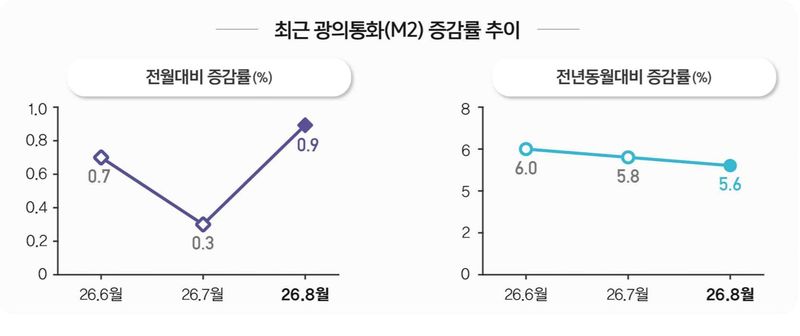
According to the Bank of Korea’s August 2026 Money and Liquidity Trends, released on the 15th, broad money (M2, seasonally adjusted average balance) stood at 4,266.8 trillion won last month, up 0.9% (39.1 trillion won) from the previous month.
M2 has risen for 10 consecutive months since last November. The increase was also three times as large as July’s (0.3%) and the biggest since August last year (44.5 trillion won). On an unadjusted basis, the money supply rose 5.6% from the same month a year earlier.
The biggest driver of the sharp increase in the money supply was companies’ ample idle funds. Funds in the non-financial corporate sector surged by 33.9 trillion won last month, an increase of more than 10 trillion won from the previous month (+20 trillion won and 4,000 won), extending the run of gains to 10 consecutive months.
By type of financial product, deposits and installment savings with terms of less than two years (+28.7 trillion won) and money trusts with terms of less than two years (+14.2 trillion won) increased sharply. These were the largest increases since December 2022 (44.6 trillion won) and January 2022 (36.3 trillion won), respectively. MMFs also returned to growth in August (+12.6 trillion won), following a decline the previous month (-9.5 trillion won).
The Bank of Korea said, “Deposited funds flowing in, particularly from large semiconductor companies, appear to have spread across short-term products and deposits and installment savings more broadly.”
By economic sector, in addition to non-financial corporations, funds held by other financial institutions rose from -6.1 trillion won to +1 trillion won, while those held by households and nonprofit institutions rose from -11.8 trillion won to +300 billion won.
In particular, household funds that had flowed out through loan repayments and investments in housing and stocks, among other things, turned positive for the first time in four months since April, amid rising market interest rates and a contraction in short-term borrowing. By contrast, the other sector, which includes the government and public institutions, fell by 3.5 trillion won, returning to decline.
Narrow money (M1, average balance), which represents short-term funds held in liquid form, stood at 1,357.6 trillion won, down 1.1% from the previous month. However, the decline narrowed to about half the previous month’s 2.2% drop. On an unadjusted basis, it rose 4.1% from the same month a year earlier.
Meanwhile, all broad liquidity indicators showed expansion.
Financial institution liquidity (Lf, average balance), which represents funds handled by all financial institutions, stood at 6,386.4 trillion won, up 0.6% from the previous month.
Broad liquidity (L, end-of-month balance), which includes government-issued bonds, corporate bonds and other instruments, stood at 8,094.3 trillion won, up 0.2% from the end of the previous month. Both were up 7.2% from the same month a year earlier.
[email protected] Jeong Sang-gyun Reporter