“Multiculturalism Is Not a Choice but a Reality” ... Education Communities Nationwide Join Forces to Support Students with Migrant Backgrounds
- Input
- 2026-10-15 10:16:08
- Updated
- 2026-10-15 10:16:08
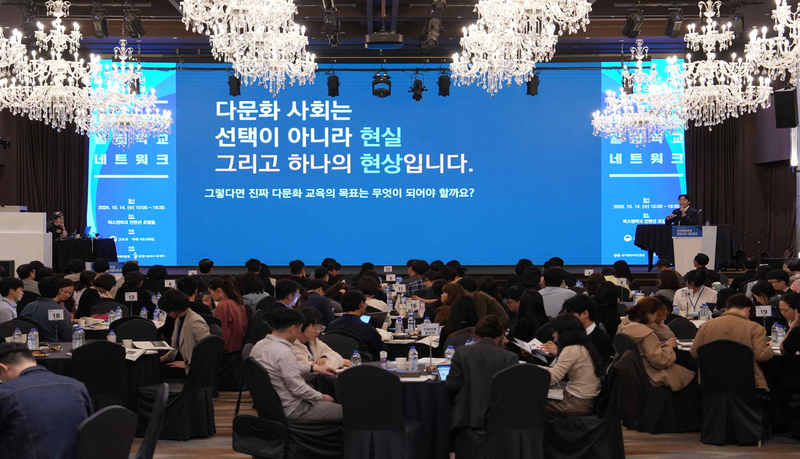
[Financial News] As the country’s transition to a multicultural society accelerates amid a low birth rate and demographic shifts, the education sector is working to develop tailored support measures to help students with migrant backgrounds become capable members of society.
The “Second-Half 2026 Network for Schools with High Concentrations of Students with Migrant Backgrounds,” hosted by the Ministry of Education and 16 metropolitan and provincial offices of education and organized by the Central Multicultural Education Center of the National Institute for Lifelong Education, was held on the 14th at Peace & Park Convention in Yongsan-gu, Seoul. According to the National Institute for Lifelong Education on the 15th, around 170 people attended, including principals and teachers from schools with many students with migrant backgrounds, as well as education office officials from across the country.
Participants agreed that multicultural education is a key challenge for schools and local communities to address together, going beyond simply providing aid.
One teacher who attended the event said, “It was a great help to hear about successful practices at other schools and share experiences,” adding, “I plan to return to my school and actively try out support measures tailored to students.”
That morning, educators presented exemplary practices that had proven effective on the ground, including those at Yeongnim Elementary School in Seoul, Buheung Elementary School in Incheon, Gwansan Middle School in Gyeonggi Province, and Dunpo Middle School in South Chungcheong Province. In the afternoon, representatives of schools with extensive support experience and schools that have recently seen a sharp increase in students with migrant backgrounds met in small groups to discuss practical ways to address challenges on the ground and use local educational resources.
The government and the organizing institution also said they would continue to expand support that reflects the voices of those on the ground.
Na Hyeon-ju, director of the Student Support Coordination Division at the Ministry of Education, said, “I hope this event has helped enhance educators’ expertise and strengthen cooperation among schools,” adding, “We will continue to provide support so that students with migrant backgrounds can grow and develop in a stable manner.”
Lee Se-jeong, head of the Digital Strategy and Projects Division at the National Institute for Lifelong Education, also stressed, “I hope this event has been a meaningful opportunity to share experiences and best practices from schools,” adding, “We will continue to strengthen support that provides practical help with teaching students with migrant backgrounds in schools.”
[email protected] Kim Man-gi Reporter