Joo Ho-young: “Moving the Ministry of National Defense and the Ministry of Foreign Affairs to Sejong is a self-destructive decision that undermines national security”
- Input
- 2026-10-15 09:45:03
- Updated
- 2026-10-15 09:45:03
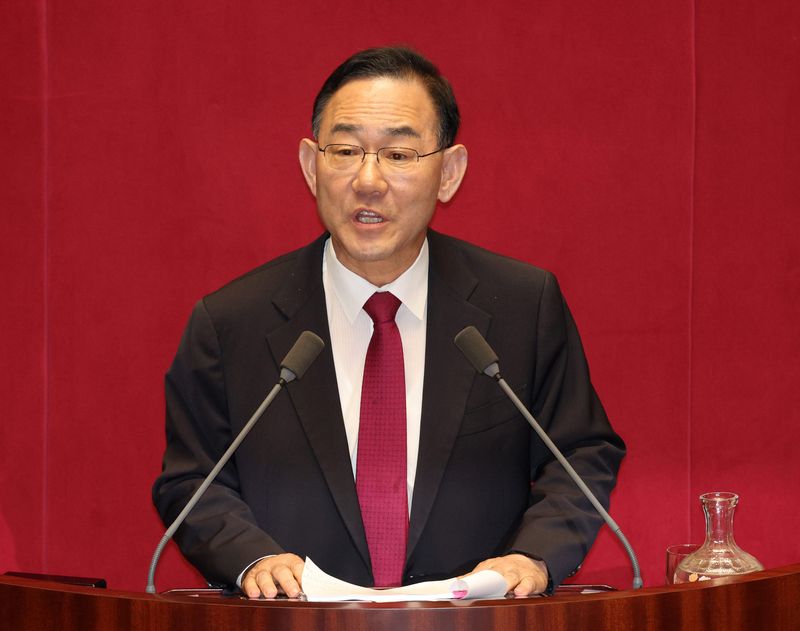
[Financial News] People Power Party lawmaker Joo Ho-young called the government’s push to relocate the Ministry of National Defense and the Ministry of Foreign Affairs to Sejong “a self-destructive decision that jeopardizes national security” and urged it to halt the plan immediately. He argued that the move would not only run counter to the intent of the Constitutional Court ruling but could also create serious gaps in national security and diplomatic capabilities.
At a press conference at the National Assembly Communication Hall on the 15th, Rep. Joo criticized the plan, saying, “Relocating the Ministry of National Defense and the Ministry of Foreign Affairs to Sejong is not simply a matter of decentralizing administrative functions; it is a dangerous idea that undermines constitutional legitimacy and fundamentally destabilizes the country’s diplomatic capabilities and national security posture.”
Rep. Joo first argued that relocating the two ministries would run counter to the intent of the Constitutional Court of Korea’s ruling. He explained, “The main reason the Constitutional Court of Korea dismissed the constitutional complaint against the construction of the Multifunctional Administrative City in 2005 was its finding that Seoul continued to serve as the country’s de facto capital, as the political and administrative hub and the center of its foreign relations.”
He went on to ask, “If the country’s core functions of diplomacy and defense are moved out, how can Seoul maintain the symbolism and stature of the Republic of Korea’s capital internationally?” He demanded that “the government first explain the constitutional basis for its plan and clarify whether it is denying the underlying premise of the Constitutional Court’s earlier ruling.”
He also raised concerns that the move could create gaps in national crisis response and the defense of the capital. Rep. Joo stressed, “In the Republic of Korea, a divided country still under a ceasefire, immediate communication and decision-making among the commander-in-chief of the armed forces, the Ministry of National Defense and Joint Chiefs of Staff (JCS) officials during an emergency can determine the nation’s fate.”
He then asked, “Have you thoroughly assessed how dispersing the wartime leadership would affect the cohesion of the chain of command and the air defense and defense posture in the Seoul metropolitan area?” He added, “Relocating the Ministry of National Defense without thorough security measures could be seen as effectively abandoning the defense of the capital.” He urged the government to provide evidence that the chain of command would not be disrupted in an emergency.
He also criticized the diplomatic inefficiency that could result from relocating the Ministry of Foreign Affairs. Rep. Joo said, “Embassies from 118 countries are currently based in Seoul,” and argued, “If the Ministry of Foreign Affairs moves, each country’s embassy will have to bear the cost of relocating with it or put up with diplomatic inefficiency as it travels between Seoul and Sejong.”
He noted that relocating embassies would require approval from the countries concerned and securing budgets, as well as arranging office buildings, residences and security facilities. He also asked, “Has the government even held serious preliminary consultations with the foreign diplomatic corps in Korea?” He pressed the government, asking, “What solution does it have for the severing of diplomatic channels and delays in responding to urgent issues if embassies remain in Seoul?”
Rep. Joo added, “The country’s diplomatic and security systems and the capital’s essential functions are not things the government can unilaterally change based on political considerations,” and said, “A reckless approach to governing that simply seeks to lock in the relocation without due consideration, with people’s lives and national security at stake, can never be tolerated.”
[email protected] Kim Kyung-min Reporter