KOSPI tumbles to the 5,600 level... SK Hynix in the ₩1.2 million range, Samsung Electronics in the ₩210,000 range [fn Market Opening]
- Input
- 2026-10-15 09:34:03
- Updated
- 2026-10-15 09:34:03
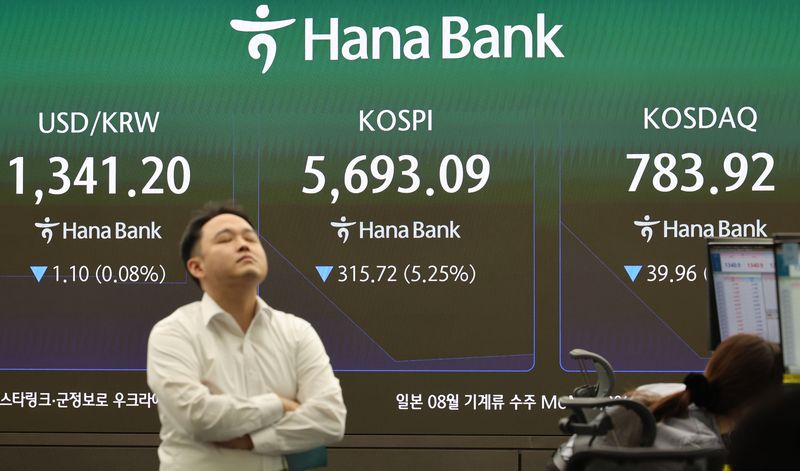
[Financial News] The KOSPI plunged more than 5% early in the session amid an overnight fall on the New York stock market, breaking below the 5,600 level. Samsung Electronics and SK hynix are each down 6–9%, dragging the index lower. According to the Korea Exchange, as of 9:30 a.m. on the 15th, the KOSPI stood at 5,628.09, down 6.21% from the previous trading day. It opened at 5,673.01, down 5.59% from the previous day’s close of 6,008.81.
By investor category, foreign investors are selling 856.7 billion won. Institutions and individual investors, by contrast, are net buyers of 729.6 billion won and 73.7 billion won, respectively.
Among the stocks with the largest market capitalizations, Samsung Electronics was trading at 216,000 won, down 6.90% from the previous trading day. SK hynix was at 1,295,000 won, down 8.74%.
Semiconductor-related stocks are particularly steep decliners. Samsung Electro-Mechanics has plunged 12.45%, posting a double-digit drop. Samsung Electronics preferred shares (-6.34%) and SK Square (-9.27%) are also down sharply. LG Energy Solution (-4.62%), Hyundai Motor (-4.63%) and Samsung Life Insurance (-4.26%) are also weaker. KB Financial Group (-1.44%) and Samsung Biologics (-0.51%) have fallen less by comparison.
All three major U.S. stock indexes fell on the 14th. The Nasdaq Composite was down 1.88% from the previous trading day, while the S&P 500 and Dow Jones Industrial Average fell 1.11% and 0.09%, respectively.
At the same time, the KOSDAQ stood at 777.88, down 6.35% from the previous trading day. It opened at 784.45, down 39.4 points (4.79%) from the previous close of 823.88. By investor category, individual investors are net sellers of 55.9 billion won. Foreign investors and institutions, by contrast, are net buyers of 44.6 billion won and 12.4 billion won, respectively.
Meanwhile, both of South Korea’s major markets plunged early in the session, triggering simultaneous sell-sidecars. It is the first time sell-sidecars have been triggered simultaneously in the KOSPI and KOSDAQ markets in 51 trading days, since July 29.
At 9:07 a.m. that day, the Korea Exchange triggered a sidecar in the KOSPI market, temporarily suspending program sell orders. It was the 51st sidecar triggered in the KOSPI market this year and the 27th sell-sidecar.
At 9:12 a.m., a sidecar temporarily suspending program sell orders was also triggered in the KOSDAQ market. It was the 33rd sidecar triggered in the KOSDAQ market this year and the 15th sell-sidecar.
A sidecar is a market-stabilizing measure that suspends the effectiveness of program trading orders for five minutes. A KOSPI sidecar is triggered when the KOSPI 200 futures price rises or falls by at least 5% from the previous day’s close and remains at that level for at least one minute. In the KOSDAQ market, a sidecar is triggered when the KOSDAQ 150 futures price rises or falls by at least 6% from the previous day’s close and remains at that level for at least one minute.
The recent decline in the stock market has also been slow to ease. The KOSPI has continued to fall since closing at 7,003.74 on the 2nd. It plunged 5.46% on the 13th and fell another 0.44% on the 14th. Selling pressure expanded early in the session today, pushing the index below 6,000.
Han Ji-young, an analyst at Kiwoom Securities, said, “We are leaning toward the possibility that the market will find support near its previous low,” while adding, “As the market tests that low, additional selling and bargain buying could vie for supply and demand, increasing volatility.”
[email protected] Han Young-jun Reporter