Chey Tae-won: “Korea and Japan should build an economic community ... and jointly respond on energy and AI”
- Input
- 2026-10-15 08:46:07
- Updated
- 2026-10-15 08:46:07
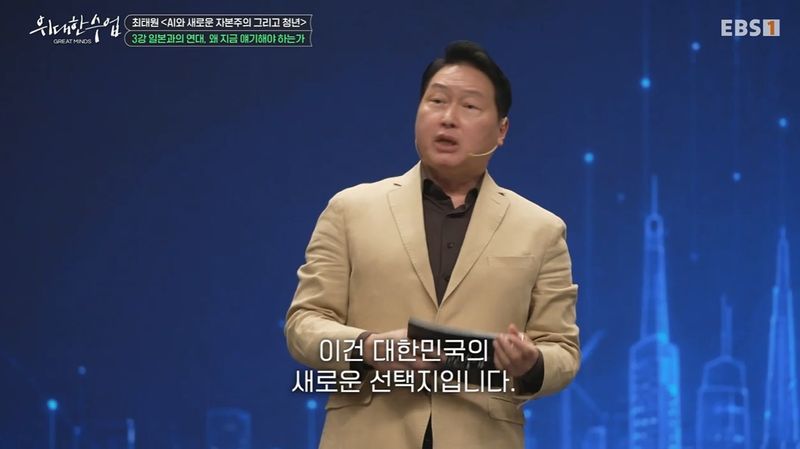
[Financial News] SK Group Chairman Chey Tae-won has proposed elevating economic cooperation between South Korea and Japan to the level of an “economic community” amid global power rivalry and an increasingly bloc-based international order. His proposal is that if the two countries jointly purchase energy and pool resources in AI and semiconductors, they could cut costs and become a “Rule Setter” that shapes the rules of the global market.
According to business sources on the 15th, Chey Tae-won fleshed out this vision of a Korea-Japan economic community in a lecture titled “Solidarity with Japan: Why Talk About It Now?” broadcast on EBS’s “Great Minds” on the night of the 14th. Since the 12th, Chey has been giving a series of lectures on “AI, a New Capitalism, and Young People.”
Chey first cited the rapidly changing international situation, including mounting U.S.-China tensions, as the backdrop to his proposal for an economic community.
“Under the World Trade Organization (WTO) system in the past, South Korea could survive on its own without forming an alliance with anyone,” he said. “But now, caught amid U.S.-China tensions, we need to consider whether we can protect ourselves on our own.”
He went on to emphasize that the combined GDP of South Korea and Japan amounts to about $6 trillion, arguing that expanding the market would create opportunities for growth. Chey’s view is that, backed by a unified, large-scale market, the two countries should move beyond being “Rule Takers” that simply follow the international order and become “Rule Setters” that lead in shaping its rules.
The first area of cooperation Chey identified was energy.
With the two countries’ annual fossil fuel imports totaling about $300 billion (about 403 trillion won), the calculation is that joint purchasing and shared use of storage facilities could cut costs by about 5–10%. He also proposed broadening cooperation beyond fossil fuels to joint development in nuclear power, renewable energy and hydrogen, reducing dependence on external sources and increasing energy self-sufficiency.
He also stressed the need for an alliance in AI and semiconductors, key growth industries of the future.
Chey said, “AI is a business that requires astronomical sums of money,” explaining that the two countries should pool resources to maximize efficiency rather than invest separately. He also noted that in semiconductors, combining South Korea’s global manufacturing competitiveness with Japan’s strengths in materials, components and equipment would create powerful synergies.
He cited structural similarities as the reason for identifying Japan as the top-priority partner for cooperation.
Both South Korea and Japan face shared social challenges, including low birthrates, aging populations and sluggish growth, making them ideally placed to seek common solutions. Chey also said that the vision for solidarity was inspired by patriot Ahn Jung-geun’s “Treatise on Peace in East Asia.”
Chey emphasized, “Although issues that need to be resolved between the two countries, including historical issues, remain, we must explore new economic options for the future,” adding, “If we are willing to seek opportunities shoulder to shoulder and in step with one another, economic solidarity between Korea and Japan will become a new engine of growth for South Korea.”
[email protected] Park So-hyun Reporter