“They said, ‘Buy when it falls’” ... Retail investors scoop up bargains as forced liquidations hit 59.3 billion won
- Input
- 2026-10-15 08:17:30
- Updated
- 2026-10-15 08:17:30
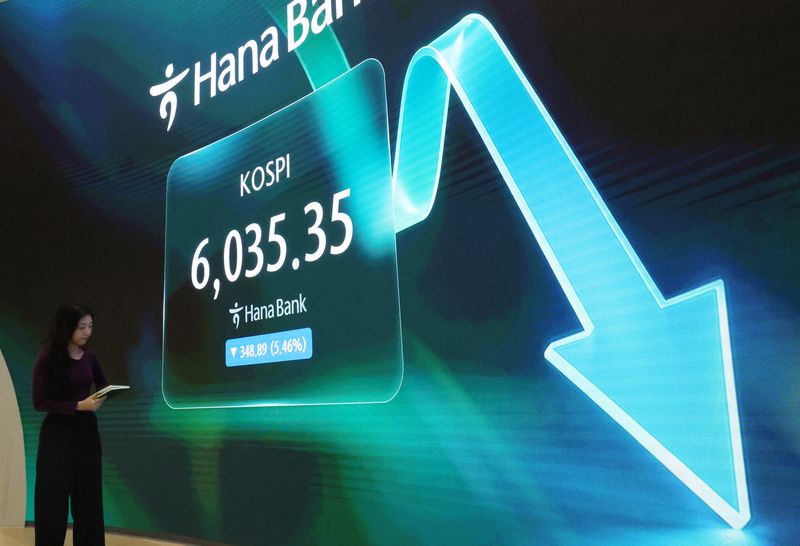
[Financial News] With the KOSPI recently suffering a sharp decline, individual investors have found themselves in different situations. Some are buying stocks that have fallen, while more investors who bought shares using borrowed money are suffering losses from forced sales.
Even as the market has plunged, individual investors have continued to be net buyers, while the volume of forced liquidations—when brokerages sell investors’ shares without their consent—is also rising rapidly. There are concerns that further declines in share prices could increase the losses borne by individuals who invested with borrowed money.
According to the Korea Exchange, the KOSPI closed at 6,008.81 on the 14th, the previous day. That was down 26.54 points (0.44%) from the previous trading day, leaving the index just above the 6,000 mark.
The KOSPI had also plunged 5.46% on the 13th, closing at 6,035.35. After falling for two consecutive trading days through the 14th, the index moved even closer to the 6,000 mark.
During intraday trading on the 13th, the KOSPI fell as low as the 5,900 level. It recovered to above 6,000 by the close, but the sharp swings in the index over the course of the day heightened investor anxiety.
Blue-chip semiconductor stocks that represent the domestic market also fell sharply. Samsung Electronics shares dropped 7.39%, while SK Hynix plunged 10.09%. SK Hynix’s share price fell by more than 10% in a single day, contributing to the KOSPI’s decline.
Some individual investors, however, are treating steep falls in share prices as buying opportunities. Even as the market plunged, individual investors continued to be net buyers, with demand emerging to buy stocks that had fallen.
On the 12th, when the KOSPI fell 3.65%, individual investors were net buyers of 1.4674 trillion won worth of shares on the KOSPI market. In other words, the amount they bought exceeded the amount they sold by that much.
Individual investors continued buying on the 13th as well. On that day, when the KOSPI plunged 5.46%, they were net buyers of 541.3 billion won. Their net purchases over the two days totaled 2.0087 trillion won.
By contrast, some individuals who invested using borrowed money are suffering losses as falling share prices trigger forced liquidations. These can be more burdensome than an ordinary decline in share prices because investors’ holdings may be sold at a time they do not choose.
According to the Korea Financial Investment Association, the actual amount of forced liquidations involving unsettled balances from brokerage trades was 59.35 billion won on the 13th. This was the value of shares forcibly sold by brokerages that had been held by investors who failed to pay for their stock purchases on time.
The increase is even greater compared with a month earlier. Forced liquidations totaled 10.865 billion won on September 14, but by October 13 the amount had risen by 48.485 billion won (446.2%).
The amount of forced liquidations thus increased about 5.5-fold in a month. As share prices plunged, the value of forced sales of holdings by investors unable to repay their unsettled balances also expanded considerably.
The increase was steep even compared with the previous day, the 12th. Forced liquidations totaled 27.083 billion won that day, rising to 59.35 billion won on the 13th. The amount increased by 32.267 billion won in a single day, more than doubling.
The proportion of total unsettled balances accounted for by forced liquidations also rose. The share increased from 1.1% a month earlier to 5.6% on the 13th, a rise of 4.5 percentage points in a month.
Forced liquidations occur when investors fail to pay by the deadline amounts owed from stock purchases or fail to meet the maintenance margin ratio required for margin trading. Brokerages can sell shares to recover unpaid balances or loans, regardless of the investor’s wishes.
Another burden when share prices are falling is that investors may find it difficult to choose when to sell. Even if prices rebound after a forced sale, investors cannot benefit from the recovery on shares that have already been sold.
As forced liquidations surged, the outstanding balance of margin loans also topped 34 trillion won. Although falling share prices increased investment risks, the balance of funds borrowed from brokerages to buy shares rose instead.
According to the Korea Financial Investment Association, the outstanding margin-loan balance stood at 34.2529 trillion won on the 13th. This balance refers to money investors have borrowed from brokerages to buy shares and have not yet repaid.
On the 8th, before the market began its sharp decline in earnest, the outstanding margin-loan balance was 33.8113 trillion won. In just a few days, it rose by about 441.5 billion won (1.31%), reaching the 34-trillion-won range.
Investors who borrowed money to buy shares could suffer even greater losses if prices fall further. That is because the value of their holdings would decline while they would still have to repay the borrowed funds.
In particular, if the maintenance margin ratio falls to or below the required level, investors may have to provide additional collateral. Failure to do so could lead to forced liquidation, with brokerages selling the shares they hold.
[email protected] Han Seung-gon Reporter