With Breast Cancer Survival at 94.8%, ‘Life After Treatment’ Now Matters
- Input
- 2026-10-15 07:03:04
- Updated
- 2026-10-15 07:03:04
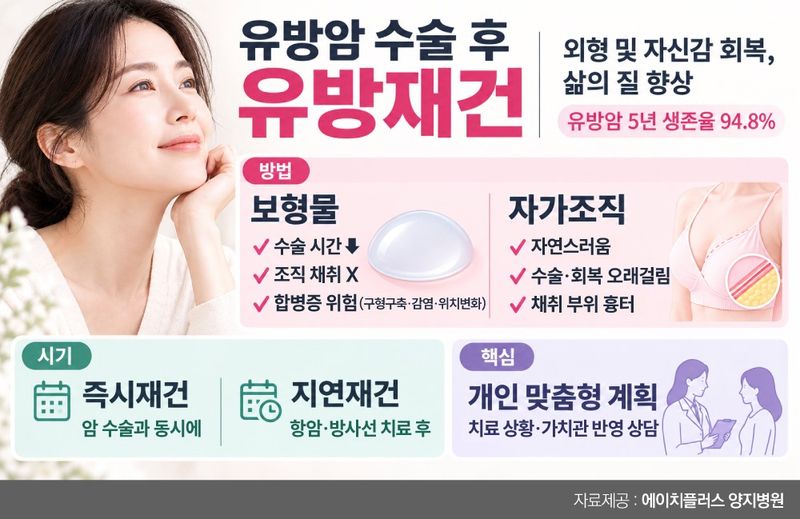
[Financial News] With the five-year relative survival rate for breast cancer reaching 94.8%, how to rebuild life after treatment is emerging as a new challenge. For women, breast reconstruction is an important part of life after treatment.
According to the 2023 National Cancer Registration Statistics, released this year by the Ministry of Health and Welfare and the Korea Central Cancer Registry, 29,715 women were diagnosed with breast cancer in 2023, accounting for 21.6% of all cancers among women and making it the most common cancer among them. The five-year relative survival rate for 2019–2023 was 94.8%.
As survival periods grow longer, quality of life after treatment has also become more important. Changes in appearance and asymmetry that can result from partial or total breast removal may affect body image and confidence, and can remain a burden even after treatment ends.
Breast reconstruction is a treatment that restores the shape of a breast removed or altered during breast cancer surgery or other procedures. Using implants or the patient’s own tissue, it restores the breast’s shape and balance and helps with physical and psychological recovery and a return to daily life after cancer treatment.
Dr. Kim Mi-jung, a plastic surgery specialist at H+ Yangji Hospital, said, “Changes to the breasts after breast cancer treatment can affect not only appearance but also confidence and quality of life. The method and timing of reconstruction should be determined by considering the extent of cancer surgery, future treatment plans, body type, skin condition and other factors.”
Shorter surgery vs. a more natural feel: Pros and cons of each reconstruction method
Breast reconstruction is broadly divided into implant-based reconstruction and autologous tissue reconstruction. The method is chosen after considering the extent of tissue removal, skin condition, body type, underlying conditions and whether radiation therapy is planned or has been given.
Implant-based reconstruction restores the breast’s shape and volume using silicone or other implants. Depending on the condition of the skin and soft tissue, an implant may be inserted right away, or the skin may first be expanded with a tissue expander before it is replaced with an implant. Its advantages include a shorter operation and no need to remove tissue from another part of the body. However, complications can include infection, capsular contracture—in which tissue around the implant hardens—and a change in implant position. If radiation therapy is planned or has already been given, the decision should be made carefully, taking the condition of the tissue into account.
Autologous tissue reconstruction uses skin, fat and other tissue taken from areas such as the abdomen, back or thighs to create a breast. It can provide a relatively natural shape and feel, but the surgery and recovery take longer, and scars may remain where the tissue was removed. In some cases, microsurgery is needed to reconnect blood vessels in the transferred tissue, so the patient’s overall health and the medical team’s surgical experience should also be considered.
Reconstruction takes into account not only volume but also balance in size and position with the opposite breast, breast contours and scars. If needed, additional procedures may include symmetry correction on the opposite breast, nipple and areola reconstruction, or tattooing.
Immediate or delayed? Reconstruction timing tailored to each patient
Reconstruction can be performed immediately, at the same time as breast cancer surgery, or delayed until some time after surgery. Immediate reconstruction can shorten the time a patient spends without a breast, while delayed reconstruction takes into account recovery from surgery and the schedule for chemotherapy and radiation therapy.
Those considering reconstruction should consult their medical team from the treatment-planning stage, as the appropriate method and timing depend on the extent of tissue removal, whether the nipple and areola can be preserved, and the radiation therapy plan. Even if a patient did not have reconstruction after a mastectomy in the past, delayed reconstruction may be considered depending on their condition. However, reconstruction is not essential for every patient; the decision should fully reflect the circumstances of cancer treatment and the patient’s preferences.
Regular follow-up is needed after surgery. For implant-based reconstruction, doctors should check for infection, capsular contracture and changes in implant position; for autologous tissue reconstruction, they should check the condition of the transferred tissue and recovery at the donor site. Scars, asymmetry and changes in sensation can also vary over time.
Dr. Kim emphasized, “Because the extent of surgery, body type, skin and soft tissue condition, and future treatment plans differ from patient to patient, breast reconstruction should not be approached as a one-size-fits-all procedure. It is important to prioritize the safety of cancer treatment while discussing the patient’s desired recovery in depth, and to plan a reconstruction method and timing suited to that individual.”
[email protected] Jeong Myeong-jin, Medical Correspondent Reporter