[The Editorial Desk’s News Diagnosis] On the scorched launch pad Nuri left behind... writing the history of the “private space age”
- Input
- 2026-10-14 18:41:33
- Updated
- 2026-10-14 18:41:33
I first visited the Mission Director Center (MDC) in the Launch Control Building. Inside, surrounded by glass walls, 26 launch operations personnel monitor and control every stage of the launch in real time. It is a place where the breathless tension of launch gives way to cheers of success. The team had gathered again that morning to review the previous day’s launch. Together with Han Young-min, head of the Space Launch Vehicle Research Division at the Korea Aerospace Research Institute, whom I met there, I retraced Nuri’s journey. Han is a living witness who has been on site since the early days of developing Korea’s own rocket engines. He is now the head of the launch-vehicle program, responsible for Nuri’s development and launches.
■ The technology behind 370,000 parts
The assembly building, where Nuri had been kept horizontally until the previous day, felt strangely empty. “It feels very unfamiliar now that it’s suddenly gone,” Han said. But at one end, assembly was already underway on the first stage of the Nuri scheduled for next year’s sixth launch. The work, which began last July, was about 20% complete. According to Han, assembling the first stage alone takes 10 months.
Large yellow and blue support structures stood in the assembly building. These are assembly fixtures, used to support and rotate Nuri’s thin fuselage, which is 3.5 meters in diameter, and adjust its height so it does not buckle. Han said, “There’s a tremendous amount of know-how in fixtures like these, too.” When Nuri is moved, an orange crane attached to the ceiling is used. Rocket-building expertise covers not only engines but also the equipment needed to assemble and move a rocket safely.
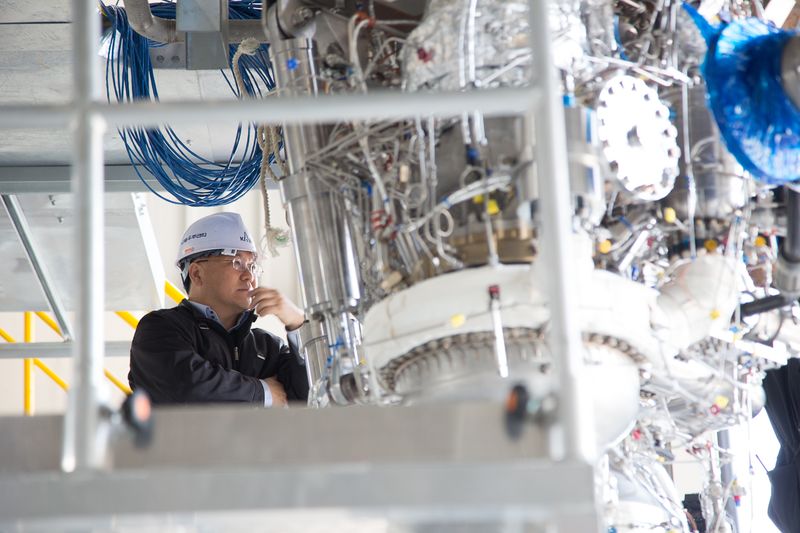
A single Nuri contains as many as 370,000 parts. About 6,500 parts are needed for just one 75-ton-class engine. The propellant tanks, made of aluminum alloy, are only 2–3 mm thick at their thinnest point. They must be lightweight yet withstand internal pressure and the loads imposed during launch. The tanks, engines, pipes and valves, stage-separation systems, and guidance and control systems must all be integrated so that the many parts work together precisely. This is called systems integration technology.
How did Korea acquire that expertise? The country’s launch-vehicle development began with research on scientific rockets in 1990. It launched its first solid-propellant scientific rocket in 1993 and succeeded in developing its first liquid-propellant scientific rocket in 2002. It then partnered with Russia to develop the space launch vehicle Naro-1 (Korea Space Launch Vehicle-1, KSLV-1). The design combined a Russian-built first-stage rocket with a Korean-developed second stage. After two failures, it successfully placed a satellite in orbit in 2013, but the critical first-stage engine still relied on Russian technology. Developing Nuri, with the aim of building everything from the engine to the entire launch vehicle ourselves, was a challenge to overcome that limitation.
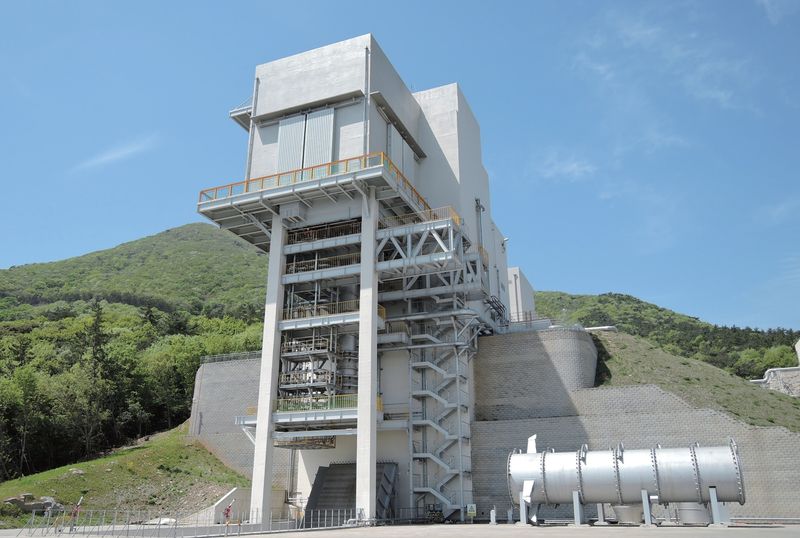
I followed Han to the engine test site. Scattered across the slopes of Naro Space Center were ground-level and high-altitude combustion test facilities for 75-ton-class engines, as well as test facilities for turbopumps and combustors. In the early days of the space program, Korea did not even have a facility for testing large liquid-propellant engines. Researchers approached other countries, but Europe demanded an enormous sum and the United States gave no answer. In the end, the researchers built the facilities themselves.
Han and 25 colleagues built the test site on land cleared by cutting into the mountain. They calculated the layout and safety distances to prevent damage to other test facilities and launch pads in the event of an explosion. Han stopped in front of the high-altitude combustion test facility. “This is the place. For a while, it appeared in my dreams every day. It was somewhere I couldn’t escape even in my sleep.”
■ Rocket technology built through failure
The place Han said he saw even in his dreams was where a 75-ton-class engine for Nuri’s second stage exploded on May 13, 2020. The explosion sent the pressure inside the chamber—which recreates high-altitude flight conditions—soaring. The rupture disk installed to protect the chamber burst in an instant, and the escaping gas blew off the roof. The cause was a tiny amount of moisture left in the ignition system. Particles formed there clogged a filter, preventing the ignition agent from being supplied properly. The researchers collected the scattered debris and spent the night tracing the cause.
Was that the most painful moment? Han said no. Even after an engine explosion, once the cause is found, countermeasures can be devised. What truly wrings you out is a problem whose cause you cannot even identify. A prime example was the many trials and errors during development of the 75-ton-class engine as the team struggled with combustion instability, in which pressure oscillations in the combustion chamber grew stronger.
7 p.m. on May 3, 2016. Han remembers the date and time vividly. It was the moment Korea successfully fired its self-developed 75-ton-class engine as a complete unit for the first time. The burn lasted only 1.5 seconds, but the combustor, turbopump, gas generator and valves finally operated together as a single system.
Completing the engine was not the end of the story. On Nuri’s first launch in October 2021, the third-stage engine shut down early, and the satellite mock-up failed to reach its target orbit. The cause was a problem with the mechanism securing a helium tank inside the oxidizer tank. The researchers reanalyzed the acceleration, vibration and cryogenic conditions experienced during actual flight and improved the design. The following year, the second launch finally succeeded in placing its payload into the target orbit. Starting with the third launch in 2023, Nuri carried actual satellites into space; on last year’s fourth launch, it carried 13 satellites.
Then, on the 7th, the fifth Nuri departed from Goheung. This launch completed the demanding mission of successfully placing five NeonSat nanosatellites for a constellation into their target orbit. A major achievement was not only launching precisely at the scheduled time but also demonstrating the ability to release multiple satellites with precision. Each satellite separation produces a slight reaction on the launch vehicle and changes its mass and inertia. The third stage must be precisely oriented to prevent the satellites from colliding with one another.
The five NeonSat satellites will join satellites added on next year’s sixth launch in a mission to repeatedly observe the Korean Peninsula. Once the full constellation is in place, it will be able to image the peninsula at least three times a day and revisit the same area within 24 hours. Its applications range widely, from monitoring wildfires and floods to land management and national security.
■ What it takes for the space industry to take off
After more than three decades of work, Korea has succeeded in developing its own space launch vehicle and is now preparing for the era of private-sector space transportation. The next step is to transfer to the private sector the technology behind Nuri, developed to date under the leadership of KARI, and build it into an industry. Hanwha Aerospace has overseen Nuri’s production as the systems integration company since the fourth launch. For the fifth launch, it also took on a substantial share of launch operations. Starting with next year’s sixth launch, the company is expected to assemble each stage of the launch vehicle at its own factory in Suncheon and transport them to Naro Space Center. This is the first step toward entering the commercial launch market.
But signing a technology-transfer agreement does not mean the private sector’s capabilities are immediately complete. Companies need more time before they can independently handle the entire process, from production and testing to launch. The same applies to the ability to change a design or devise a technical solution when something goes wrong, and to judge whether to proceed with or abort a launch if a problem arises during preparations. This is why closer cooperation between national research institutes and private companies is needed.
KARI is turning its attention to future technologies. Han said that proven production and launch operations technologies would be transferred to the private sector, while government research institutes would focus on developing high-risk, technically demanding technologies such as reusable launch vehicles and high-performance methane engines. But the challenge he stressed with even greater urgency was generating demand for launches. At least three to four launches a year are needed to maintain specialized personnel and production lines steadily, he said. According to KARI’s analysis, launching four or more times a year would bring launch costs down to 65% of their current level.
■ The world is competing for space supremacy
The global space industry is already undergoing major change. According to BryceTech, a space industry research firm, there were 325 orbital launches worldwide last year, up 25% from the previous year. Commercial launch providers carried out 87% of them. U.S. operators account for 60% of global launches. Rocket launches, once national events, are becoming an industry that regularly carries customers’ satellites into space.
U.S. company SpaceX has changed the economics of launch frequency and cost by recovering and reusing rocket first stages. It is also creating sustained demand for launches by building its own satellite communications network, Starlink. China, too, is rapidly catching up by combining state-led space development with technological competition among private companies. Global space competition is expanding beyond launch-vehicle technology into a contest for industrial supremacy encompassing satellite communications, Earth observation, navigation and national security.
Korea is also preparing for the next stage. Its goal is to develop a next-generation launch vehicle to follow Nuri as a reusable vehicle powered by methane engines, and to send a Korean lunar lander aboard a Korean launch vehicle in 2032. But reusable technology alone will not make the space industry grow. The key questions are how cheaply and how often rockets can reach space, and whether enough customers can be secured to use them. Many experts advise that the government must become a customer in the early market to make this happen.
The commercialization of the existing Nuri also needs to pick up pace. Han said it was urgent to lower production and operating costs to meet demand for a variety of satellites. Production processes also need to be simplified and measurement equipment optimized. Beyond transferring national technology, it will be up to companies to build a launch vehicle that customers choose in the global market.
The market outlook is bright. The World Economic Forum and McKinsey forecast that the global space economy will grow from $630 billion in 2023 to $1.8 trillion by 2035. They expect value to increase in fields that use satellite services, including logistics, agriculture, disaster response and defense. An ecosystem linking launch-vehicle and satellite manufacturing with data services is needed.
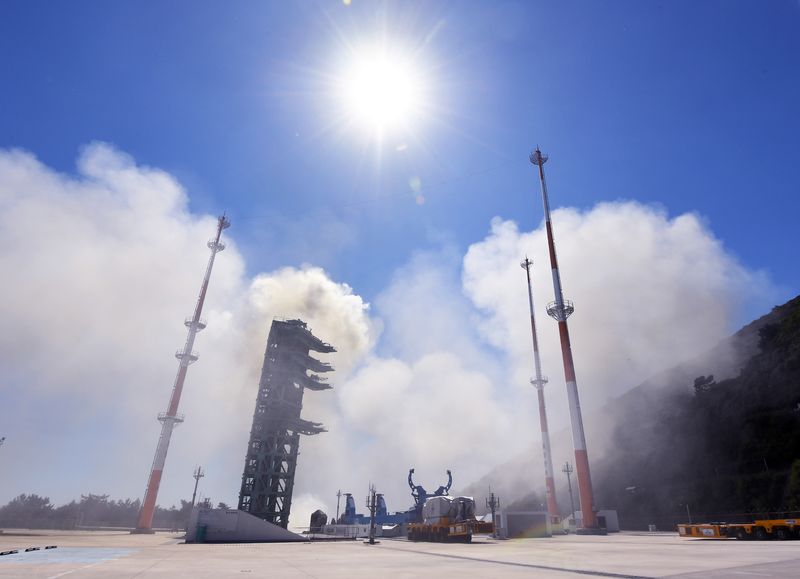
At the Second Launch Pad, the last stop on my visit, the traces of the flames Nuri left behind the day before were unmistakable. The once-white structures were blackened with soot, and the paint on the ground had melted in the intense heat and turned sticky. Pointing to the insulation that had protected the hydraulic equipment, Han said the protected area would be expanded for the next launch. Nuri had departed, but preparations for the next launch were already underway.