[Editorial] Hyundai to invest 20 trillion won in India, using it as a foothold to break into the market
- Input
- 2026-10-14 18:40:56
- Updated
- 2026-10-14 18:40:56
Hyundai Motor Group ranked third worldwide in vehicle sales in 2022 and has maintained its standing among the “Big Three” for four consecutive years. But having risen to the top tier globally has also brought fiercer competition and pushback. The biggest threat is China’s electric vehicles. China’s BYD is sweeping through global markets with EVs leading the charge. Backed by the Chinese government, which is seeking to offset weak domestic demand with exports, Chinese automakers are trying to increase their market share in Europe and other EV markets where they compete with Korean companies. Labor-management conflict is another challenge. Strikes disrupt production every year, while union obstruction has also wasted time and held up efforts to improve manufacturing processes.
These interrelated problems contributed to Hyundai Motor’s global sales of about 2.886 million vehicles from January to September this year, down 7.0% from a year earlier. Domestic sales plunged 16.3% to about 448,000 vehicles. This has not been seen in recent years. It is also a worrying sign that the auto industry, which has helped sustain exports alongside semiconductors, may be facing structural limits.
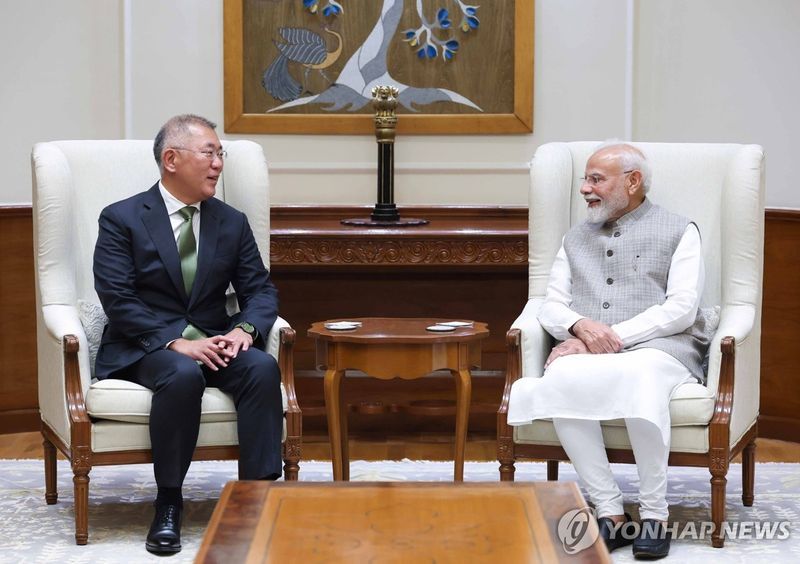
Reaching the top is difficult, but staying there is even harder. Hyundai Motor must not stop innovating if it is to firmly hold on to its place among the global top three. Alongside technological innovation, it must continually break into new markets. Chairman Chung’s decision to make a bold investment in India is part of this strategy.
To counter the challenge from Chinese EVs making inroads into overseas markets by aggressively pushing low-priced cars, Korea must respond with proactive investment. Pursuing localization strategies, including strengthening research facilities, is another way to survive cutthroat global competition.
The government must also respond thoroughly to changes in the trade environment. According to an analysis by the Korea Institute for Industrial Economics & Trade, after the Comprehensive and Progressive Agreement for Trans-Pacific Partnership (CPTPP) took effect, regional competitiveness indicators declined for 47.7% of the 5,185 Korean export items. Passenger cars (0.26→0.03) and electric vehicles (0.82→0.50) saw particularly sharp declines, the analysis said.
No matter how competitive Korea’s auto industry is, it cannot increase its share of overseas markets if it is blocked by tariffs in export destinations. But strong opposition from Korea’s agricultural and fisheries sectors has delayed the application to join the CPTPP. The government must quickly devise measures to mitigate the harm to domestic farmers and fishers and build social consensus to dismantle tariff barriers. When a crisis looms, the pace of innovation must quicken. Korea’s automotive success story can continue if businesses accelerate technological innovation and the government moves faster to find trade solutions.