“The AI Order Paradox” ... Warning that Doosan Fuel Cell Co., Ltd.'s financial risks are rising despite a 400 billion won capital raise [fn Market Watch]
- Input
- 2026-10-14 17:08:11
- Updated
- 2026-10-14 17:08:11
Lee Young-gyu, an analyst at NICE Investors Service, said in a report on the 14th that “the 400 billion won in hybrid capital securities Doosan Fuel Cell Co., Ltd. has decided to issue will help ease short-term liquidity risks, but is seen as a factor that will increase its actual debt burden in the short to medium term.”
He analyzed that “given the presence of a call option and interest rate step-up clauses, the hybrid capital securities scheduled for issuance this time are effectively debt-like,” adding that “the company’s financial risk could vary significantly depending on the profitability of future order projects and whether the conversion rights and warrants are exercised.”
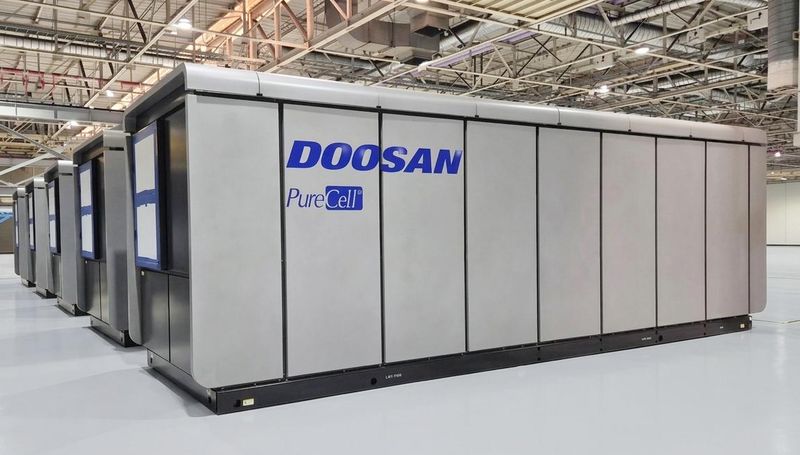
On the 13th, Doosan Fuel Cell Co., Ltd. decided to issue 300 billion won in perpetual convertible bonds (CBs) and 100 billion won in perpetual bonds with warrants (BWs). Of the funds raised, 300 billion won will be used for working capital, including the purchase of raw materials needed for its AI data center fuel cell business, while 100 billion won will go toward repaying existing borrowings.
The problem is that a sharp increase in large-scale orders does not translate into an immediate improvement in cash flow. Last September, Doosan Fuel Cell Co., Ltd. secured an order worth 823.6 billion won for a fuel cell project for a U.S. AI data center. However, the advance payment amounts to just 20% of the total contract value. The remaining 80%, or about 658.9 billion won, is structured to be collected mainly upon product delivery.
This means the company must finance the costs of purchasing raw materials and production itself until it manufactures and delivers the products. Even if it secures more orders in the U.S. market, its working capital burden could accumulate until deliveries and payment collections gain momentum.
Its financial structure is already deteriorating rapidly. Doosan Fuel Cell Co., Ltd.'s total borrowings on a standalone basis stood at 666.9 billion won at the end of June this year, up 122.2 billion won from 544.7 billion won at the end of last year. Over the same period, its debt ratio rose by 114.7 percentage points, from 221.5% to 336.2%, while its borrowing dependence ratio also increased from 45.3% to 49.7%.
Deteriorating profitability is also cited as a burden. Revenue in the first half of this year fell to 189.1 billion won from 228.2 billion won in the same period a year earlier. The operating loss widened from 12.4 billion won to 51.2 billion won over the same period. EBITDA also posted a loss of 78.4 billion won for the full year last year, followed by a loss of 30.9 billion won in the first half of this year. Doosan Fuel Cell Co., Ltd. currently has a BBB credit rating with a “Negative” outlook.
[email protected] Kim Hyeon-jeong Reporter