“Jobs are housing value” ... Developments built around living close to work are taking off among people in their 20s and 30s
- Input
- 2026-10-14 16:36:11
- Updated
- 2026-10-14 16:36:11
According to the Ministry of Land, Infrastructure and Transport and the Korea Real Estate Board on the 14th, people in their 20s and 30s accounted for 33.4% of nationwide apartment buyers in the first quarter of this year, up 4.8 percentage points from 28.6% in 2019. They are also playing a leading role in the housing market: people aged 30 and under made up 58.0% (8,266) of the 14,241 successful applicants nationwide in the first quarter of this year.
A notable characteristic of these younger generations is that they place the greatest importance on proximity to work when choosing a home. According to the Korea Gallup Research Institute’s “2026 Real Estate Trends,” the share of respondents who said they would consider the distance to work when choosing a home in the future was markedly higher among people in their 20s (58%) and 30s (47%) than among other age groups. As most employees in business districts and industrial complexes prefer efficient commutes, pent-up demand for developments close to workplaces is continuing to grow.
In fact, developments near major business districts with excellent access to workplaces have been seeing strong demand in housing subscription rounds.
According to the Korea Real Estate Board’s subscription portal, The Sharp Singil Central City, offered for sale in Seoul’s Yeongdeungpo-gu in April, closed with an average first-priority competition ratio of 31.8 to 1, benefiting from its location near the Yeouido Financial Business District and G Valley. The Sharp Songdo Granterre G5-6 Block, launched in Incheon’s Yeonsu-gu in May, also posted a high average competition ratio of 50 to 1, buoyed by the concentration of bio and IT companies in the Songdo International Business District. In the officetel market, developments in the Songpa area and near Dongtan Techno Valley have also performed steadily on the strength of their convenient access to workplaces.
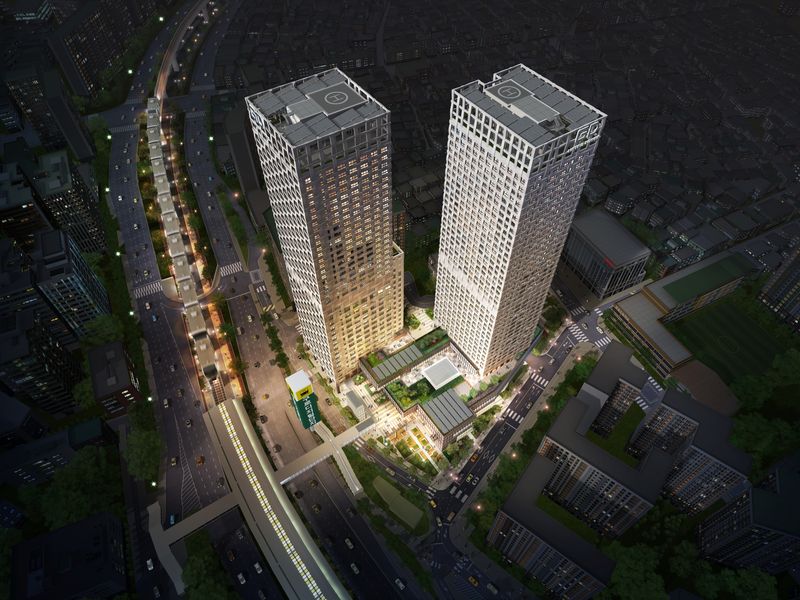
New developments near major business districts that will bring homes and workplaces closer together are drawing attention ahead of their October launches. BYC will launch GD Metro Tower in October on the former site of its headquarters in Seoul’s Yeongdeungpo-gu. The development will include 770 officetel units with exclusive areas of 24–53 sq. m., among other offerings. It is located near G Valley, Seoul’s largest center for the IT and software industries, and boasts a prime location directly connected to an entrance of Guro Digital Complex Station on Subway Line 2, maximizing commuting convenience.
Bando Construction plans to launch Gyeyang New Town Kaive Ubora in Gyeyang-gu, Incheon, in October, with 1,110 homes offering exclusive areas of 84–93 sq. m. The planned Gyeyang AX Park, which will be about 1.4 times the size of Pangyo Techno Valley, is expected to bring future benefits from proximity to workplaces.
Hanwha Corporation E&C Division will supply Hanwha Forena Jije Station in Segyo-dong, Pyeongtaek, Gyeonggi Province, with 1,098 homes offering exclusive areas of 84–116 sq. m. Key industrial hubs, including Samsung Electronics Pyeongtaek Campus, Godeok International New Town and Brain City, are located within a radius of the development, giving it access to strong demand from workers.
[email protected] Jeon Min-kyung Reporter