“Factor in future education needs” vs. “Can’t even spend the budget allocated”—head-on clash over education grant reform at parliamentary audit
- Input
- 2026-10-14 16:19:32
- Updated
- 2026-10-14 16:19:32
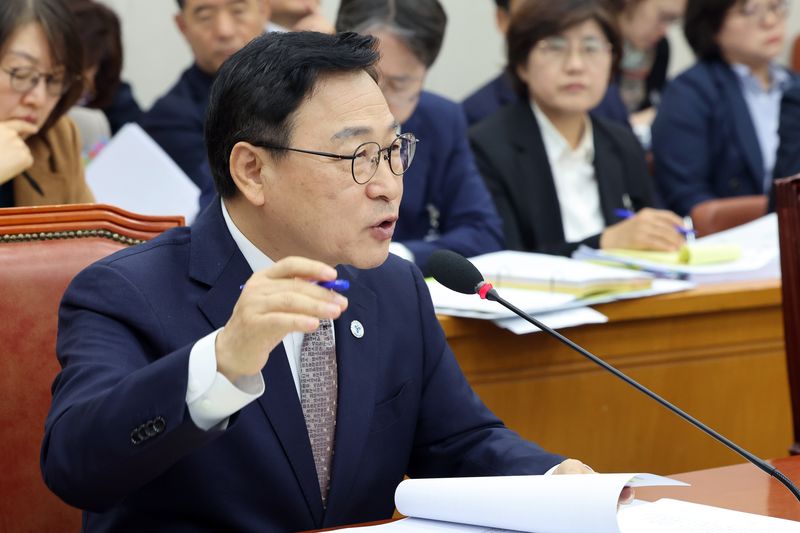
[Financial News] At a parliamentary audit on the 14th of the Seoul, Gyeonggi and Incheon Offices of Education, held by the National Assembly of the Republic of Korea’s Education Committee, ruling and opposition lawmakers clashed over the government’s proposed reform of the system linking the Local Education Finance Grant to domestic tax revenues, as well as the crisis in local education finances.
In his opening remarks before the audit began, Seoul Metropolitan Office of Education Superintendent Geun-sik Chung voiced concern about discussions on reforming the education grant system. “Please take particular care to ensure that the reform of the Local Education Finance Grant system now under discussion reflects not only changes in the school-age population, but also actual education costs and future education needs in a balanced way,” he said. “Even if the number of students falls, the value of each child’s life does not diminish. The responsibilities schools must shoulder—in guaranteeing basic academic skills, supporting mental health and special education, and improving aging facilities—are, if anything, growing.” He appealed for the need to secure funding.
Opposition lawmakers who questioned officials strongly criticized the government’s reform plan, arguing that changes to the education grant formula would inevitably cut funding for projects at local schools. People Power Party lawmaker Seo Beom-soo said, “Comparing allocations before and after the reform, based on 2027, budgets would fall by around 2.7 trillion won in Seoul, 7.4 trillion won in Gyeonggi and 1.6 trillion won in Incheon.” He asked, “Once essential recurring expenses such as personnel costs and school operating costs are budgeted for, won’t funding for programs that go directly to students inevitably be cut?” Superintendent Chung replied, “That’s right,” acknowledging that budget cuts would disrupt programs. Gyeonggi Superintendent of Education Ahn Min-seok also voiced opposition to the government’s proposed direction, saying, “The truth is, our situation is even more difficult.”
Seo also pointed to local governments declaring fiscal emergencies and moves to reduce the provincial government’s share of funding. “If local governments have less fiscal capacity, they will also have less capacity to invest in education, potentially jeopardizing key education policies, including the Gyeonggi Office of Education’s program to open school facilities to the public,” he said.
By contrast, lawmakers from the ruling Democratic Party of Korea countered by citing a lack of fiscal efficiency and poor budget execution. Democratic Party of Korea lawmaker Ko Min-jung criticized the argument, saying, “Claiming that a budget has been cut when it has not even been created yet is no different from reviewing a phantom budget.”
Democratic Party of Korea lawmaker Park Beom-gye also said, “Complaining about the budget while failing to properly use the funds transferred from local governments makes no sense.” He noted, “The Seoul Metropolitan Office of Education returned 84 billion won allocated to the Green Smart School project, and its construction start and completion rate is 34.5%, far below the 92.4% average for other education offices.”
Rep. Park said, “It is an obvious contradiction for superintendents to oppose grant reform in the name of improving aging facilities while failing to properly spend even the budgets they have been given,” calling on local education offices to reflect on their shortcomings. In response, Seoul Superintendent Geun-sik Chung said, “Some facility improvement projects were delayed, partly because of opposition from parents,” but added, “There are points raised that we need to reflect on.”
During the afternoon audit, lawmakers also raised pointed questions about major challenges facing education in Seoul and school safety, beyond the grant issue.
People Power Party lawmaker Jang Dong-hyuk raised the Seoul Metropolitan Office of Education’s policy to expand short-answer and essay-type assessments, expressing concern about the lack of preparation in schools and the burden of private education. “As of October 2026, do you think the preparations and conditions are sufficient to expand these assessments?” he asked. “When even preparing for the CSAT minimum-score requirements is so demanding that students are being pushed into private education, introducing short-answer and essay-type assessments before the teacher-student ratio and curriculum have been properly studied and established will drive students who cannot keep up back into the private education market and widen educational disparities between regions and schools even further.” He called for thorough pilot operation and preparation. Superintendent Chung replied, “The plan is to expand gradually from the current level of 30% to 40% next year,” adding, “We will prepare steadily and gradually so that disparities do not widen.”
Democratic Party of Korea lawmaker Ahn Gyu-baek then cited an audit by the Board of Audit and Inspection and strongly criticized the practice of “copy-pasting” student records. “It was found that 30–40% of all high schools copied and pasted the detailed abilities and special remarks section of student records in a uniform, formulaic manner,” he said. “Every student is a living being like a universe, and entering identical content in student records—the core of assessment—is a very serious problem.” Superintendent Chung explained that inadequate face-to-face instruction during the COVID period and other factors had contributed to the situation, but said, “Given that the Board of Audit and Inspection has raised the issue, we will carefully review the matter and ensure that follow-up measures are carried out.”
Criticism also continued over violations of teachers’ rights and school safety measures. People Power Party lawmaker Jeong Seong-guk brought up a knife-threat incident in the teachers’ office at Seoul A High School in May, criticizing the education office’s lax response. “There had already been two similar incidents in April before the incident, but they were simply classified as student self-harm behavior. And even after the student threatened to kill the head of academic affairs while holding a kitchen knife, no suspension was imposed for 20 days despite the victimized teachers’ repeated requests,” he said. Jeong demanded a thorough investigation and a report on countermeasures, asking, “With teachers trembling in fear, do you consider this an appropriate response?” Superintendent Chung bowed his head and said, “There were shortcomings in ensuring the safety of the affected teachers and immediately separating them from the student responsible.” He added, “The Seoul Metropolitan Office of Education will do everything possible and report the results of the investigation.”
[email protected] Kim Man-gi Reporter