"Guaranteeing Basic Services Such as Healthcare and Housing Is Central to a Basic Society in the AI Era"
- Input
- 2026-10-14 16:04:12
- Updated
- 2026-10-14 16:04:12
[Financial News] A citizens’ deliberative panel convened by the government said that guaranteeing basic services such as healthcare, housing, education and care should be a priority in responding to the social impact of the transition to Artificial Intelligence (AI). The panel broadly agreed that profits generated by AI should be returned to society and used to expand basic services and support job transitions, and that common assets and funds should also be established to prepare for future crises. The central pillars of a basic society are taking shape as basic services and a safety net for periods of transition (income security + job transition).
Kim Jeong-hun, chair of the Basic Society Public Deliberation Expert Committee, announced the results on the 14th at Government Complex Seoul. The deliberation involved 223 members of a citizens’ panel and was titled “Public Deliberation on a Basic Society in Response to the AI Transition.”
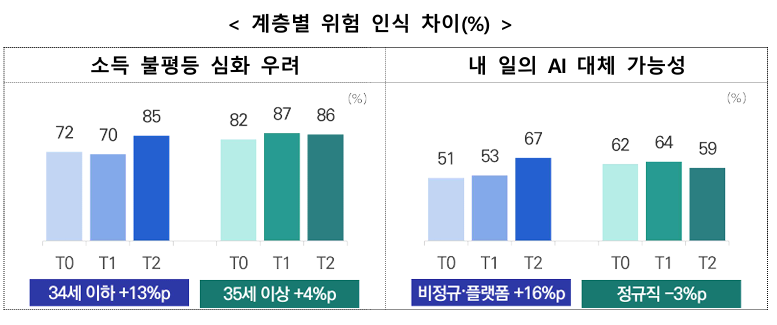
While 95% of the panel viewed the expanded adoption of AI positively, the share concerned that job opportunities for young people would decline rose from 86% before the discussions to 95% afterward. 90% said AI’s economic gains would be concentrated in some large corporations and platform companies, while 86% expressed concern that income inequality would worsen.
78% agreed that businesses and society should share responsibility for employment risks arising from the AI transition, and 93% agreed that companies’ responsibility to support retraining and job transitions should be strengthened.
Guaranteeing basic services such as healthcare, housing, education and care was chosen more often as a key priority for a basic society (60%) than guaranteeing basic income (42%). The services respondents said should be guaranteed first were healthcare (86%), housing (52%) and care (50%), in that order.
There were, however, differences by age group. While those aged 35 and older placed importance on basic income security (50%), those aged 34 and under put relatively more weight on stable jobs and opportunities for job transitions (28%), as well as technological innovation and new challenges (23%). Both age groups put support for basic services at around 60%.
Views on how to prioritize the use of AI-related funds also shifted over the course of the discussions. Before the discussions, support for vocational retraining and job-transition assistance was the most popular option (38%). Afterward, support for expanding basic services rose from 25% to 46%, making it the top choice. Support for establishing people’s common assets and a future-response fund also increased, from 14% to 30%.
The share of respondents who said temporarily generated additional resources should be accumulated in funds or common assets rose from 46% to 61%. The share who said returns on investments from common assets should be reinvested rather than distributed at present increased from 49% to 67%. There was strong support for using returns from public corporations, public assets and national investments to raise funds (98%), and for rationalizing tax exemptions and reductions and improving the efficiency of government programs (97%).
A total of 223 people aged 15 or older, recruited through random telephone-number sampling, took part in the deliberation. Of these, 102 were aged 15 to 34. The committee plans to prepare a policy proposal in November based on the deliberation’s findings. The scope of basic services and income security, as well as the size and management of the fund, has yet to be determined.
The committee plans to flesh out its policies through a Policy Agenda Planning Group comprising 44 people, including representatives of the deliberative panel and experts, and submit a policy proposal in November.
[email protected] Lee Bo-mi Reporter