EVs and villages to become power sources... Jeju secures KRW 9.8 billion in national funding for pilot projects
- Input
- 2026-10-14 15:27:34
- Updated
- 2026-10-14 15:27:34
【Financial News, Jeju = Jeong Yong-bok】 Jeju has secured KRW 9.8 billion in national funding to expand a pilot project that feeds electricity stored in EV batteries back into the grid and enables the shared use of electricity generated in villages.
According to Jeju Special Self-Governing Province on the 14th, it secured KRW 9.8 billion in national funding after being selected for both calls for proposals for distributed energy special-zone projects held by the Ministry of Climate, Energy and Environment in July and September this year.
Following its designation by the government as a distributed energy special zone in November last year, Jeju will now develop concrete plans to link energy production, storage and consumption by EVs, homes and villages.
Distributed energy is energy produced or stored and used near where it is needed, unlike electricity generated at large power plants and transmitted over long distances. Its potential is drawing attention in regions such as Jeju, where solar and wind power account for a large share of generation and output varies with the weather.
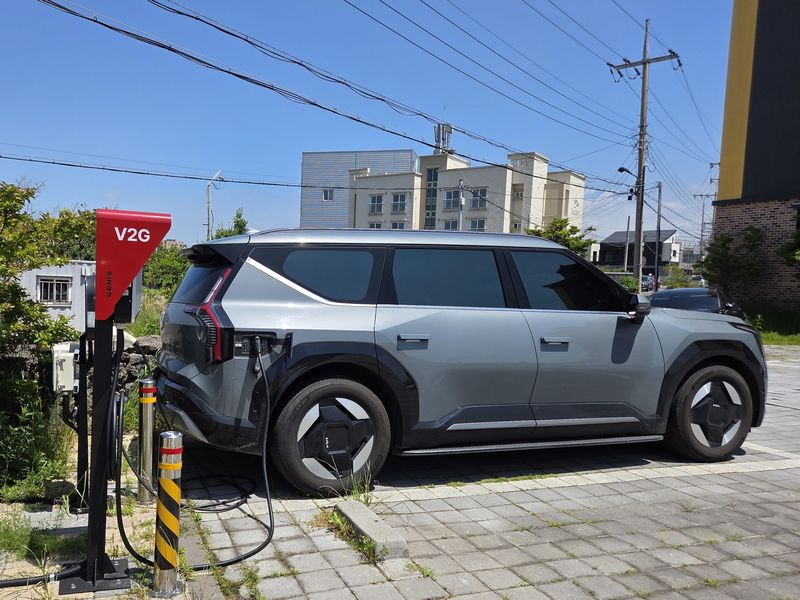
The first project being expanded is a demonstration of V2G (Vehicle to Grid), which connects EVs to the power grid. V2G is a technology that uses EV batteries as mobile energy storage systems. It charges vehicles when there is surplus electricity and, when demand rises, sends the stored electricity back to the grid to balance supply and demand.
Since December last year, Jeju Province has been running a V2G pilot project involving a total of 60 vehicles, including 20 SOCAR EVs and 40 vehicles owned by local residents.
Following the selection in this round of calls for proposals, Jeju will recruit 40 additional local residents to participate. If recruitment is completed as planned, the number of vehicles in the demonstration will rise to 100.
Eligible applicants are Jeju residents who own a Hyundai Ioniq 9 or Kia EV9 capable of bidirectional charging. Applications are expected to be accepted through the Jeju Provincial Government website for about a month starting in the fourth week of this month. V2G-specific chargers and other related equipment will be installed in selected vehicles, and the demonstration will be expanded from next year to enable participation in the electricity market.
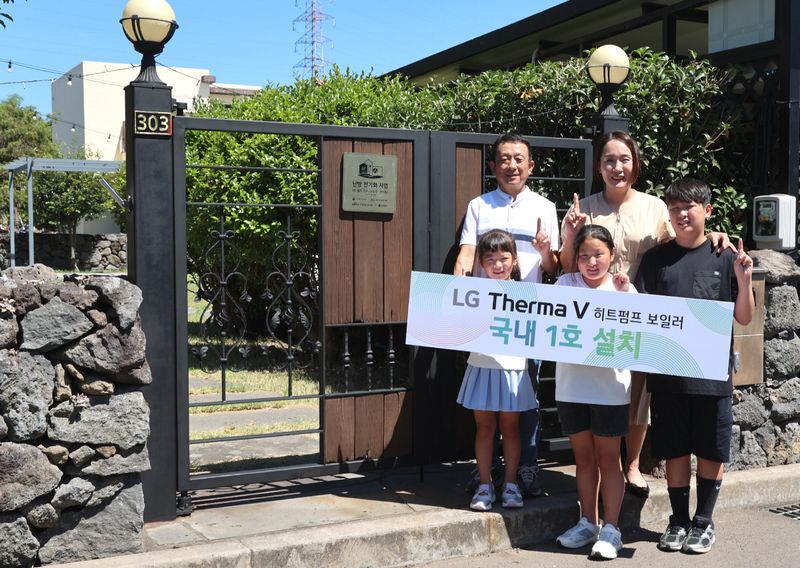
The second project, which will receive KRW 7.8 billion in national funding, aims to build a foundation for energy self-sufficiency in homes and villages. Jeju Province will select around 10 households participating in its existing home-heating electrification program and install energy management systems (EMS). An EMS monitors household electricity use in real time and efficiently manages heating and power consumption.
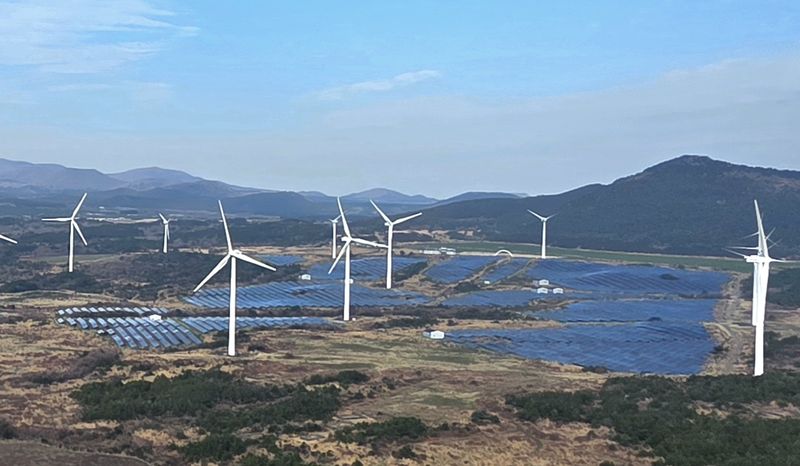
Shared solar power generation facilities will be connected to energy storage systems (ESS) on unused village land. The plan is to store electricity generated during the day for use when needed and to test a new distributed energy tariff that reflects patterns of production and consumption.
The province will also pursue a demonstration linking ultra-fast charging stations with non-lithium batteries designed for improved fire safety, as well as a virtual power plant (VPP) project that integrates and manages the electricity resources of smart farms. A virtual power plant links small-scale generation and storage facilities in multiple locations using information and communications technology, enabling them to operate as a single power plant.
The project is drawing attention because it addresses structural problems in Jeju’s power grid.
As solar and wind power generation has expanded, Jeju has imposed output curtailments during periods when electricity generation exceeds demand. This underscores the need for technologies that can store renewable electricity until it is needed or connect it to new sources of demand.
EV batteries and village energy storage systems can help ease this imbalance between supply and demand. Their actual impact, however, will depend on the amount of electricity that can be stored, grid operating conditions and the scale of participation.
Significant challenges remain before the technology can be commercialized. In a study published in July, the Korea Energy Economics Institute noted that while V2G has considerable potential, systems for deploying bidirectional charging equipment, regulations governing the return of electricity to the grid and user compensation frameworks are not yet sufficiently established.
Village-level tariffs also need to be tested to determine how the benefits of electricity generation and storage should be distributed among residents. Securing national funding and being selected for a demonstration project do not guarantee lower electricity bills or revenue from electricity sales.
Jeju Province plans to refine its energy-use models for EVs, homes and villages based on the demonstration results and expand their application.
Cho Seon-hui, head of Jeju Province’s Climate and Energy Bureau, said, “We are now able to apply a distributed energy model encompassing EVs, homes and villages in real-world settings,” adding, “We will develop a model that delivers tangible benefits to residents and businesses and expand it across Jeju Province.”
[email protected] Jeong Yong-bok Reporter