“With no apartment supply” ... Two months after group-loan restrictions were eased, balances at the five major banks turn lower
- Input
- 2026-10-14 18:15:14
- Updated
- 2026-10-14 18:15:14
[Financial News] Two months have passed since the government expanded the capacity for group lending through its Aug. 13 real estate measures, but outstanding group loans at the five major banks have instead started to decline. With nonbank financial institutions also competing for final-payment loans, and new apartment presales and urban renewal projects such as redevelopment remaining sluggish, the balance is expected to stay around last year’s level this year.
According to financial-sector data on the 14th, outstanding group loans at the five major banks—KB Kookmin, Shinhan, Hana, Woori and NH Nonghyup—stood at 149.5394 trillion won as of that day, down 212.7 billion won from 149.7521 trillion won at the end of September.
On Aug. 13, the government raised its target for managing the total volume of household loans from 1.5% to 3% and decided to manage group loans, including relocation, interim-payment and final-payment loans, separately. But group lending at the five major banks has nevertheless lost momentum. Their outstanding group loans rose by 1.0544 trillion won, from 148.2426 trillion won at the end of July to 149.297 trillion won at the end of August. The increase then fell to less than half, at 455.1 billion won in September, and the balance has turned lower this month.
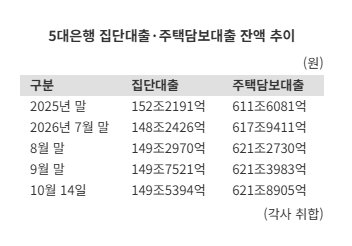
Mortgage lending, however, is increasing. Outstanding mortgage loans at the five major banks rose by 125.3 billion won, from 621.273 trillion won at the end of August to 621.3983 trillion won at the end of September. The balance stood at 621.8905 trillion won as of the 13th, showing an increase of 492.2 billion won so far this month.
Intensifying competition among financial institutions is cited as a reason for the slowdown in growth of outstanding group loans. After the Aug. 13 measures, group loans were to be excluded from management of the total household-loan volume, allowing not only banks but also nonbank financial institutions—including savings banks, specialized credit finance companies and mutual finance institutions—to join the lending competition. Seeking to acquire relatively high-quality collateral-backed loan assets, nonbank lenders are competing on interest rates and loan terms, making it harder for the five major banks to secure final-payment loan business as they did before.
In particular, if a bank that provided interim-payment loans fails to secure the final-payment loans as well, outstanding group loans may fall as existing loans are repaid. Some banks handle interim-payment loans on a project-by-project basis, but more financial institutions take part in final-payment lending when residents move in.
Although move-ins to large apartment complexes are scheduled for year-end, it is uncertain whether outstanding group loans will increase. A banking-sector official said, “Final-payment loans largely involve repaying and converting existing interim-payment loans, so their effect on increasing total outstanding loans across the banking sector is limited.” The official added, “New loan demand is generated by interim-payment loans for newly presold developments or relocation loans for redevelopment and reconstruction projects.”
The problem is that there are few new development projects. With new presales and urban renewal projects stalled amid a construction downturn, analysts say it is difficult to significantly increase outstanding group loans simply by converting existing loans into final-payment loans. For this reason, financial institutions expect the balance of group loans at the end of this year to remain around the level at the end of last year, 152.2191 trillion won.
A commercial-bank official said, “Group loans grow when new presales or redevelopment and reconstruction projects are active.” The official added, “With the housing construction market sluggish, it will be difficult for outstanding group loans to rise significantly by year-end.”
[email protected] Seo Ji-yoon Reporter