Lee: “A major shift in population policy ... the socioeconomic system must be fundamentally redesigned”
- Input
- 2026-10-14 15:32:48
- Updated
- 2026-10-14 15:32:48
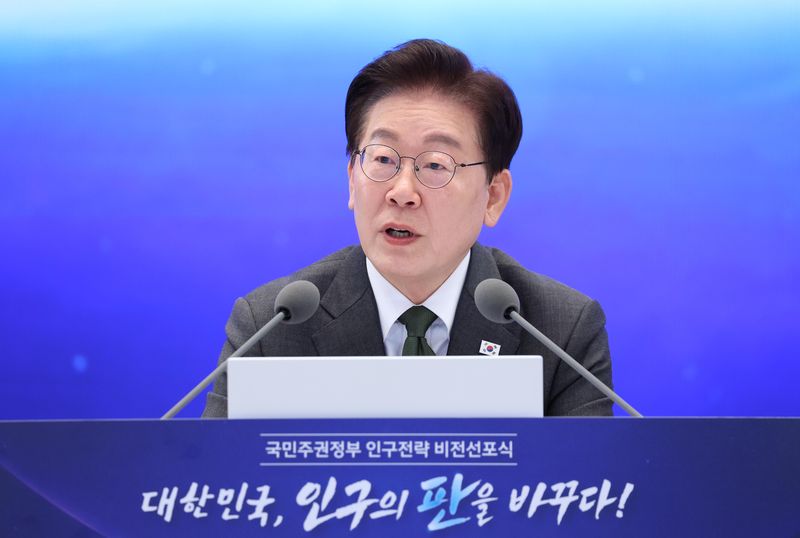
[Financial News] President Lee Jae-myung said on the 14th that “South Korea’s entire socioeconomic system must be fundamentally redesigned to adapt to demographic change.” The government unveiled its first National Population Strategy Basic Plan, shifting the population policy’s flagship goals from birth indicators to life satisfaction and labor force participation, and encompassing support for childbirth, housing for young people, and care for older adults. The plan aims to improve quality of life and social sustainability alongside raising the birth rate.
At the Population Strategy Vision Declaration Ceremony of the National Sovereignty Government, held that day at the guesthouse of Cheong Wa Dae, Lee said, “Issues of quantitative growth, such as the birth rate and population size, are important. But in addition to that, I think we now need a major shift in population policy that pursues qualitative growth.”
Regarding policy responses over the past 20 years, he said, “Successive governments have expanded various institutional foundations to address low birth rates and population aging, and have invested enormous amounts of public funding accordingly.” Yet he assessed that “population problems seem instead to be growing increasingly complex and deepening into structural problems.”
Lee said, “I believe the population problems we face are comprehensive social problems brought about by a traditional environment in which individuals are responsible for childcare and child-rearing, anxiety about the future, a lack of opportunities, and disparities that concentrate even the few opportunities available in the hands of a small number of people.” He added, “I think that only when there is hope that, wherever we live and whoever we live with, my family and I can grow and be happy together will a starting point emerge for easing and resolving the population problems we face.”
On the direction of policy, he stressed, “The population policy we create must also be a labor policy, a welfare policy, an employment and housing policy, and a childcare policy.” He called for “comprehensive measures that cover issues of marriage, childbirth and child-rearing while further strengthening the state’s responsibility for care and qualitatively improving working conditions.”
On recent changes in population indicators, he said, “The number of births has rebounded for two consecutive years,” adding, “Statistics from January through July this year show that the number of marriages rose 6.1% from the previous year, and surveys show an increase in the share of people saying they intend to marry or have a child.” He added, “I think this is a very welcome development, and it seems important to ensure that this trend continues going forward.”
Lee said, “With the historic transformation known as the artificial intelligence revolution upon us, I think this has become an opportunity to redesign systems across our society, including industry and jobs, education and care.”
According to the basic plan released by the Population Strategy Committee, titled “Beyond Generations and Boundaries: A Korea Leaping Forward Together,” life satisfaction will rise from 6.6 points last year to 7.0 points in 2030, while the labor force participation rate will increase from 71.8% to 74.0%. The plan will pursue 117 basic tasks and seven challenge initiatives under three strategies: “mitigation, adaptation and leap forward.”
The Child Welcome Support Grant will provide 10 million won for a first child, 12 million won for a second, and 15 million won for a third or subsequent child, with up to 20 million won available in regions receiving preferential support. The basic child allowance will be 200,000 won per month, with an additional 100,000 won per month in those regions and an additional 300,000 won per month for home care of children aged 0 to 1. Artists, workers in special employment, freelancers and sole proprietors will receive a childcare allowance of 500,000 won per month for three months.
The government will supply 571,000 public housing units for young people, newlyweds and families raising children. It will introduce the Youth Future Bogeumjari Loan, offering an interest-rate reduction of up to 2.1 percentage points to young people aged 39 or younger who are buying a non-apartment home costing no more than 400 million won for the first time. Newlywed policy loans will also be available if only one spouse meets the income requirement.
The distinction between births “within marriage” and “outside marriage” will be removed from birth registration forms, and the registration process for unmarried fathers will be improved. The government will also consider a birth registration system for foreign-national children born in South Korea and childcare fee support for foreign-national infants and young children. The number of public guardians for people with dementia will rise from 300 this year to 1,900 by 2030, and 25,000 age-friendly housing units will be supplied over five years.
Starting next January, ministries will consult the Population Strategy Committee in advance on population-related budget programs, and a population impact advance notice system will be introduced to publish projections of demographic change and their effects. The basic plan is to be finalized after public input and revisions, followed by deliberation and approval at vice-ministerial and Cabinet meetings.
[email protected] Seong Seok-woo Reporter