NPS Chairman Kim Seong-ju: “If rebalancing had not been deferred, 800 billion won would have had to be sold per day” [2026 parliamentary audit]
- Input
- 2026-10-14 15:02:27
- Updated
- 2026-10-14 15:02:27
[Financial News] It was explained that the scale of sales would have been astronomical had the National Pension Service not deferred rebalancing. The key measure in the deferral last May was to expand the permitted range for strategic asset allocation (SAA) in domestic stocks from the previous ±3 percentage points to ±6 percentage points, raising the maximum possible holdings ratio to 28.8%.
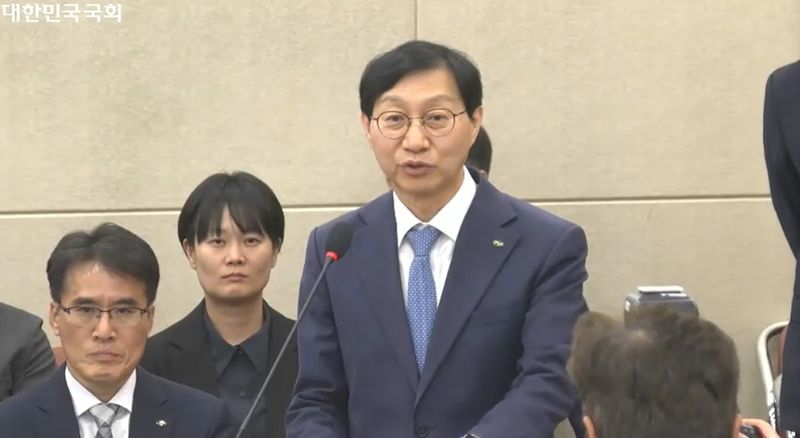
At a parliamentary audit by the Health and Welfare Committee on the 14th, National Pension Service Chairman Kim Seong-ju said, “If rebalancing had not been deferred, large-scale selling would have been unavoidable, and the profitability of the National Pension Fund would have fallen. We would have had to sell 800 billion won a day. That is equivalent to 10% of the KOSPI index.”
Nam In-soon of the Democratic Party of Korea (DPK) stressed, “I understand that the experts’ meeting was also held eight times at the time.”
That day, Baek Jong-heon of the People Power Party said, “The National Pension Service raised its target allocation to domestic stocks. The minutes are to be made public in 2030, which means the public will only find out how their retirement funds are being managed four years later.” The lawmaker added, “I call on the DPK to submit the minutes at the standing committee level. If it does not, the only option left is a parliamentary investigation. The People Power Party will not shy away from it.”
People Power Party lawmaker Lee Dal-hui said, “After President Lee Jae-myung remarked at a press conference marking his 100th day in office on September 11, 2025, that ‘it is strange that domestic pension funds have a low proportion of their investments in domestic stocks,’ Chairman Kim said at the Ministry of Health and Welfare’s policy briefing on December 16, 2025, ‘I am looking to change the investment guideline criteria somewhat.’ This is evidence of political power intervening in the National Pension Service.” The lawmaker also claimed, “With President Lee having called on the public to enter the stock market, the National Pension Service failed to realize 250 trillion won in gains.”
The lawmaker stressed, “Because of the rebalancing deferral, the National Pension Service did not sell even when it exceeded the limit, and suffered valuation losses of 124.8 trillion won over the month of July. Foreign investors took profits and all left. The National Pension Service of the Republic of Korea has even earned the nickname ‘ATM’ overseas.”
In response, Seo Young-seok of the Democratic Party of Korea said, “If making the minutes public would interfere with the National Pension Service’s fair conduct of its work, they are released four years later following a vote. This is a principle established by the National Assembly in 2013—a principle tied to market stability.” He added, “Making public important decisions that move the market would affect financial-market stability, undermining ongoing investment strategies and the independence of National Pension Service fund management.”
The National Pension Fund Operation Committee decided that the deliberations over the National Pension Service’s decision to expand domestic investment would not be made public until 2030. Under Article 103-2 of the National Pension Act, matters that could hinder the fair performance of fund-management duties or potentially affect financial-market stability are disclosed four years later, following a resolution by the National Pension Fund Operation Committee.
The National Pension Service appears to have delayed disclosure of the portfolio review item as it could also reveal the service’s future policy direction and the investment strategies of its Fund Management Headquarters. In 2021, when the National Pension Service raised the strategic asset allocation (SAA) limit and lowered the tactical asset allocation (TAA) limit, the minutes of the National Pension Fund Operation Committee were also kept confidential for four years.
[email protected] Kang Gu-gwi Reporter