Former Presidential Security Service Chief Park Jong-joon Sentenced to One Year in Prison on Appeal for ‘Secure-Phone Evidence Destruction’; First-Trial Acquittal Overturned
- Input
- 2026-10-14 15:03:37
- Updated
- 2026-10-14 15:03:37
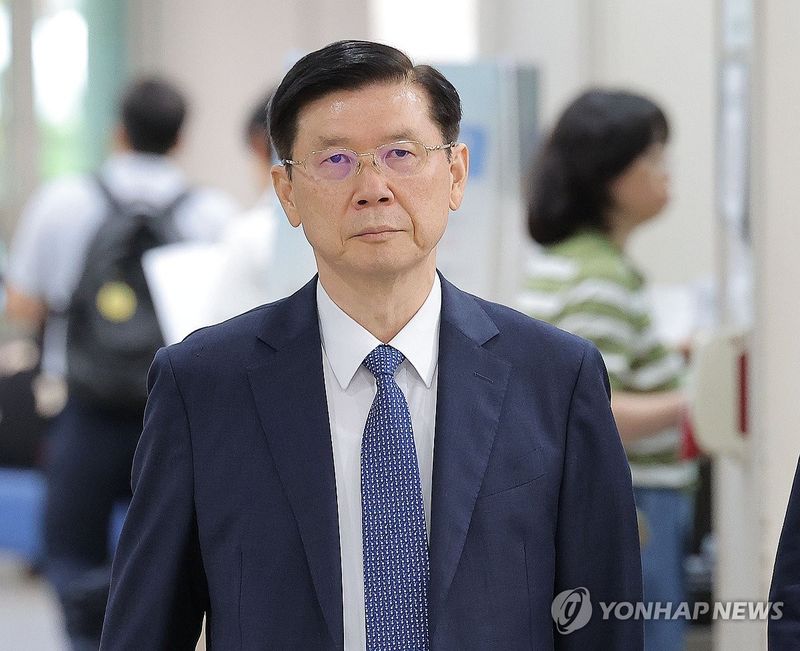
[Financial News] After the Dec. 3 emergency martial law, Park Jong-joon, the former chief of the Presidential Security Service, who was indicted on suspicion of deleting secure-phone accounts belonging to former National Intelligence Service First Deputy Director Hong Jang-won and others and acquitted at his first trial, was sentenced to one year in prison in the appeals court.
On the 14th, a panel of Seoul High Court’s Criminal Division 12-2, comprising High Court Judges Jo Jin-gu, Kim Min-a and Lee Seung-cheol, overturned the first-trial acquittal and sentenced Park Jong-joon, the former chief of the Presidential Security Service, to one year in prison on charges of destroying evidence.
Park was indicted in December last year on suspicion of remotely deleting, on Dec. 6, 2024, secure-phone data belonging to former President Yoon, former deputy director Hong, former Seoul Metropolitan Police Agency Commissioner Kim Bong-sik and others.
The Seoul High Court panel overturned the first-trial acquittal and found Park guilty of the entire charge of destroying evidence. The first-trial court had acquitted him, saying the evidence submitted by the special counsel alone was insufficient to establish either that the accounts had been deleted or that he had intended to destroy evidence.
The appeals court panel said, “The lower court’s ruling contains an error of law that affected the outcome because it misapprehended the facts or the law,” adding, “We accept the special counsel’s appeal and overturn the lower court’s ruling.”
The panel found that electronic information, including call records on the Presidential Security Service’s secure-phone devices used by former Commissioner Kim Bong-sik, former First Deputy Director Hong Jang-won and former President Yoon, constituted “evidence” under the Criminal Act’s offense of destroying evidence, and that Park was aware of this. The panel noted, “It has been confirmed that former Commissioner Kim called former Defense Minister Kim Yong-hyun and former President Yoon on a Presidential Security Service secure phone around the declaration of martial law,” adding, “Through the gathering at the safe house in Samcheong-dong, the process of controlling the National Assembly and, among other things, a lunch with former President Yoon on Dec. 4, the defendant knew or could have expected that secure phones were actually being used as a means of communication.”
The panel also rejected the defense’s claim that the defendant “did not know the consequence of the deletion—the deletion of electronic information—and had no intent to do so.” It found that a department head surnamed Kim under the Presidential Security Service’s Support Headquarters had submitted a report to Park about deleting electronic information after staff had tested the process.
The panel also found that Park had conspired with former National Intelligence Service Director Cho Tae-yong. It ruled, “Former Director Cho treated Hong’s loss of contact and unknown whereabouts as established facts, providing a pretext for a security incident, and the defendant approved the deletion on that basis,” adding, “He deleted electronic information from the secure phones of Kim Bong-sik and Yoon Suk Yeol and, in conspiracy with former Director Cho, deleted electronic information from Hong’s secure phone, thereby destroying evidence in the criminal insurrection case.”
The panel said, “The defendant was in a position to oversee the Presidential Security Service’s operations and direct and supervise the entire organization,” adding, “He negatively affected efforts to uncover the substantive truth surrounding the emergency martial law and impeded the exercise of the state’s criminal justice authority, making legal accountability commensurate with his responsibility unavoidable.”
In its closing arguments last month, prosecutors sought a three-year prison sentence. The panel considered it a mitigating factor that Park did not appear to have actively ordered or led the deletion of user accounts, as well as the fact that he had served diligently for about 30 years in public service related to policing and security.
[email protected] Lee Chang-hoon Reporter