National Defense Committee sets aside scrutiny of Hanwha-KAI takeover battle for now; tougher M&A security reviews could be a wild card
- Input
- 2026-10-14 15:16:35
- Updated
- 2026-10-14 15:16:35
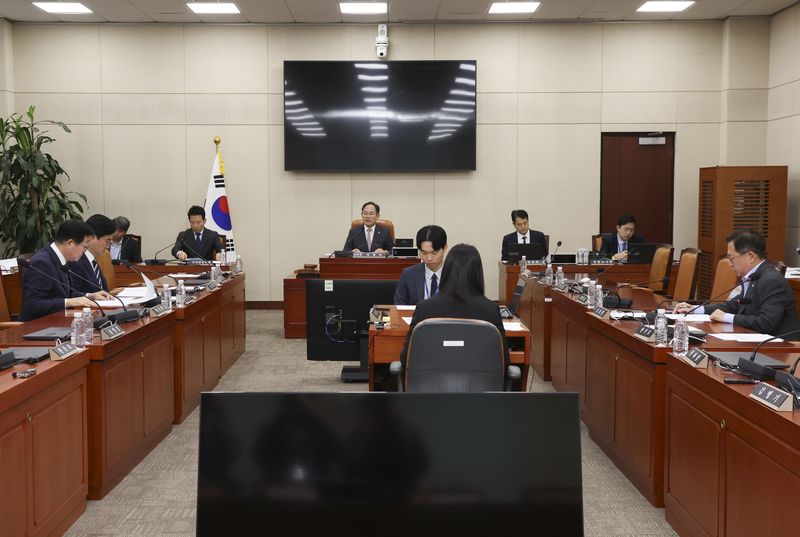
The National Defense Committee held a plenary meeting on the 14th and approved the selection of additional witnesses for the parliamentary audit. Kim was not included on the additional witness list that day. His selection as a witness had initially been considered to clarify the possibility of Hanwha taking part in KAI’s management following an increase in its stake, as well as its plans going forward. However, the ruling party’s policy of minimizing the selection of business leaders as witnesses, along with the fact that lawmakers from both sides had yet to settle on a position regarding Hanwha’s bid to acquire KAI, appears to have influenced the decision.
Hanwha Group currently holds a combined 15.89% stake in KAI—through Hanwha Aerospace (9.90%), Hanwha Systems (4.98%) and Hanwha Aerospace USA (1.01%), among others—making it the second-largest shareholder. KAI’s largest shareholder is the Export-Import Bank of Korea, which holds a 26.41% stake. Hanwha has cited strengthening its competitiveness in the aerospace sector, among other reasons, to justify the acquisition. KAI and its labor union, by contrast, have pushed back, saying that concentrating defense capabilities in a single company could weaken competition and limit supply-chain choices. The future direction of the Export-Import Bank’s stake and the government’s policy decisions are seen as key variables in the future control structure.
The previous day, the possibility of Hanwha acquiring KAI also came under scrutiny during the National Defense Committee’s audit of the Defense Acquisition Program Administration (DAPA). Chun Ha-ram, a Reform Party lawmaker, said that if Hanwha were to acquire KAI as well, monopolization of the domestic defense market could intensify. Chun Jun-ho, a Democratic Party lawmaker, also called for medium- and long-term plans to be reviewed and drawn up, taking into account the impact that changes to KAI’s governance could have on the defense industry ecosystem.
DAPA Commissioner Lee Yong-cheol said, “I 100% agree that this needs to be examined very closely from a national security perspective, especially with national interests at the forefront.” However, he said that bargaining power in project management and supply-chain risks should be considered alongside the possibility that economies of scale could improve international competitiveness. Asked about Hanwha acquiring management control, Lee replied, “This is not the stage to offer an opinion at this point,” and explained that the government has yet to decide its policy on privatizing KAI.
Meanwhile, on the 13th, Kim Byeong-ju, the Democratic Party’s ranking member on the National Defense Committee, introduced as the lead sponsor an amendment to the Defense Acquisition Program Act that would strengthen security reviews of acquisitions of control over defense companies. The bill would require the Minister of Trade, Industry and Energy, before approving the acquisition of managerial control of a defense company, to consult not only the DAPA commissioner but also the Minister of National Defense.
In particular, the bill would prohibit approval if the Minister of National Defense or the DAPA commissioner submits an opinion expressing concern that the acquisition could seriously impede national security, the protection of military secrets, or the implementation of defense policy. The aim is to give the views of the country’s lead defense-industry authorities legal force and establish an effective veto. Kim stressed that defense companies need to meet stricter requirements, saying, “The Fair Trade Commission’s review of restrictions on competition alone cannot assess the ripple effects that defense M&A could have on national security and military operations.”
[email protected] Kim Hyeong-gu Reporter