“A Robot with a 99% Success Rate Is Useless”... Inference Efficiency and Reliability Are Key to Commercialization
- Input
- 2026-10-14 15:40:08
- Updated
- 2026-10-14 15:40:08
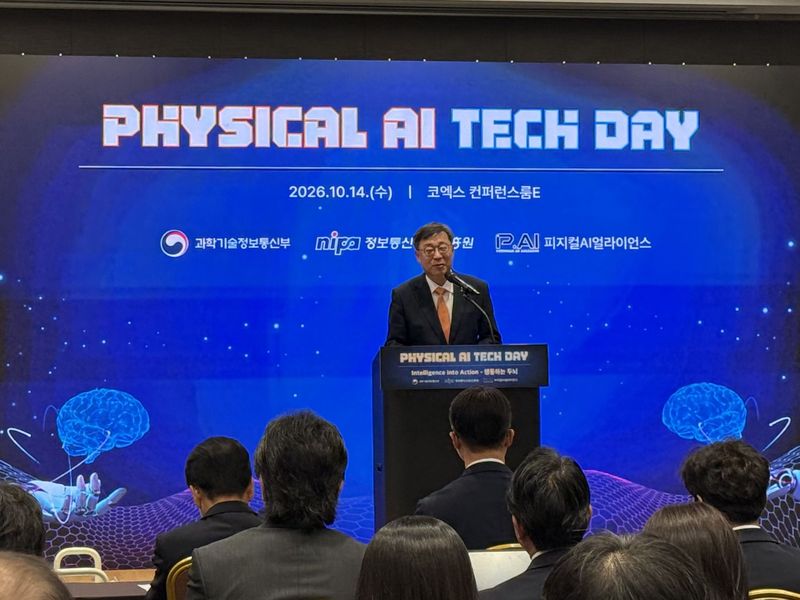
[Financial News] As artificial intelligence (AI) expands into the physical world, inference infrastructure and accuracy are emerging as key technologies that will determine the success of commercializing general-purpose robots. Analysts say that no matter how sophisticated a robot’s brain becomes, it will be difficult to deploy in industrial settings unless it can process vast amounts of data in real time and operate reliably in unpredictable environments.
At the Physical AI Tech Day held on the 14th, hosted by the Ministry of Science and ICT and organized by the National IT Industry Promotion Agency (NIPA), experts from Korea and abroad discussed technologies for improving AI inference efficiency and ways to ensure robot reliability. The event was held under the theme “A Brain in Action.”
Advancing robot brains depends on inference infrastructure efficiency
In his keynote address, Jeon Byeong-gon, CEO of FriendlyAI, stressed that realizing general-purpose humanoid robots requires not only high-performance AI models but also inference infrastructure capable of running them efficiently. “This is the year of agents,” Jeon said. “We need a frontier-level model to build a robot’s brain.”
He also noted that the technical foundation for building robot intelligence is expanding as the performance of open models—recently made publicly available for anyone to use—improves rapidly. “Open models with strong performance relative to cost are emerging on benchmarks that evaluate software development capabilities,” Jeon said, adding, “Chinese models largely dominate the competitive landscape, and, unfortunately, there are no Korean models.”
Jeon also identified the growing memory burden from data processing as AI agents become more sophisticated as a challenge. Unlike conventional chatbots, AI agents perform tasks in multiple steps and repeatedly use the results of previous runs. A coding agent, for example, may receive about 116,000 tokens of input for a single task, while producing just 184 tokens of output, meaning the volume of input data it must process is enormous.
“The longer the context gets, the more memory it uses, making it difficult to process many agents at once,” Jeon said. “The next step is figuring out how to build a robot’s brain so it can think and move, and I think we’ll encounter the same problem in that process.” He emphasized the importance of technologies that improve inference efficiency, such as managing the “key-value (KV) cache,” which stores the results of previous computations, and “sparse attention,” which selectively processes only the information needed.
A 99% success rate is not enough... Robot reliability is key to commercialization
In the following keynote, Professor Sangbae Kim of the Massachusetts Institute of Technology (MIT) in the United States identified high reliability and access to physical data as key challenges to commercializing physical AI. He explained that, unlike “virtual intelligence,” in which AI processes digital data such as text and images, physical AI requires physical data—such as force, touch, and contact between objects—that is difficult to obtain from the internet.“A language model with a 99% success rate is excellent, but a robot with a 99% success rate is useless,” Professor Kim said, emphasizing that “mistakes are hard to tolerate in the physical world.” Robots require a high level of reliability because their results can vary depending on the condition of an object or the surrounding environment, even when performing the same action.
Comparing autonomous driving with “manipulation,” the robot technology for handling objects, he noted that data alone is not enough to realize general-purpose robots. Autonomous driving has the relatively clear goal of reaching a destination, whereas robots need to make different decisions and apply different controls at each step of grasping, moving, and putting down an object. “End-to-end approaches operate like black boxes, making it difficult to identify and correct the causes of errors,” Professor Kim said. “We need a system architecture that can analyze, understand, and verify robot actions, and correct errors.”
Government: “We must go beyond technology demonstrations and transform industrial structures”
The government plans to strengthen support across industries to expand the adoption of physical AI in industrial settings. “We will actively support industrial applications and wider adoption so that outstanding technologies do not remain in research and development, but lead to on-site demonstrations and commercialization,” said Ryu Jemyoung, Second Vice Minister of Science and ICT.
“Now is the time to move beyond physical AI demonstrations and bring implementation to the forefront,” said Park Yun-gyu, president of NIPA. “What will matter as a source of competitiveness is not how widely AI has been adopted, but how fundamentally it has changed the way we work and the structure of industry.”
Park added, “We must build on our world-class manufacturing capabilities, outstanding AI technologies, and extensive industrial base to expand the use of physical AI and translate it into stronger industrial competitiveness and tangible results. NIPA, too, will actively support domestic companies in enhancing their competitiveness in global markets.”
[email protected] Choi Hyerim Reporter