Land Minister Hong Ji-seon reiterates push to speed up housing supply, visits youth purchase-rental housing in Mapo
- Input
- 2026-10-14 14:17:04
- Updated
- 2026-10-14 14:17:04
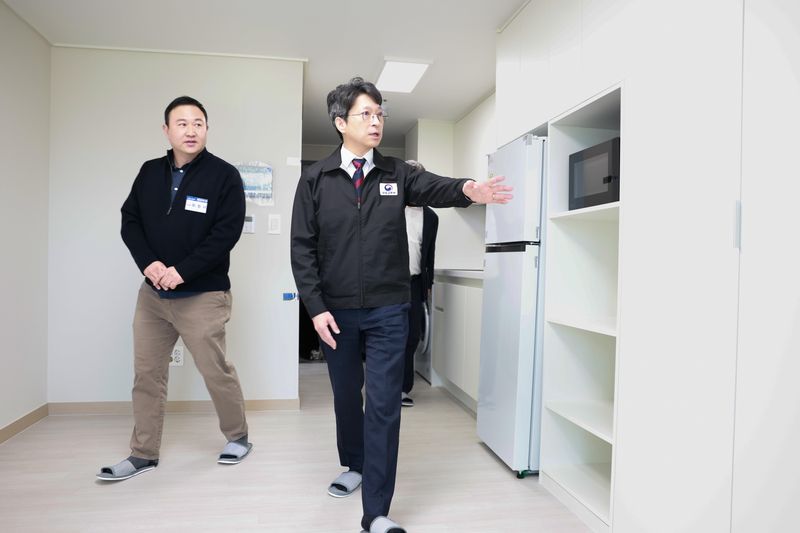
[Financial News] Hong Ji-seon, Minister of Land, Infrastructure and Transport, inspected a youth purchase-rental housing site and once again stressed the need to speed up housing supply.
According to the Ministry of Land, Infrastructure and Transport on the 14th, Hong Ji-seon visited a newly built purchase-rental housing site in Seongsan-dong, Mapo-gu, Seoul, that day to review the supply situation. It was his third on-site inspection, following visits to Bucheon Daejang District (a third-generation new town) on the 22nd of last month and a private-sector project site in Godeok-Gangil, Seoul, on the 8th.
Hong said, "The speed of supply is more important than anything else to stabilize the jeonse and monthly rental market," and called on Korea Land and Housing Corporation (LH) to meet all its targets for construction starts and purchase agreements within the year. He also signaled that he would personally monitor whether the supply measures announced in May and August translate into actual housing units.
The complex was completed in one year and seven months after a purchase agreement was signed in November 2024 and construction began in March 2025. It has 132 units on a 1,698.3-square-meter site. It is 450 meters from Gajwa Station on the Gyeongui–Jungang Line, and Mapo-gu Office Station on Line 6 is also about a 10-minute walk away. The Ministry of Land, Infrastructure and Transport said that the area has steady demand from young people because Yonsei University, Hongik University and Myongji University are nearby, and that the homes can be rented at prices below the surrounding market rates, helping young people secure stable housing.
After receiving a briefing from LH on this year’s construction-start and purchase-agreement results and the supply schedule through year-end, Hong toured units nearing occupancy and personally inspected their layouts, finishes and storage space. He urged LH and other officials on the ground to "meet the targets for construction starts and purchase agreements planned through year-end without a hitch, and ensure homes are supplied quickly so residents can live comfortably."
He struck a cautious note on the housing supply market. Hong said, "Housing permits and construction starts are increasing, particularly in Seoul, but the impact is not yet being felt across the capital region." He added, "We will further accelerate the process so that permits lead to construction starts, and construction starts lead to occupancy."
He described newly built purchase-rental housing as "an important policy tool that uses private-sector capabilities to supply homes in urban areas in a relatively short period, while enabling the public sector to use them as rental housing." Through the "Supplementary Measures for the Supply of Purchase-Rental Housing" on May 22 and the "Measures for the Rapid Supply of Housing" on August 13, the government introduced measures to boost private-sector participation, including expanding acquisition tax reductions and improving the price calculation method. Hong stressed, "We will now manage the implementation of these policy improvements and address difficulties on the ground so that they lead to an actual increase in housing supply."
Purchase-rental housing is also a supply measure that accounts for a large share of the planned housing supply in the Housing Stability Plan announced by the government on the 21st of last month. In the plan, the government set a target of supplying 1.19 million public housing units from 2026 to 2030 and outlined tailored supply measures for different groups. Of these, 890,000 are public rental units: 350,000 construction-rental units, 310,000 purchase-rental units and 230,000 jeonse-rental units.
Hong said, "Supplying a large number of homes alone is not enough to ensure housing stability for young people. We must provide homes in places where young people actually want to live, and where they can live with peace of mind."
[email protected] Jeong Gyeong-su Reporter