AI accelerates manufacturing innovation... POSCO Future M lays groundwork for an “AI-native” system
- Input
- 2026-10-14 14:58:58
- Updated
- 2026-10-14 14:58:58
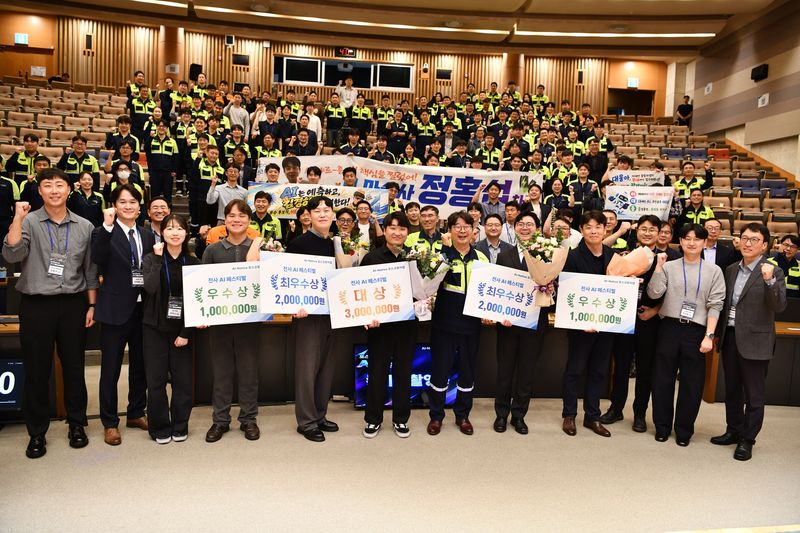
POSCO Future M said on the 14th that it had held an “AI Festival” the previous day at POSTECH in Pohang, North Gyeongsang Province, to share employees’ achievements in using AI. The event reviewed the results of the “AI 100-Day Challenge,” which has been conducted in three stages since June. A total of 28 best practices were selected and recognized in two categories: developing AI apps to improve efficiency in office and manufacturing work, and producing AI videos for internal communications, safety and training.
■ AI solutions developed by employees... eliminating inefficiencies on the shop floor
A key feature of these achievements was that frontline employees took the lead. During the challenge, POSCO Future M trained a total of 87 in-house “AI-use experts.” Employees who completed the training used AI to automate and optimize inefficiencies they encountered in their actual work. A total of 87 workplace tasks were identified in the process and are slated for application in the respective departments’ work.The grand prize went to the “Calcination Furnace Heater Condition Prediction Model.” Maintaining a consistent calcination temperature is important in producing cathode materials, and the model was designed to have AI automatically collect data related to heater conditions and calculate the risk of failure and inspection priorities. It is expected to enable proactive inspections and replacements, reducing unexpected repair work and increasing production efficiency. A calcination furnace is heat-treatment equipment used to process raw materials at high temperatures.
The top excellence awards went to “AI-Based Integrated Management of Maintenance, Repair and Operations (MRO) Materials and Intelligent Procurement System” and “Unattended Collection and Automated Analysis of SEM Data.” When a user searches for a material by name, the procurement system uses AI to find information scattered across multiple systems and recommend materials that can be purchased together, as well as domestic alternatives. This is expected to save time and reduce costs. The SEM automation system uses AI to handle everything from imaging product particles to analyzing them and generating results. The company expects that it will reduce repetitive work—manually taking images with a scanning electron microscope (SEM) and organizing the data—and improve accuracy and work efficiency by automatically analyzing particle size and shape.
The event also featured the latest robotics technologies, giving employees an opportunity to discuss ways to use them on-site. The grand prize and top excellence awards were determined by combining the preliminary review results with real-time mobile voting, after the nominated frontline employees presented the systems they had developed themselves. The selected best practices are slated for on-site implementation by the first half of 2027, following field tests and the collection of employee feedback.
Park Hyeong-jun, a manager in the Gwangyang Cathode Materials Production Technology Group who completed the AI-use expert program in September, spoke on behalf of the graduates. “Although it was challenging to start the training without prior knowledge of coding or AI, I experienced the joy and limitless potential of learning AI as I studied the theory and worked on assignments,” he said. “Even after returning to my department, I will keep the meaning of ‘Human-in-the-loop’ in mind, bring human judgment and AI technology together in a balanced way, and actively apply them to on-site work.”
■ Manufacturing productivity up 30% by the first half of 2028... companywide AX roadmap underway
These changes on the shop floor are tied to the company’s mid- to long-term AX strategy. In July, POSCO Future M presented its digital innovation vision, “BoT (Battery of Things) Ecosystem Game Changer,” and established a companywide AX roadmap focused on process standardization and data.The targets are to increase manufacturing productivity by 30% and shorten product development time by 50% by the first half of 2028. To achieve them, the company identified the following key priorities: optimizing processes and systems by integrating AI agents; accelerating intelligence through an integrated data hub; building AI-based intelligent factories; establishing intelligent, hyperconnected end-to-end operations from raw materials to products; and advancing R&D collaboration with strategic customers.
In September, the company held a kickoff event for an AX project based on process innovation (PI), sharing its AX goals, strategic direction and detailed action items. It is using this initiative to integrate AI into work across manufacturing, R&D and marketing. The in-house DX task force will discuss with employees who completed the AI-use expert program how to apply AI to PI projects as well, and plans to incorporate trainees’ feedback into next year’s DX training plan.
[email protected] Kim Dong-chan Reporter