“If it falls further, things will get serious”: Anxiety deepens in and around the stock market
- Input
- 2026-10-14 15:39:09
- Updated
- 2026-10-14 15:39:09
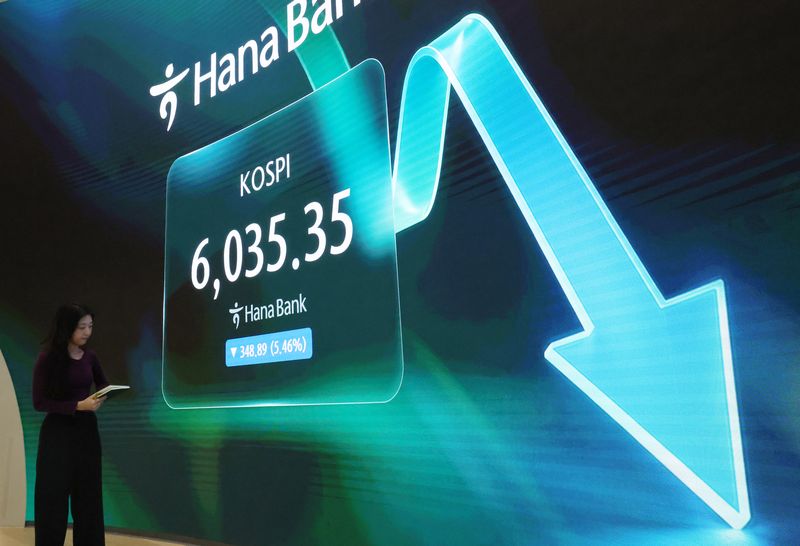
[Financial News] Even after the KOSPI plunged sharply over a short period this year, it took an average of 12.5 trading days to recoup its losses. The KOSPI has been highly volatile this year, prompting rapid technical rebounds immediately after sharp declines.
According to the Korea Exchange on the 14th, the KOSPI fell at least 500 points from its level five trading days earlier on seven occasions so far this year. Excluding the decline currently underway, the index fully recovered its pre-plunge level in four of the six cases, taking an average of 12.5 trading days.
The fastest recovery came in May, when the index made up its losses in just three trading days. The KOSPI fell 772.46 points, from 7,981.41 to 7,208.95, but rose to 8,047.51 three trading days later, on May 26, recovering its previous level. By contrast, in March it took more than a month to regain that level. After falling 1,213.73 points from 6,307.27 on February 26 to 5,093.54 on March 4, the KOSPI took 34 trading days to return to its previous level. Following the sharp drop on March 4, it finally made up its losses on April 21, reaching 6,388.47.
Partial recoveries came faster. The index regained 50% of its losses in five cases, taking an average of four trading days, and recovered 70% in an average of 9.6 trading days. Technical rebounds came quickly after sharp drops, driven by short-term bargain buying and the perception that the decline had been excessive.
But the pattern changed when the declines were larger. The KOSPI fell 2,598.28 points, from 9,114.55 on June 22 to 6,516.27 on July 20, but even 74 trading days later it had yet to recover half of its losses. At the end of July, it also plunged 1,503.33 points, from 7,096.89 to 5,593.56. It then recovered half its losses in three trading days and 70% in 12, but did not reach its previous level.
The KOSPI fell for six consecutive trading days, from 7,003.74 on the 2nd of this month to 6,008.81 today, shedding 994.93 points. The decline amounted to 14.21%. During the session, it fell as low as 5,944.65, briefly dropping below the 6,000 mark.
Market analysts say it is important to distinguish the possibility of a short-term rebound from a recovery in the broader trend. Han Ji-young, a researcher at Kiwoom Securities, said, “The pace of this plunge itself is unusual,” and analyzed, “At current levels, a rebound reflecting a correction after an excessive sell-off seems likely.”
Analysts caution, however, that a rapid recovery will be difficult unless foreign investor flows improve. Kim Seok-hwan, a researcher at Mirae Asset Securities, said, “Strong earnings can put a floor under the market, but without new buyers, it is difficult to establish an uptrend. Rather than focusing on a one-day rebound in the index, we first need to see whether foreign investors’ selling in the spot market and through non-arbitrage trades is easing.” He added, “If foreign selling continues and corporate earnings estimates also begin to trend downward, investors should reconsider their medium-term investment decisions, going beyond a simple adjustment in supply and demand.”
[email protected] Han Yeong-jun Reporter