SK hynix President Ahn Hyun: “We must overcome data bottlenecks by optimizing the memory hierarchy”
- Input
- 2026-10-14 12:58:50
- Updated
- 2026-10-14 12:58:50
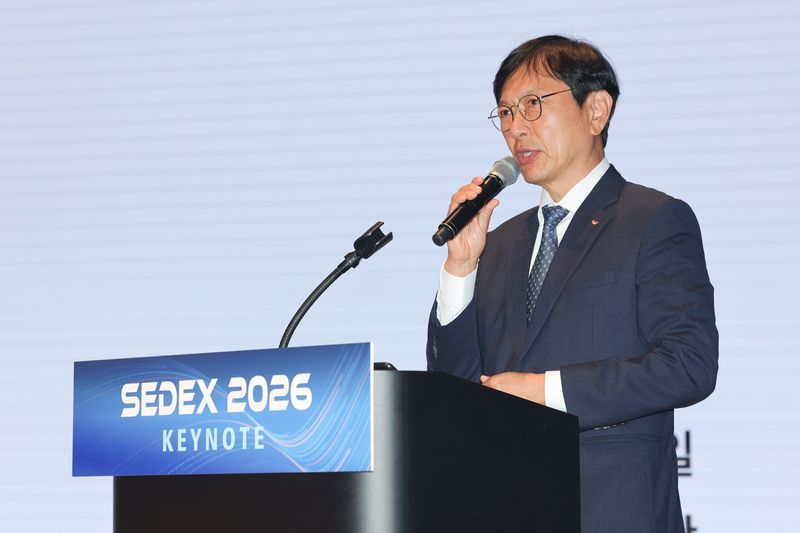
[Financial News] Ahn Hyun, SK hynix’s president and head of development, outlined plans to expand development of next-generation memory beyond high-bandwidth memory (HBM) in response to rising demand for AI inference. He said that as data movement between memory units emerges as a new bottleneck limiting AI performance, the industry must improve the efficiency of entire systems as well as the performance of individual products.
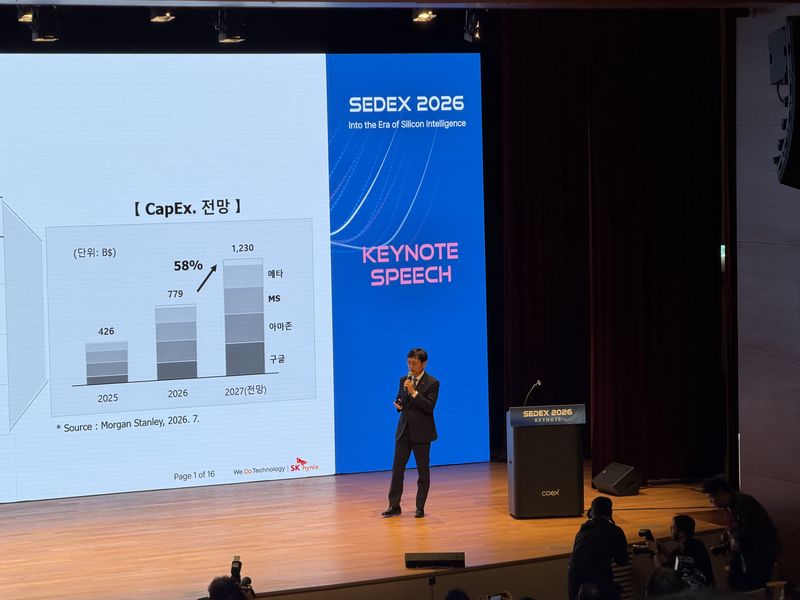
At the semiconductor trade show “SEDEX 2026,” held at COEX in Seoul on the 14th, Ahn delivered a keynote address on “The Evolution of Memory Technology in the AI Era” and presented this technology roadmap.
Ahn forecast that the performance scale of AI infrastructure would grow to about 20 times its level this year by 2030. He said the importance of memory, which stores and processes data, would grow further as AI models expand and their range of applications broadens.
“Data centers and the semiconductor industry, too, can no longer make decisions one at a time at the same pace as in the past,” he said, stressing that “memory development, standardization and securing production capacity must be prepared in advance, before AI demand takes shape.”
Ahn identified “3D-stacked DRAM” as a next-generation AI memory technology to follow HBM. “The fastest memory currently available is static random-access memory (SRAM),” he said, explaining that “a new memory tier needs to be developed between SRAM and HBM.”
Whereas conventional HBM stacks multiple DRAM chips vertically and places them around a GPU, 3D-stacked DRAM places DRAM directly on top of a processor such as a GPU and connects it using through-silicon vias (TSVs), linking the processor and memory in a single product. This shortens the distance data must travel.
“If it is combined with advanced packaging that directly connects the processor and memory while increasing bandwidth, reducing power consumption and enabling thermal management, it can develop into a new AI memory solution,” Ahn said.
He also forecast that custom HBM would account for a larger share following HBM. Custom HBM is a product that incorporates functions tailored to customer requirements into the base die located beneath the memory.
“Custom HBM is made by incorporating customer requirements into the base die,” Ahn said. “SK hynix is making good preparations based on its core technologies through consultations with customers.” He went on to forecast that “custom HBM will expand over the long term as we pursue custom HBM alongside standard HBM.”
He also highlighted high-bandwidth flash (HBF) as a new tier to meet growing demand for memory capacity during AI inference. HBF is a next-generation NAND solution that uses TSV technology and logic processes, as HBM does. HBM offers fast data processing, but has limitations in terms of capacity and cost. By contrast, NAND flash memory-based HBF can efficiently store large volumes of data and is attracting attention as a new memory tier between HBM and a solid-state drive (SSD).
SK hynix is developing HBF with the goal of delivering about half the bandwidth and roughly 10 times the capacity of HBM from the same generation. Ahn stressed that “HBF’s capacity and bandwidth make it a model particularly well-suited to AI inference, which centers on repeatedly reading large volumes of data.”
“Memory is no longer just a component in the AI era,” he said. “To help AI grow and advance further, we are addressing problems by starting with HBM and developing new AI memory.” He added, “Memory is the best industry for South Korea, and this amounts to a golden opportunity.”
[email protected] Park Ji-yeon Reporter