Korea Customs Service blocks 280,000 counterfeit goods at the border in two months
- Input
- 2026-10-14 11:05:27
- Updated
- 2026-10-14 11:05:27
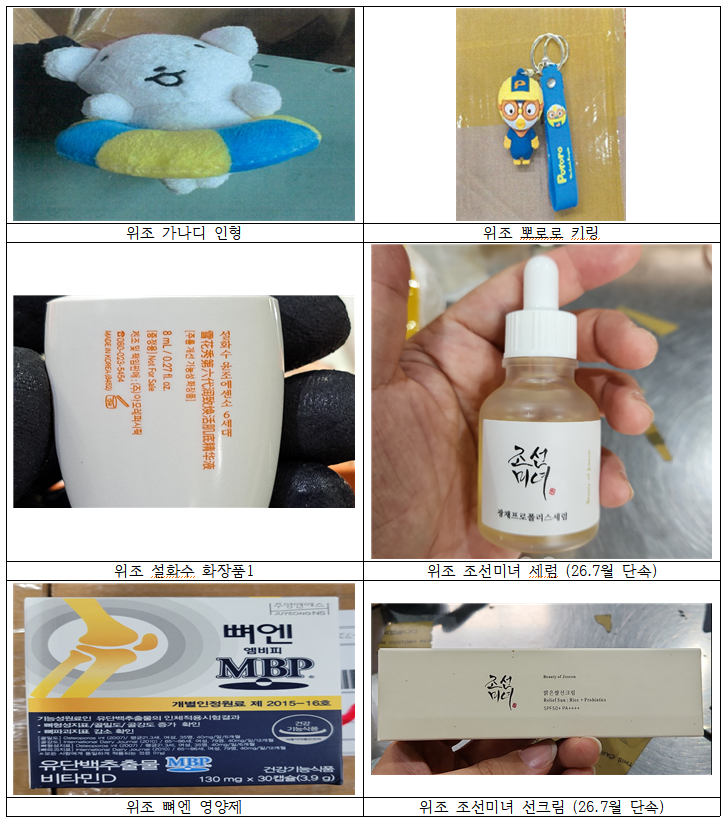
The Korea Customs Service said it had detected and blocked a total of 280,733 counterfeit products attempting to enter the country after conducting an “Intensive Crackdown on Goods Infringing Intellectual Property Rights” at 34 customs offices nationwide over two months, from August 3 to September 30. That figure amounts to about 24% of the total number of items seized during all of 2025 (more than 1.17 million), meaning an average of about 4,700 counterfeit items were intercepted at the border each day.
Toys and stationery top the list... Sharp rise in inflow through overseas direct purchases
Toys and stationery accounted for the largest share of items seized, at 33.4% (93,862 items). They were followed by personal accessories (24.8%), clothing (12.4%), bags (9.7%) and cosmetics (2.0%). Since counterfeits were concentrated in children’s products that come into direct contact with their skin and that they handle, consumers should take particular care when making purchases.
By route of entry, regular import cargo carried by cargo ships and other means accounted for the largest share, at 52.1% (146,323 items). But express and postal shipments used by overseas direct-purchase shoppers came close, accounting for 46.2% (129,627 items). This reflects the large-scale inflow of counterfeit goods targeting individual consumers as the overseas direct-purchase market expands.
K-brands targeted; risks from unverified safety
In this crackdown, the rise in goods infringing domestic K-brands stood out alongside counterfeits of famous international brands (96.6%). A total of 9,571 K-brand counterfeits were seized, a 102% surge compared with the May–June crackdown. Popular K-beauty cosmetics such as Sulwhasoo, d’Alba and AHC, and merchandise from K-pop artists such as BTS and IVE, were among the main targets.
These counterfeit goods are said to pose a direct threat to public health and safety. Unlike genuine products, counterfeits entering through illegal channels such as smuggling do not undergo safety certification. Counterfeit cosmetics, toys and clothing, among other products, carry a high risk of containing excessive levels of harmful substances, including cadmium, lead and phthalate plasticizers (DEHP), which the International Agency for Research on Cancer (IARC) has identified as carcinogenic to humans. Counterfeit home appliances can cause electric shocks or fires, while counterfeit dietary supplements can cause adverse health effects.
Park Jun-seong, chief of the Customs Inspection Division at the Korea Customs Service, said, “Counterfeit goods bought because of their low prices can end up threatening your family’s health and safety,” adding, “We will continue to strengthen enforcement against goods that infringe intellectual property rights at the border, establish a fair market order and protect public safety.”
Meanwhile, the number of users of Chinese ultra-low-cost e-commerce platforms (C-commerce), such as AliExpress and Temu, has surged recently, diversifying the ways individual consumers can buy counterfeit goods directly and making enforcement more difficult. In response, the Korea Customs Service is developing measures including upgrading a system that combines X-ray screening with artificial intelligence (AI) to identify in advance express shipments likely to contain counterfeits, and strengthening monitoring by expanding information-sharing with e-commerce platform operators.
[email protected] Kim Won-jun Reporter