NVIDIA partner LTX opts for ‘open models’ amid U.S.-China AI rivalry... “An opportunity to cooperate with Korea”
- Input
- 2026-10-14 16:04:19
- Updated
- 2026-10-14 16:04:19
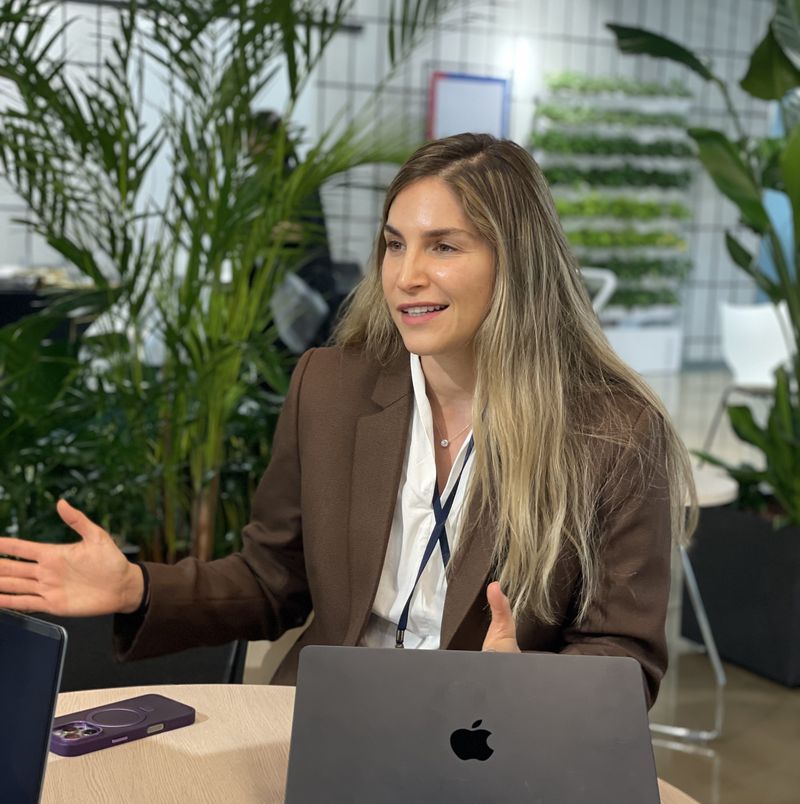
Shani Mandel Roper, chief business officer (CBO) of Israeli AI company LTX, met with Financial News at COEX in Gangnam, Seoul, on the 14th and offered this assessment of Korea’s AI competitiveness. He cited Korea’s ability to work with technology and companies on both sides of the U.S.-China divide as a strength, while also voicing concern about the possibility that one country could restrict another country’s use of AI.
Roper came to Korea as part of a visit by six Israeli tech companies from a country widely known as the “Startup Nation.” LTX, where he works, grew out of Lightricks, a generative AI video technology company. LTX develops models that predict changes in physical environments to support robots’ learning and actions. As a founding member of NVIDIA’s Cosmos Coalition, it is working on model optimization and research collaboration.
In the interview, Roper distinguished between investment levels and technological capabilities in the U.S.-China AI rivalry. He said, “The scale of investment in the United States is much larger,” but noted that “Chinese models are also very powerful and competitive.” He predicted that “Western companies won’t want to pay a lot for AI models either” and “will look to use them if there are good open models.”
Roper also pointed to a commonality between Korea and Israel: both are positioned to use a variety of technologies while situated between the United States and China. Speaking about Korea in particular, he recalled meeting people from the United States, China, Singapore and Israel at an event hosted by Hyundai, and said, “Being active in many different fields is a strength.”
Asked about the pressures of being caught between the United States and China, he warned, “AI can, in some ways, become like a weapon,” and “if some countries prevent other countries from using AI, it will cause major disruption.” He emphasized, “It is hard to say that countries without their own sovereign AI are in a good position,” adding that “they need to secure the ability to use models themselves, and from this perspective, open models are important to that ecosystem.”
He cited as a key advantage of open models, unlike closed models, the fact that users can adjust their weights to suit particular uses and train them further. This allows them to accommodate the different equipment and working conditions of each robot, he explained.
He then traced the difference between the two countries to their industrial bases. Roper said, “Israel is not strong in manufacturing, but it is strong in AI models, cybersecurity and technology solutions,” while “Korea’s strengths in manufacturing and deployment-related expertise mean that the two countries can complement each other.” The opportunity for cooperation, he said, lies in combining Israel’s AI technology with Korea’s manufacturing and robotics base.
Roper said that, to foster this kind of cooperation in the AI industry, companies should not make fixed distinctions between competitors and partners. “Things are changing so quickly that today’s competitor could become a future research partner or a partner in entering new markets,” he explained. As examples, he cited competing company Runway offering LTX models on its platform and Adobe being an important partner. “Everyone is doing several things at once, so we need to keep talking with the ecosystem as a whole,” he added.
On concerns about an AI bubble looming over the industry, he acknowledged the gap between expectations and reality. “A lot of money is going in, perhaps too much,” he said, adding, “Physical AI is still at the testing and proof-of-concept (PoC) stage; it is not yet at the stage of actual commercial operation.” The point was that while large amounts of capital are flowing in, the technology is still being developed.
However, he did not make a definitive judgment about whether there is a bubble. He said, “AI could reduce the workforce needed in certain fields and change the structure of the economy,” suggesting that the economic impact could offset overheated investment. He said Korea has “many opportunities to gain, given its large manufacturing base,” and assessed that “if it is open to experimentation to solve problems, it can get ahead.”
[email protected] Hong Chae-wan Reporter