"Anonymous reports also accepted, rewards of up to 1 billion won" ... How will compliance reporting change at mutual financial institutions and savings banks?
- Input
- 2026-10-14 12:00:00
- Updated
- 2026-10-14 12:00:00
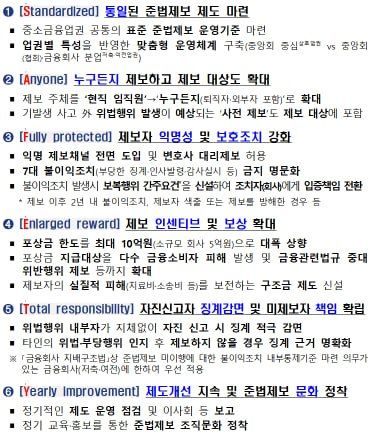
[Financial News] The Financial Supervisory Service (FSS), together with the small and medium-sized financial sector, has established a standardized compliance reporting system. The reforms, which will be rolled out in stages starting in October, raise the reward cap to as much as 1 billion won. Protections for reporters have also been strengthened, allowing anyone to submit reports anonymously, both before and after a violation occurs.
According to the FSS on the 14th, the reforms to the compliance reporting system in the small and medium-sized financial sector are based on six core principles (S.A.F.E.T.Y.). First, the internal whistleblowing systems, which had been operated differently across sectors, have been standardized, and the system has been renamed “compliance reporting.” Central federations and associations in each sector have taken the lead in establishing tailored operating systems. In the mutual finance sector, central federations will handle and investigate reports directly, while the savings bank and specialized credit finance sectors have adopted a division of responsibilities between central federations (associations) and financial companies.
Eligibility to submit reports has been expanded from current employees to anyone, including current and former employees and outsiders. The scope of reportable matters has also been broadened to allow advance reports not only of violations that have already occurred but also of matters where a violation is expected.
Protections for reporters have been significantly strengthened. Anonymous reporting channels are being introduced across the board, and reports may also be submitted through a lawyer. Seven types of retaliatory measures for reporting—disadvantages related to employment status, unfair personnel actions, transfers or job reassignment, discrimination, restrictions on professional development opportunities, ostracism or verbal abuse, and unfair audits—have been explicitly defined and prohibited. If a retaliatory measure occurs within two years of a report, or if someone tries to identify or obstruct the reporter, the burden of proof shifts to the person responsible for the action.
The reward cap has been substantially raised to as much as 1 billion won (500 million won in some cases) for savings banks and the mutual finance sector, and to as much as 1 billion won (or 500 million won) for the specialized credit finance sector. Eligibility for rewards has also been expanded to include reports of harm to multiple financial consumers and serious violations of financial laws and regulations. A relief payment system has also been introduced to cover reporters’ actual losses, such as medical and legal expenses.
Disciplinary penalties will be actively reduced when insiders involved in violations voluntarily report them without delay. The grounds for disciplinary action have also been clarified for cases in which someone is aware of another person’s illegal or improper conduct but does not report it. These measures will initially apply to savings banks and the specialized credit finance sector.
Each central federation and financial company will regularly review how the system is being operated and report to its board of directors or other relevant bodies, making improvements where shortcomings are found. They will also work to establish a culture of compliance reporting through regular training and outreach for employees.
The FSS has established uniform operating standards in consultation with the central federations and associations in each sector. The measure is intended to make the compliance reporting system more effective. Under the reforms, savings banks have been operating the system since the 1st. The mutual finance sector will implement it starting on the 19th, and the specialized credit finance sector starting on November 1.
An FSS official said, “We expect the system to become a robust monitoring network that proactively prevents various forms of misconduct and to mark a turning point in strengthening the sector’s ability to police itself.”
[email protected] Park Mun-su Reporter