Hopes for a recovery in Busan manufacturing grow, but 8 in 10 companies expect to fall short of targets
- Input
- 2026-10-14 10:20:30
- Updated
- 2026-10-14 10:20:30
The Busan Chamber of Commerce and Industry announced on the 14th the results of its survey of 256 local manufacturers, titled “Survey of the 2026 Fourth-Quarter Busan Manufacturing Business Outlook Index.”
A Manufacturing Business Outlook Index (BSI) of 100 or higher indicates improving business conditions, while a reading below 100 indicates worsening conditions.
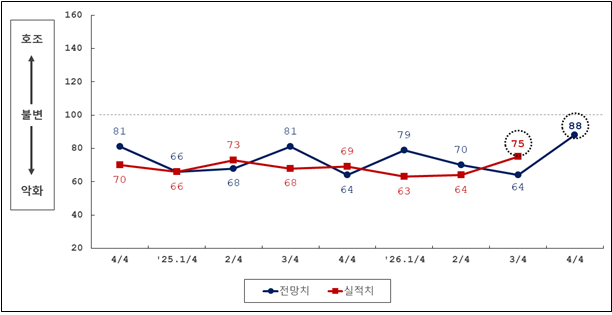
The BSI for Busan’s manufacturing sector stood at 88 in the fourth quarter, up 24 points from 64 in the previous quarter. The increase is attributed to a reduction in the cost burden of importing raw materials as the won-dollar exchange rate fell, and to an easing of raw-material supply disruptions that had driven the downturn in the previous quarter.
The BSI rose sharply from the previous quarter for both export-oriented and domestic-focused companies. Export-oriented companies recorded 115, up 35 points from 80 in the previous quarter and above the benchmark. The increase is thought to reflect the positive effects of more orders for high-value-added vessels, including LNG and ammonia carriers, and growing demand for power infrastructure. Domestic-focused companies also rose 20 points to 81, from 61 in the previous quarter.
By industry, food and beverages, electrical and electronics, and shipbuilding and equipment forecast improving business conditions for the second consecutive quarter. Food and beverages had the highest BSI, at 138. Expectations were boosted by demand for souvenirs and duty-free goods amid an increase in tourists, as well as the impact of major events such as the Busan International Film Festival and the Busan Fireworks Festival. Electrical and electronics recorded 110, down 44 points from 154 in the previous quarter but still above the benchmark. Shipbuilding and equipment also forecast improving conditions for the second consecutive quarter, with a BSI of 107.
Industries whose outlook had been far below the benchmark in the previous quarter also rebounded notably: apparel and fur rose from 27 to 80, chemicals and rubber from 35 to 74, and textile products from 40 to 67. Machinery and equipment jumped 62 points, from 38 to 100, returning to the benchmark. By contrast, footwear had the lowest reading among industries, at 40, weighed down by ocean freight rates and naphtha prices.
Although the overall business outlook improved, at least 8 in 10 local manufacturers expected to have difficulty meeting this year’s performance targets.
Asked how they expected this year’s actual operating profit to compare with the target set in their plans at the start of the year, 85.2% of responding companies expected to fall short of the target. Only 10.2% expected to meet it, while 4.6% expected to exceed it slightly. This is thought to reflect the negative impact on local companies’ performance of higher production costs due to external risks and sluggish sales and order conditions.
The biggest obstacle cited by companies was rising production costs, including those for raw materials and energy, at 37.5%. Worsening sales and order conditions followed at 28.1%, rising labor costs and difficulty securing workers at 11.3%, and exchange-rate volatility at 9.0%.
An official from the Busan Chamber of Commerce and Industry’s research team said, “Business sentiment among local manufacturers has improved thanks to the lower exchange rate and better raw-material supply conditions, but companies continue to face management burdens.” The official added, “More support from the government and local authorities is needed to ease the burden of financing costs resulting from higher interest rates and to stabilize supplies of raw materials and energy.”
[email protected] Kwon Byeong-seok Reporter