As semiconductor construction races ahead, securing water is another challenge ... Welcron Hantec expands water-treatment opportunities
- Input
- 2026-10-14 09:51:16
- Updated
- 2026-10-14 09:51:16
[Financial News] As the semiconductor industry expands its production capacity, securing water is emerging as a key challenge. The growing scale of water reuse by Samsung Electronics and SK hynix, which purify used water for reuse, alongside efforts by overseas companies to diversify their water sources, is driving the increasing importance of water-treatment technology.
According to the financial investment industry on the 14th, Samsung Electronics and SK hynix reused a combined 168.52 million tonnes of water at their domestic semiconductor operations last year. That averages about 460,000 tonnes a day, enough for around 1.5 million people to use in a day.
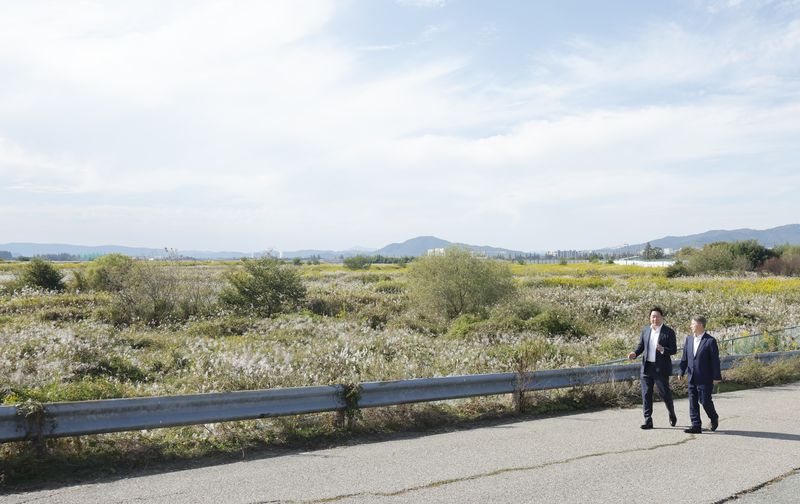
SK Group Chairman Chey Tae-won visited the site of the Gwangju military airport, a planned location for a semiconductor cluster in the Honam region, and said that foundation work would begin first even if water and power supplies were delayed. The aim is to shorten the construction schedule by moving ahead with factory construction at the same time, rather than waiting for the infrastructure to be completed.
Samsung Electronics collects condensation from its air-conditioning equipment and uses it as makeup water for cooling towers. SK hynix purifies wastewater generated during semiconductor manufacturing and supplies it to facilities for preventing air pollution, among other uses. Semiconductor manufacturing requires ultrapure water from which impurities have been rigorously removed, because it is used to wash fine particles and chemical residues off wafer surfaces. The larger production becomes, the more important it is to secure enough water and maintain the required water quality.
A water-treatment industry official said, “As the number of semiconductor plants grows, demand for water grows as well,” adding, “Technology that purifies used water for reuse is an important foundation for supporting stable plant operations.”
Welcron Hantec has key process technologies for Zero Liquid Discharge (ZLD) systems, which recover as much water as possible from wastewater. The resulting highly concentrated wastewater concentrate is treated through evaporation, concentration, crystallization, separation and drying.
First, ultrafiltration (UF) removes suspended solids and fine particles, among other substances, and reverse osmosis (RO) separates dissolved salts and other substances from the water. The remaining concentrate then undergoes evaporation to recover additional water, while residual materials are separated as crystalline solids. The actual process configuration varies depending on the wastewater composition and treatment goals.
A securities industry official said, “(Welcron Hantec) can recover additional water from highly concentrated wastewater concentrate using mechanical vapor recompression (MVR) technology, which reuses the vapor generated during evaporation as a heat source,” adding, “By treating even the concentrate left after an initial purification, it can broaden the scope of water reuse.”
Diversifying water-supply sources is also becoming increasingly important. Taiwan’s TSMC is expanding its use of reclaimed water and diversifying its water sources through measures such as seawater desalination. In South Korea, too, as plans move forward to build large-scale semiconductor clusters, the need to consider both water reuse within plants and external water-supply infrastructure is growing.
Welcron Hantec is seeking to expand the application of its water-treatment expertise in advanced industries, drawing on its accumulated experience in water-treatment projects at power plants and industrial facilities. In South Korea, it is carrying out equipment supply projects for the Haman and Andong combined-cycle power plants. The project is scheduled for completion in 2027.
Welcron Hantec also has experience in overseas seawater desalination projects. It supplied seawater desalination and wastewater treatment facilities to the Gatun combined-cycle power plant in Panama; the project was completed in 2024. The company is said to have capabilities not only in recovering water from wastewater but also in water-treatment infrastructure projects that secure new water sources.
An investment industry official said, “Securing water requires considering together the reuse of water within a plant and the diversification of external sources,” adding, “The competitiveness of water-treatment companies depends not only on their individual technologies but also on whether they can design and build processes suited to each site.”
[email protected] Choi Du-seon Reporter