“Korean Banks Fully Meet International Standards” ... South Korea Earns Top Rating in Leverage Ratio Assessment
- Input
- 2026-10-14 10:59:04
- Updated
- 2026-10-14 10:59:04
[Financial News] In the regulatory consistency assessment programme (RCAP) for the leverage ratio conducted by the Basel Committee on Banking Supervision (BCBS) for six countries, including South Korea, starting in the fourth quarter of 2025, South Korea received the highest rating, “Compliant,” in every category, including the overall rating.
According to the Financial Supervisory Service (FSS) on the 14th, the assessment covered six countries—South Korea, the United Kingdom, Japan, Australia, Canada and Switzerland—and was conducted using a group-based approach in which one assessment team evaluated multiple countries simultaneously. The team comprised one leader from the Hong Kong Monetary Authority (HKMA) and four assessors from the central banks of Brazil, Sweden, India and Spain. During the FSS’s self-assessment and the team’s on-site and written reviews, the FSS actively explained South Korea’s position. It amended implementation rules where necessary, responding promptly throughout the assessment.
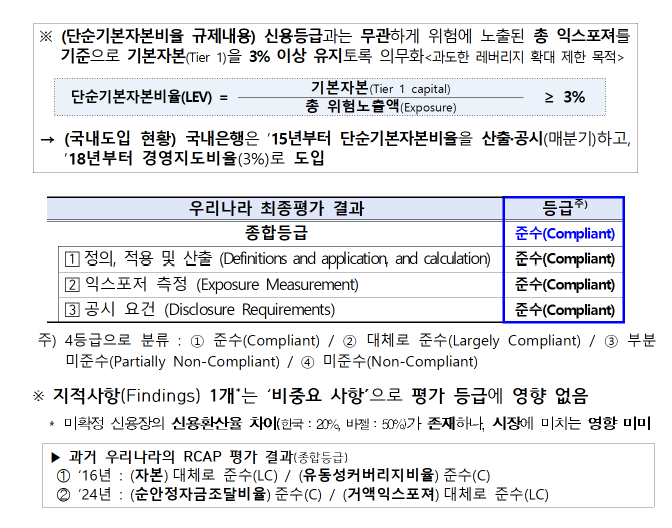
The leverage ratio (LEV) is one indicator of a bank’s capital strength. The regulation requires banks to maintain Tier 1 capital at no less than 3% of their total exposures, regardless of credit ratings. It is intended to curb excessive growth in leverage. Domestic banks have calculated and disclosed the ratio since 2015. A 3% management guidance ratio was introduced in 2018.
The Basel Committee concluded that South Korea’s leverage ratio regulatory framework closely conforms to Basel standards. South Korea received a “Compliant” rating not only overall but also in all three detailed categories: definition, application and calculation; exposure measurement; and disclosure requirements. The rating system has four levels: Compliant, Largely Compliant, Partially Non-Compliant and Non-Compliant. A difference in the credit conversion factor for unconfirmed letters of credit—20% in South Korea versus 50% under Basel—was noted during the assessment, but it was considered immaterial and did not affect the rating.
In previous RCAP assessments, South Korea received a “Largely Compliant” rating in the capital category in 2016, a “Compliant” rating for the Liquidity Coverage Ratio (LCR), a “Compliant” rating for the Net Stable Funding Ratio (NSFR) in 2024, and a “Largely Compliant” rating for large exposures (LEX).
The FSS said, “This assessment has officially confirmed that South Korea’s regulatory framework is aligned with international standards,” adding, “Building on the response capabilities developed during the assessment, we plan to handle without disruption the RCAP assessment of risk-weighted assets (RWA), scheduled for 2027.” It added, “We will closely monitor developments in the adoption and revision of Basel international standards and continue to improve the international alignment of domestic prudential regulations.”
[email protected] Park Mun-su Reporter