Companies seethe over Labor Relations Commission rulings after Yellow Envelope Act... Two in three fear excessive demands from subcontractor unions
- Input
- 2026-10-14 12:00:00
- Updated
- 2026-10-14 12:00:00
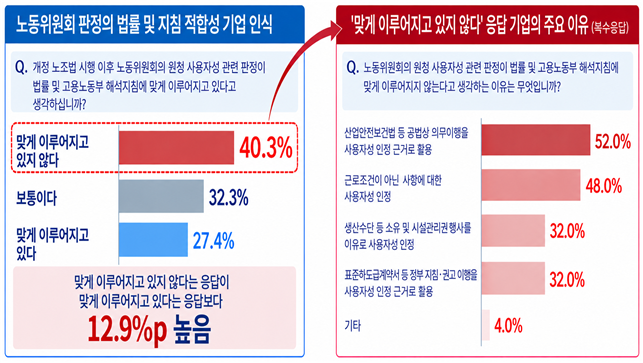
■ 40.3% view rulings negatively... “OSH Act obligations used as grounds for employer status”
According to a survey released on the 14th by the Korea Enterprises Federation, just 27.4% of companies said the Labor Relations Commission’s rulings on principal contractors’ employer status were being made in accordance with the law and the Ministry of Employment and Labor’s interpretive guidelines. Of these, 24.2% said “generally yes” and 3.2% said “strongly yes.” By contrast, 40.3% said the rulings were “not being made appropriately,” 12.9 percentage points more than the positive responses.The Korea Enterprises Federation commissioned Southern Post to conduct the survey, which used both online and telephone interviews with 62 companies (based on the number of respondents) that had undergone Labor Relations Commission rulings on cases involving principal contractors and subcontractors, from September 7 to 18.
Among the 25 companies that said the rulings did not comply with the law and guidelines, the most frequently cited reason was “using the fulfillment of public-law obligations, such as those under the Occupational Safety and Health Act, as grounds for recognizing employer status” (52.0%; multiple responses allowed). This was followed by “recognizing employer status on matters unrelated to working conditions” (48.0%). “Recognizing employer status on the basis of ownership of production means or the exercise of facility-management rights” and “using compliance with government guidelines or recommendations, such as standard subcontracting contracts, as grounds for recognizing employer status” each received 32.0%.
The Korea Enterprises Federation said the findings reflected negative perceptions of the paradoxical situation in which fulfilling legal obligations under the OSH Act and other laws instead leads to an expanded burden on employers. It explained that, in actual Labor Relations Commission proceedings, workplace walkthroughs and joint safety and health inspections conducted by principal contractors to meet their legal obligations are being cited as grounds for recognizing them as employers.
■ Concerns over expanded bargaining and mediation agendas... “Clarifying the criteria is urgent”
The most frequently cited concern about bargaining with subcontractor unions was “excessive union demands that include issues for which employer status has not been recognized,” at 66.1% (multiple responses allowed). This was followed by “demands that principal contractors bargain over matters to be negotiated with subcontractors, such as wages and union activities” (43.5%); “higher bargaining costs due to multiple bargaining processes and prolonged negotiations” (33.9%); and “joint action, such as solidarity strikes among subcontractor unions” (24.2%). According to the Korea Enterprises Federation, there have been cases in which, after a principal contractor was recognized as an employer on certain occupational safety issues, a subcontractor union went on to demand bargaining over issues for which employer status had not been recognized, including wages, performance bonuses and guarantees of union activities.When subcontractor unions apply to the Labor Relations Commission for mediation, the greatest concern was “proceeding with mediation after adding issues for which employer status has not been recognized,” cited by 59.7% (multiple responses allowed). “Opening mediation proceedings while a dispute over the principal contractor’s employer status is ongoing” was cited by 48.4%; “ending mediation, including suspending the process, despite insufficient bargaining” by 41.9%; and “proposing mediation terms on matters over which the principal contractor has no authority to make decisions” by 32.3%. The Korea Enterprises Federation warned that if mediation is suspended before the principal contractor’s status as a bargaining party has been established, unions could move on to industrial action, adding to disruption at worksites.
The top priority for supplementary legislation to amend the Trade Union Act was “clarifying the criteria for determining principal contractors’ employer status,” at 67.7% (multiple responses allowed). This was followed by “excluding high-level corporate management decisions from the scope of labor disputes” (54.8%); “explicitly prohibiting workplace occupation” (22.6%); “removing criminal penalties for unfair labor practices” (19.4%); and “allowing replacement workers” (14.5%).
The Korea Enterprises Federation interpreted the findings as reflecting concern that expanding the scope of labor disputes to include management decisions on matters such as investment, business restructuring and organizational restructuring could constrain swift decision-making and the execution of investments. It said confusion continues because the Ministry of Employment and Labor’s implementation guidelines state that business-management decisions are not subject to labor disputes, while also saying that matters such as reassignment resulting from the construction of a new factory could be subject to them.
Korea Enterprises Federation Executive Vice Chairman Lee Dong-geun emphasized, “Uncertainty surrounding Labor Relations Commission rulings has continued since the amended Trade Union Act took effect.” He added, “To reduce this kind of confusion in industrial workplaces and ensure predictability, principal contractors’ status as employers must be determined fairly and strictly in accordance with legal provisions and administrative guidelines, alongside supplementary legislation.”
[email protected] Kim Dong-chan Reporter